
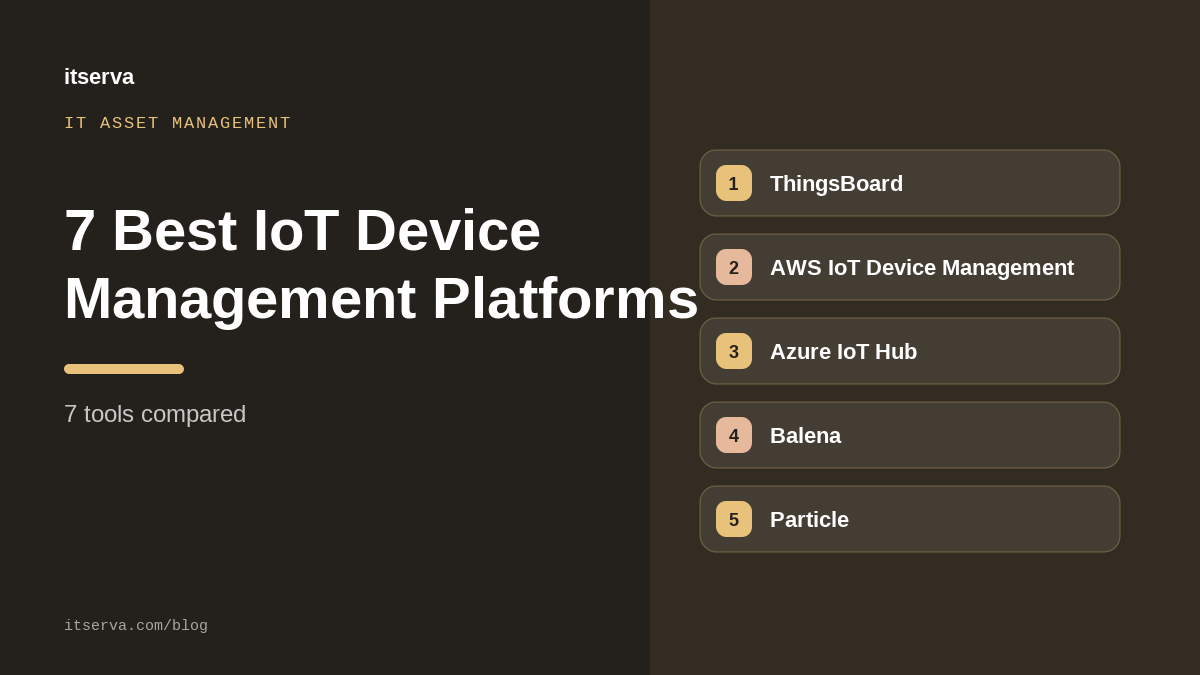
What does an IoT device management platform do?
An IoT device management platform registers, organizes, monitors and remotely updates connected devices at scale. It replaces manual work on each device with bulk onboarding, grouping, health monitoring, configuration changes and over-the-air firmware updates.
Pricing rarely follows a simple per-device rate. Some platforms bill per remote action or message, others per block of devices, and a few publish no price at all. Compare the free tier, the update story and the per-device cost at your real fleet size before you commit.
Quick comparison
| Tool | Best for | Starting price | Free plan |
|---|---|---|---|
| ThingsBoard | Best free start for industrial dashboards | $49/month (50 devices) | Yes (5 devices free) |
| AWS IoT Device Management | Best for AWS-based fleets at scale | Usage-based (from $0.003 per remote action) | Yes (50 remote actions/month free tier) |
| Azure IoT Hub | Best for Azure-based fleets and edge AI | Usage-based (per IoT Hub unit) | Yes (Free edition: 8,000 messages/day) |
| Balena | Best for container-based Linux fleets | $159/month (Prototype, 30 devices) | Yes (10 devices free) |
| Particle | Best for hardware, connectivity and cloud in one | $299/month per block (Basic, 100 devices) | Yes (100 devices free) |
| Datacake | Best for LoRaWAN sensor monitoring | €25/month (Hobby, up to 25 devices) | Yes (first 5 devices free) |
| Losant | Best for low-code industrial workflows | Custom pricing | No (quote-based pricing) |
The 7 best IoT device management platforms
#1
ThingsBoard
- Best for
- Best free start for industrial dashboards
- Starting price
- $49/month (50 devices)
- Free plan
- Yes (5 devices free)
ThingsBoard is an open IoT platform for device management, data collection, processing and visualization. Its free Cloud plan covers 5 devices, 5 assets and 1 million data points a month, and the first paid plan costs $49 a month for 50 devices and 10 million data points. Paid plans add help-desk support and white labelling, and optional add-ons cover edge computing from $9 a month and Trendz analytics from $29 a month.
The trade-off is breadth. A platform that covers device management, data collection, processing and visualization takes longer to set up than a narrow monitoring tool, and advanced analytics through Trendz is an add-on starting at $29 a month. Self-hosted licences start at $99 a month for 100 devices, while larger managed plans reach $749 a month for 1,000 devices. ThingsBoard fits industrial teams that want dashboards, control and updates in one open platform.
What we like
- Free plan for 5 devices
- White labelling on paid plans
- Help-desk support on paid plans
- Self-hosted option from $99 a month
Watch out for
- Broad platform takes longer to set up
- Trendz analytics is a paid add-on
- Private Cloud plans start at $1,499 a month
#2
AWS IoT Device Management
- Best for
- Best for AWS-based fleets at scale
- Starting price
- Usage-based (from $0.003 per remote action)
- Free plan
- Yes (50 remote actions/month free tier)
AWS IoT Device Management is the usage-based service for registering, organizing, monitoring and remotely managing connected devices on AWS. There are no minimum fees, and billing follows what you use: bulk registration costs $0.10 per 1,000 devices registered, Device Jobs cost $0.003 per remote action, and Secure Tunneling costs $1.00 per tunnel created. Fleet Indexing lets teams search devices by attributes and state in near real time.
The trade-off is that costs are hard to predict without modelling. Every remote action, index update and search query is metered separately, so a large fleet with frequent updates can add up quickly, and the free tier covers only 50 remote actions a month. Teams also need AWS skills to get full value from the service. AWS IoT Device Management fits fleets already running on AWS that need scale without a fixed monthly fee.
What we like
- No minimum fees
- Bulk registration at $0.10 per 1,000 devices
- Secure Tunneling for remote troubleshooting
- Fleet Indexing for fast device search
Watch out for
- Usage-based costs need modelling
- Free tier covers only 50 remote actions a month
- Needs AWS skills
#3
Azure IoT Hub
- Best for
- Best for Azure-based fleets and edge AI
- Starting price
- Usage-based (per IoT Hub unit)
- Free plan
- Yes (Free edition: 8,000 messages/day)
Azure IoT Hub is the cloud service for connecting, monitoring and managing IoT devices with two-way communication and per-device authentication. Its Free edition covers 8,000 messages a day and up to 500 device identities, while paid tiers scale from 400,000 messages a day on B1 and S1 to 300,000,000 a day on B3 and S3. Device Update for IoT Hub handles over-the-air updates, and up to 10 devices can be used to test that service free.
The trade-off is tier complexity. Pricing is set per IoT Hub unit and message volume, the page does not show dollar figures, and device management features such as device twins and direct methods need the Standard tier. Teams also need Azure skills to size units and message meters correctly. Azure IoT Hub fits Microsoft shops that already run analytics and edge workloads on Azure.
What we like
- Free edition with 8,000 messages a day
- Two-way communication with per-device authentication
- Device Update for IoT Hub
- Zero-touch provisioning at scale
Watch out for
- Dollar prices not shown on the pricing page
- Device twins need the Standard tier
- Tier and message sizing takes care
#4
Balena
- Best for
- Best for container-based Linux fleets
- Starting price
- $159/month (Prototype, 30 devices)
- Free plan
- Yes (10 devices free)
Balena is a container-based platform for developing, deploying and managing fleets of Linux devices. Its free plan covers 10 devices, the Prototype plan costs $159 a month for 30 devices with extra devices at $3 each a month, and the Pilot plan costs $329 a month for 60 devices. Pilot adds priority support and ARM64 secure boot, while Production adds dedicated support with a 60-minute response time.
The trade-off is focus. Balena is built for Linux devices, so microcontroller-only fleets are a poor match, and Production costs $1,439 a month for 110 devices with dedicated support and a 60-minute response time. Additional team members beyond the included users cost $29 to $49 a month each. Balena fits product teams shipping Linux devices that need fast, reliable remote updates.
What we like
- Free plan for 10 devices
- Prototype covers 30 devices for $159 a month
- ARM64 secure boot on Pilot and above
- Community forum support on the free plan
Watch out for
- Linux-focused, not for microcontroller-only fleets
- Production costs $1,439 a month
- Extra team members cost $29 to $49 a month
#5
Particle
- Best for
- Best for hardware, connectivity and cloud in one
- Starting price
- $299/month per block (Basic, 100 devices)
- Free plan
- Yes (100 devices free)
Particle is an integrated platform that covers hardware, connectivity and cloud for connected products. Its free plan includes 100 devices and 100,000 Data Operations a month, the Basic plan costs $299 a month per block of 100 devices and 720,000 Data Operations, and Plus costs $599 a month per block with 5 million Data Operations. Over-the-air software updates, device vitals and edge computing are included in every plan.
The trade-off is that the stack works best with Particle hardware. Teams with existing non-Particle devices should confirm compatibility before committing, and the Professional and Enterprise tiers are custom-priced with discounted Basic or Plus packages. Cellular data is included for EtherSIM devices, while satellite networking is still coming. Particle fits teams building connected products on Particle hardware from prototype to production.
What we like
- Free plan for 100 devices
- Hardware, connectivity and cloud in one
- OTA updates included in every plan
- Edge ML on Plus
Watch out for
- Works best with Particle hardware
- Professional and Enterprise tiers are custom-priced
- Satellite networking still coming
#6
Datacake
- Best for
- Best for LoRaWAN sensor monitoring
- Starting price
- €25/month (Hobby, up to 25 devices)
- Free plan
- Yes (first 5 devices free)
Datacake is a LoRaWAN monitoring platform with a dashboard builder, rules and a built-in LoRaWAN Network Server. Its first 5 devices are free, the Hobby plan costs €25 a month for up to 25 devices, and the Light plan costs €159 a month for up to 50 devices with a white label included. Every plan includes the LoRaWAN Network Server with unlimited gateways and no per-gateway fees.
The trade-off is currency and scope. Prices are listed in euros, not dollars, and the LoRaWAN focus means Wi-Fi or cellular fleets get less from the platform. Standard costs €399 a month for up to 200 devices, Plus costs €659 a month for up to 1,000, and larger fleets move to custom Enterprise pricing. Datacake fits teams monitoring LoRaWAN sensors for cold chain, air quality or environmental projects.
What we like
- First 5 devices free
- LoRaWAN Network Server included
- Unlimited gateways with no per-gateway fees
- White label on Light and above
Watch out for
- Prices are in euros, not dollars
- LoRaWAN focus limits Wi-Fi and cellular fleets
- Enterprise pricing is custom
#7
Losant
- Best for
- Best for low-code industrial workflows
- Starting price
- Custom pricing
- Free plan
- No (quote-based pricing)
Losant is an enterprise IoT platform with pricing that is entirely customized to each buyer's business needs. The pricing page asks buyers to complete a survey, after which a team member reaches out with more details and a tailored package. No starting price, plan tiers or free plan are published on the page, so there is no public figure to compare against the other platforms on this list.
The trade-off is the lack of public pricing. There is no published starting price or free plan, so budgeting means a sales conversation, and smaller teams should confirm fit before investing time in a trial. Buyers should ask what the package covers, including device count, message volume, support level and contract length, since none of those figures are public. Losant fits large industrial operators that want a tailored platform for connected equipment.
What we like
- Custom pricing for large fleets
- Survey-based quote process
- Enterprise IoT platform
Watch out for
- No published starting price
- No free plan shown
- Budgeting needs a sales conversation
- Smaller teams should confirm fit first
How we chose
We compared IoT device management platforms that register, monitor and remotely update real device fleets at scale, ranked by fit for different fleet types. We weighted a usable free tier first, then update and monitoring features, then how clearly prices are published. Prices come from each vendor's own pricing page, checked in November 2026, including the euro prices on Datacake and the quote-based pricing on Losant. No vendor paid for placement, and we did not run hands-on tests; we compare published information.
Why usage-based IoT pricing catches buyers out
Most platforms on this list charge for activity, not just devices. AWS bills per remote action, Azure bills per hub unit and message volume, and Particle bills per block of 100 devices and Data Operations, so the same fleet can cost very different amounts depending on how chatty its devices are.
Model a realistic month before you buy. Count messages per device per day, planned updates per month and any add-ons such as analytics or white labelling, then compare totals across two or three platforms. A free tier that covers 5 or 10 devices is useful for a pilot, but it says little about the bill at 1,000 devices.
How to choose
Start with your hardware and connectivity. LoRaWAN sensor projects fit Datacake, Linux fleets fit Balena, Particle hardware fits Particle, and industrial equipment fits ThingsBoard or Losant, while cloud-native fleets fit AWS IoT Device Management or Azure IoT Hub depending on which cloud you already run.
Next, check the update story before you scale. Over-the-air updates, rollback behaviour and bandwidth use matter more than dashboards once devices are in the field, so test updates on a small pilot fleet and confirm what each update costs under your plan.
Finally, price the fleet you will have in a year, not the one you have today. Add the per-device, per-message or per-block charges at that size, include any analytics or support add-ons, and confirm quote-based pricing in writing before you commit.