
What do resellers need from accounting software?
Resellers buy stock or digital goods and sell them across marketplaces, storefronts or wholesale channels, so small gaps between buying and selling can distort cash flow. Clear expense tracking and bank reconciliation separate inventory purchases from everyday operating costs.
Item counts, cost of goods sold and multi-channel payouts outgrow basic spreadsheets quickly once order volume climbs. Sales tax rules and supplier records also matter as soon as you sell across several states, so check plan limits on invoices, bills and user seats before signing up.
Quick comparison
| Tool | Best for | Starting price | Free plan |
|---|---|---|---|
| QuickBooks Online | Best accounting software for resellers overall | $38/month (Simple Start) | No free plan |
| Zoho Books | Low-cost entry pricing and Zoho users | $15/month (Standard, annual billing) | Yes ($0 for eligible small businesses) |
| Xero | Bank reconciliation and multi-user flexibility | $27/month (Early) | No free plan (free trial available) |
| FreshBooks | Simple invoicing and ease of use | $23/month (Lite) | No free plan |
| Wave | Starting free with optional Pro automation | $19/month (Pro; $0 Starter plan) | Yes ($0 Starter plan) |
| Kashoo | Flat-rate simple double-entry bookkeeping | $30/month (single plan) | No free plan (14-day trial) |
| Sage 50 | Detailed inventory costing and job tracking | $132.17/month (Pro, 1 user) | No free plan |
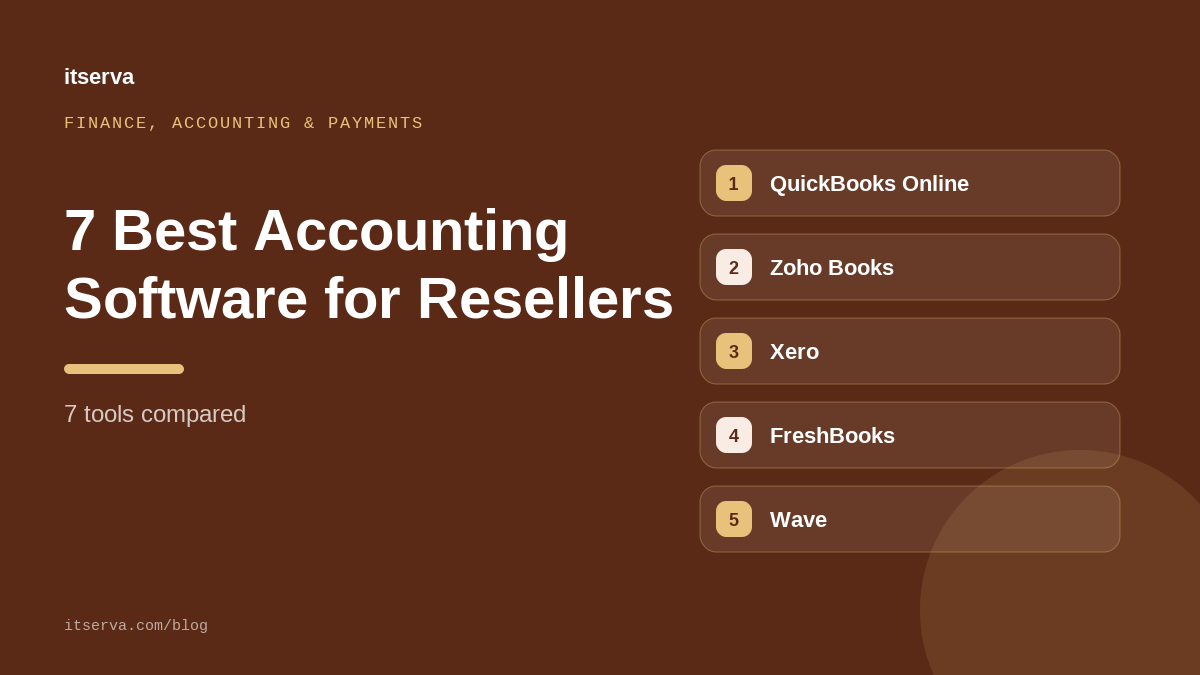
The 7 best accounting software for resellers
#1
QuickBooks Online
4.0/5 on G2 (3,911 reviews, checked Nov 2026)
- Best for
- Best accounting software for resellers overall
- Starting price
- $38/month (Simple Start)
- Free plan
- No free plan
QuickBooks Online is cloud accounting software from Intuit that covers bank feeds, expense sorting, invoicing and financial reports for small product sellers. Simple Start lists at $38 per month in the US for one user plus accountant access, while Essentials costs $85 per month and Plus costs $140 per month.
The trade-off is that regular prices climb steeply across the higher tiers, and Simple Start allows only one primary user, so extra seats and inventory features require moving up. QuickBooks Online fits resellers who want wide app integrations and easy accountant sharing.
What we like
- Broad third-party app ecosystem
- Widespread accountant familiarity
- Automated bank feeds and reconciliation
- Clear step-up tiers as needs grow
Watch out for
- Regular prices rise sharply on upper plans
- Simple Start allows only one primary user
- Some reviewers note mixed support experiences
#2
Zoho Books
4.4/5 on G2 (329 reviews, checked Nov 2026)
- Best for
- Low-cost entry pricing and Zoho users
- Starting price
- $15/month (Standard, annual billing)
- Free plan
- Yes ($0 for eligible small businesses)
Zoho Books is online accounting software that handles invoicing, expenses, accounts and financial reports for small businesses. A free plan covers qualifying small organisations at $0, and Standard costs $15 per month billed annually, or $20 per month on monthly billing, with three users included.
The trade-off is that purchase orders sit on Professional at $40 per month billed annually, and fewer US accountants use Zoho Books than QuickBooks, so external bookkeeping can take more coordination. Zoho Books fits cost-conscious resellers who want low starting rates or already use Zoho apps.
What we like
- Low entry price at $15 per month billed annually
- Free plan for eligible small businesses
- Three users included on Standard
- Connects with other Zoho apps
Watch out for
- Purchase orders need Professional at $40 per month
- Smaller integration library than QuickBooks or Xero
- Less familiar to some US bookkeepers
#3
Xero
4.4/5 on G2 (1,862 reviews, checked Nov 2026)
- Best for
- Bank reconciliation and multi-user flexibility
- Starting price
- $27/month (Early)
- Free plan
- No free plan (free trial available)
Xero is a cloud accounting platform focused on bank transaction matching, online invoicing, bill tracking and financial reporting. Its US Early plan costs $27 per month at regular pricing and covers up to 20 invoices and five bills per month, alongside sales tax and 1099 tools.
The trade-off is that the Early plan caps monthly invoice and bill counts, so higher-volume resellers must move to the $59-per-month or $97-per-month tiers, and native inventory features stay light for complex stock setups. Xero fits resellers who want a straightforward interface and strong reconciliation habits.
What we like
- Straightforward bank reconciliation
- Sales tax support and 1099 reporting
- Broad ecommerce and inventory integrations
Watch out for
- Early caps invoices at 20 and bills at 5 per month
- Native inventory features are light
- Higher tiers cost noticeably more
#4
FreshBooks
4.5/5 on G2 (981 reviews, checked Nov 2026)
- Best for
- Simple invoicing and ease of use
- Starting price
- $23/month (Lite)
- Free plan
- No free plan
FreshBooks is cloud accounting and invoicing software built around clean client billing, expense tracking, estimates and payment collection. Its Lite plan costs $23 per month at regular price, or $276 per year on annual billing, and covers up to five billable clients.
The trade-off is that Lite includes only one user and lacks deep stock management, while extra users cost $11 per month each and larger client lists require Plus at $43 per month or Premium at $70 per month. FreshBooks fits solo resellers with a small client list who prioritise simple invoicing and expense tracking.
What we like
- Approachable interface, quick to set up
- Straightforward invoicing and expense tracking
- Annual billing lowers the effective monthly cost
Watch out for
- Lite caps billable clients at 5
- Limited inventory depth
- Extra users cost $11 per month each
#5
Wave
4.3/5 on G2 (328 reviews, checked Nov 2026)
- Best for
- Starting free with optional Pro automation
- Starting price
- $19/month (Pro; $0 Starter plan)
- Free plan
- Yes ($0 Starter plan)
Wave is an accounting and invoicing platform that offers a $0 Starter plan for basic bookkeeping and invoicing. Its Pro plan costs $19 per month, or $190 per year, and adds automated bank transaction imports, receipt scanning, recurring billing and automated payment reminders.
The trade-off is that automated bank feeds and receipt capture sit only on the paid Pro plan, and public reviews frequently note payment-processing or support friction. Wave fits small resellers starting on a tight budget with simple, straightforward bookkeeping needs.
What we like
- No-cost Starter tier for basic bookkeeping
- Pro adds automated bank feeds and receipt capture
- Simple profit, balance sheet and cash flow reports
Watch out for
- Automated feeds need the Pro plan
- Reviews note payment holds and support delays
- Not built for complex multi-warehouse inventory
#6
Kashoo
4.6/5 on G2 (55 reviews, checked Nov 2026)
- Best for
- Flat-rate simple double-entry bookkeeping
- Starting price
- $30/month (single plan)
- Free plan
- No free plan (14-day trial)
Kashoo is a cloud bookkeeping and invoicing app that supports double-entry accounting, bank feeds, expense tracking, invoicing and core financial statements. It offers one main plan at $30 per month at regular price, with a 14-day free trial and multi-user access included.
The trade-off is a smaller integration ecosystem and fewer advanced features than larger suites, with limited inventory control and narrower multi-currency support for stock-heavy operations. Kashoo fits small resellers who want a single straightforward flat-rate monthly plan without tier hunting.
What we like
- Single straightforward $30 monthly price
- Double-entry accounting and core statements
- Multi-user access included
Watch out for
- Smaller integration ecosystem
- Limited inventory management
- Small review footprint on G2
#7
Sage 50
3.9/5 on G2 (155 reviews, checked Nov 2026)
- Best for
- Detailed inventory costing and job tracking
- Starting price
- $132.17/month (Pro, 1 user)
- Free plan
- No free plan
Sage 50 is an established accounting platform with cloud and desktop options built around detailed inventory tracking, job costing, purchase orders and financial reporting. Its US Pro Accounting cloud plan starts at $132.17 per month for one user, with Premium at $182.50 per month and Quantum at $271.17 per month.
The trade-off is a much higher entry price than basic small-business tools and a more traditional interface that can feel dated, while payroll requires a separate add-on subscription. Sage 50 fits resellers with heavier inventory and costing needs who can justify the higher monthly cost.
What we like
- Stronger inventory and job costing focus
- Purchase orders, bill tracking and bank reconciliation
- Clear tier path to multi-user plans
Watch out for
- Higher starting price at $132.17 per month
- Interface feels more traditional
- Payroll needs a separate add-on
How we chose
We compared established accounting platforms commonly used by small product sellers and resellers, ranking them by fit for reselling workflows. We weighted entry price and plan limits first, then inventory and reconciliation features, then accountant familiarity and integration range. Prices, ratings and review counts come from vendor pricing pages and G2, checked in November 2026. Free plans and trial terms were noted where vendors publish them. Tools without transparent public US pricing were excluded. No vendor paid for placement, and we did not run hands-on tests; we compare published information.
How to read the first-year price ladder
Annual totals make the gap between entry plans obvious. Zoho Books costs $180 per year on its cheapest paid plan, Wave costs $228, FreshBooks costs $276, Xero costs $324, Kashoo costs $360 and QuickBooks Online costs $456.
Sage 50 sits far above the rest at $1,586 per year for one user on Pro. Compare those renewal totals, not introductory discounts, and add the cost of extra users or add-ons before choosing.
How to choose
Start with your monthly transaction and invoice volume. Compare entry-plan limits, such as Xero Early's caps of 20 invoices and 5 bills or FreshBooks Lite's limit of 5 billable clients, against how many orders, invoices and bills you process each month.
Next, decide how you handle inventory and sales channels. If you track unit costs across several channels or warehouses, check whether built-in features or third-party integrations cover your stock workflow cleanly, and confirm whether purchase orders sit on your chosen tier.
Finally, verify regular pricing rather than promo rates, and confirm accountant compatibility. Look past introductory discounts to the standard monthly or annual renewal rate, add extra users or add-ons, and make sure your bookkeeper can work with the platform and export clean profit-and-loss reports.