
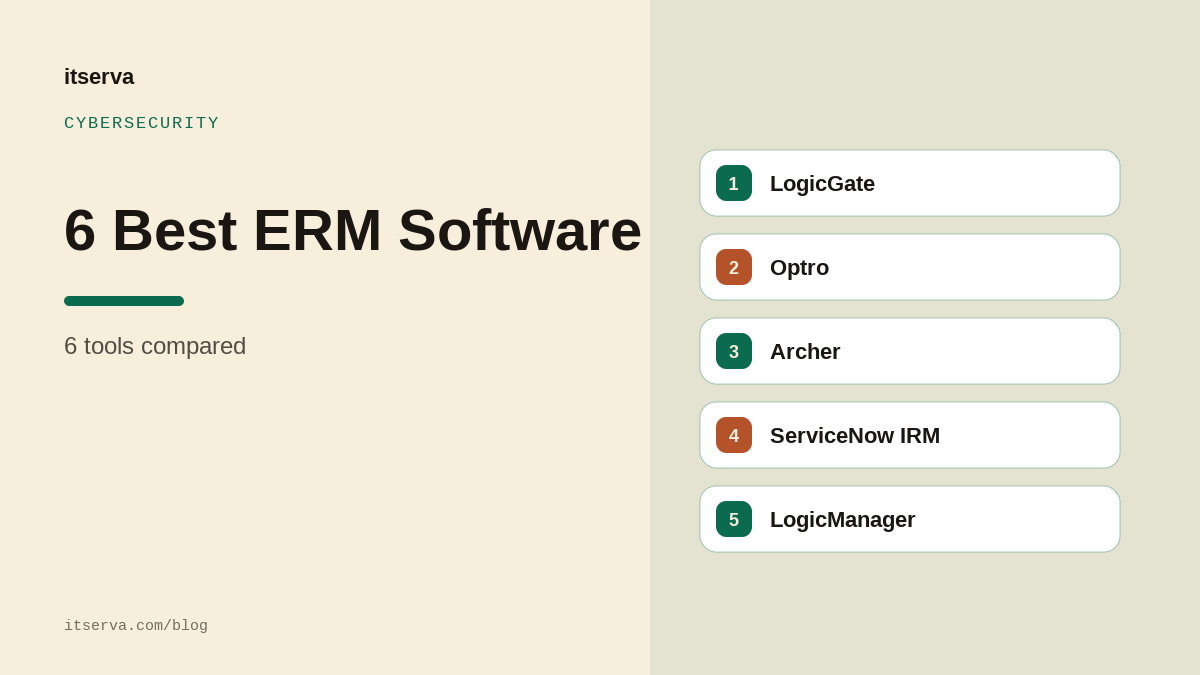
What does ERM software actually do?
Enterprise risk management software gives an organization one connected view of its risks, controls, policies and incidents, instead of separate spreadsheets for each team. It links risks to the controls that manage them, assigns owners, tracks issues to closure and produces reports for executives, auditors and the board.
The tools on this list differ mainly in scale and starting point. Some are built for global, multi-framework programs, while others suit mid-market or smaller teams that need structure without a large implementation project. Choose the scale that matches your program today, not the one you hope to reach in five years.
Quick comparison
| Tool | Best for | Starting price | Free plan |
|---|---|---|---|
| LogicGate | Flexible no-code risk workflows | Custom pricing | No |
| Optro | Audit-connected risk and compliance | Custom pricing | No |
| Archer | Regulated enterprises needing depth | Custom pricing | No |
| ServiceNow IRM | Organizations already on the Now Platform | Custom pricing | No |
| LogicManager | Mid-market teams with advisory support | Custom pricing | No |
| StandardFusion | Smaller GRC teams needing a faster start | Custom pricing | No |
The 6 best ERM software tools
#1
LogicGate
- Best for
- Flexible no-code risk workflows
- Starting price
- Custom pricing
- Free plan
- No
LogicGate is a no-code enterprise risk management platform built around Risk Cloud, where teams design assessment workflows, control mappings and reporting with drag-and-drop configuration instead of custom code. Its purpose-built Risk Cloud Applications cover single use cases such as enterprise risk management and regulatory compliance, while Risk Cloud Solutions combine several applications, integrations and services into one tailored program.
The trade-off is that pricing is tailored to business size, program maturity and the problems being solved, so there is no published starting price to compare directly. Each Risk Cloud component is priced individually, which keeps the package focused but means the final quote depends on scope. LogicGate fits risk teams whose processes change often and who want a platform they can reshape without developers.
What we like
- No-code drag-and-drop workflow builder
- Purpose-built applications for common GRC processes
- Only administrator licenses are paid
- Components priced individually
Watch out for
- No published starting price
- Tailored pricing needs a sales conversation
#2
Optro
- Best for
- Audit-connected risk and compliance
- Starting price
- Custom pricing
- Free plan
- No
Optro is the current name for AuditBoard, and its platform unifies audit, risk and compliance on one GRC Intelligence Platform. Pricing is requested through its pricing page, with flexible plans that scale as a program grows and unlimited stakeholder licenses so extra reviewers cost nothing. White-glove services support implementation, and the platform is used by more than half of the Fortune 500.
The trade-off is that no price is published, so budgeting starts with a pricing request rather than a plan comparison. Flexible plans help growing programs, but the final cost depends on the chosen plan and services. Optro fits audit-led teams that want risk, audit and compliance in one connected platform.
What we like
- Audit, risk and compliance on one platform
- Unlimited stakeholder licenses
- Flexible plans that scale
- White-glove implementation services
Watch out for
- No published price
- Pricing requires a request form
#3
Archer
- Best for
- Regulated enterprises needing depth
- Starting price
- Custom pricing
- Free plan
- No
Archer is a long-established enterprise GRC platform that runs risk and compliance as a continuous operational loop, where signals, decisions, actions and outcomes feed back into the system. Its pricing page centers on one control tested once and mapped to every standard it answers, with evidence versioned as it is tested, a scoped role for auditors, and exceptions tracked to expiry.
The trade-off is that Archer publishes no starting price, so costs only emerge through a sales conversation, and its depth brings implementation work. Teams get a single control set instead of repeated tests, but they should budget for setup and administration. Archer fits regulated enterprises with mature, multi-domain risk programs.
What we like
- One control mapped to every standard
- Evidence versioned as it is tested
- Scoped role for auditors
- Exceptions tracked to expiry
Watch out for
- No published starting price
- Depth brings implementation work
#4
ServiceNow IRM
- Best for
- Organizations already on the Now Platform
- Starting price
- Custom pricing
- Free plan
- No
ServiceNow IRM is an integrated risk management product on the ServiceNow AI Platform that connects risk and compliance across IT, cyber and business operations in one system. AI agents continuously assess controls, monitor emerging risks and identify gaps, then route remediation work to the right teams, with risks prioritized by business impact.
The trade-off is that ServiceNow publishes no IRM price on its product page, so pricing depends on the wider platform agreement, and full value depends on already using ServiceNow. Compliance is embedded in daily workflows, but a standalone buyer faces a large platform commitment. ServiceNow IRM fits organizations already standardized on the Now Platform.
What we like
- Risk embedded in existing workflows
- AI agents assess controls continuously
- Risks prioritized by business impact
- Automated control testing and audit evidence
Watch out for
- No published IRM price
- Full value needs the Now Platform
#5
LogicManager
- Best for
- Mid-market teams with advisory support
- Starting price
- Custom pricing
- Free plan
- No
LogicManager is a software-as-a-service ERM platform with value-based licensing that aligns services and solutions to each organization's job to be done. Its pricing page promises unlimited internal and external users, a single fixed price covering licensing, advisory service and onboarding, and discounts when teams engage with multiple solutions.
The trade-off is that the fixed price is tailored to business size and needs, so no starting figure is published and buyers complete a form to learn their price. The package includes a 90-day satisfaction guarantee and guided onboarding, which reduces risk but still needs a sales step. LogicManager fits mid-market teams that want advisory support included with the software.
What we like
- Unlimited internal and external users
- Fixed price includes advisory and onboarding
- 90-day satisfaction guarantee
- Discounts for multiple solutions
Watch out for
- No published starting price
- Price needs a form and sales follow-up
#6
StandardFusion
- Best for
- Smaller GRC teams needing a faster start
- Starting price
- Custom pricing
- Free plan
- No
StandardFusion is a GRC platform for risk management, audit and compliance that now operates as TeamMate, part of Wolters Kluwer, with purpose-built workflows and clear ownership aligned to the Three Lines Model. Its pricing page offers a tailored quote based on use case and requirements, with pricing aligned to program maturity and organizational needs.
The trade-off is that no price is published, so buyers complete a form and wait for a TeamMate specialist to follow up, and the rebrand may bring platform changes over time. The quote is tailored, which suits varied programs but makes direct price comparison impossible. StandardFusion fits smaller GRC teams that want a structured start without enterprise-suite overhead.
What we like
- Purpose-built workflows for audit and GRC
- Clear ownership aligned to the Three Lines Model
- Pricing aligned to program maturity
- Tailored quote for each use case
Watch out for
- No published price
- Rebrand may bring platform changes
How we chose
We compared six enterprise risk management platforms that cover risk, audit and compliance, ranking them by fit for different team sizes and starting points. We weighted configurability and audit-ready reporting first, then the breadth of risk coverage, then how transparent pricing was. Prices come from vendor pricing pages checked in November 2026; every tool here uses custom or tailored pricing, with no free plan shown. No vendor paid for placement, and we did not run hands-on tests; we compare published information.
Why every price here is custom
Enterprise risk management pricing depends on the number of frameworks, entities, modules and users, so vendors quote each deployment rather than publishing a flat rate. That is why all six tools on this list show tailored pricing, and why a headline figure from another site would mislead more than it helps.
Ask each vendor what the quote includes: implementation, content packs, advisory support and user licenses, because those items can cost as much as the software itself. Get the scope in writing before comparing two quotes, or you will compare different packages under the same name.
How to choose
Start with who will run the platform day to day. A small team needs a configurable tool with included support, while a large regulated organization needs deep content, audit reporting and dedicated administration.
Next, list the frameworks and risk domains you must cover, then check that one control can serve several frameworks without repeated testing. Ask to see board and audit-committee reports generated natively, not exported and rebuilt by hand.
Finally, compare total cost, not just the license fee. Add implementation, content, advisory support and any per-user charges, then run a short pilot with real risks, controls and reports before signing.