
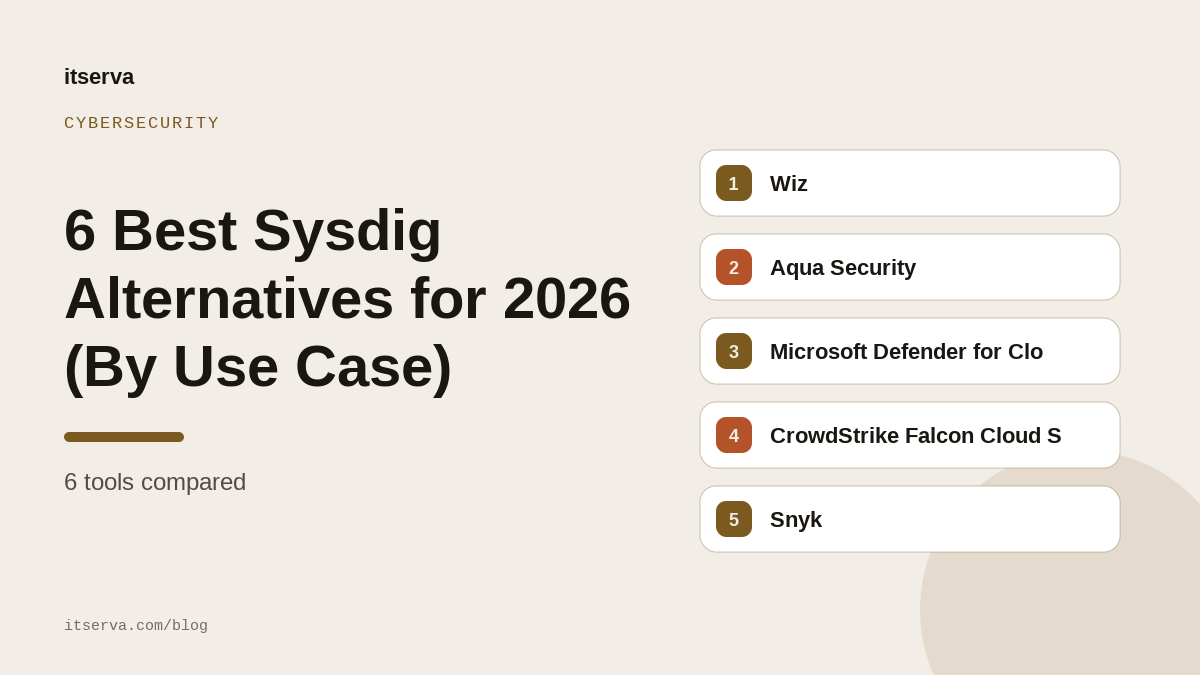
What does Sysdig do, and what should an alternative replace?
Sysdig is a cloud and container security platform known for runtime visibility and Kubernetes security. Teams usually look for an alternative because they want agentless coverage, lower cost, simpler deployment, or stronger runtime blocking.
The right replacement depends on which part of Sysdig you use most. Posture and visibility tools suit teams that mainly need misconfiguration and vulnerability findings, while runtime tools suit teams that need to detect or stop attacks on live workloads.
Quick comparison
| Tool | Best for | Starting price | Free plan |
|---|---|---|---|
| Wiz | Agentless cloud visibility overall | Custom pricing | No |
| Aqua Security | Runtime blocking and enforcement | Custom pricing | No |
| Microsoft Defender for Cloud | Azure-first value | Pay-as-you-go (Foundational CSPM free) | Yes (Foundational CSPM free; 30-day trial) |
| CrowdStrike Falcon Cloud Security | Falcon endpoint customers | From $7.99/device/month (Falcon Go) | Yes (15-day free trial) |
| Snyk | Developer-first container scanning | From $25/month | Yes (free starting option) |
| Falco | Free runtime detection | Free (open source) | Yes (free and open source) |
The 6 best Sysdig alternatives
#1
Wiz
- Best for
- Agentless cloud visibility overall
- Starting price
- Custom pricing
- Free plan
- No
Wiz is an agentless cloud security platform that connects code, cloud, and runtime into one security graph. Its pricing page describes unified offerings that cover cloud and AI security from code to runtime, with usage that can shift between capabilities as needs change and a la carte options for specific needs. Wiz reports that its licensing is designed to give complete cloud and AI security from code to runtime, with offerings customers can tailor to their exact needs.
The trade-off is depth and pricing clarity. Agentless scanning reads cloud state through APIs on a schedule, so it can miss short-lived activity that a sensor on the workload would catch, and Wiz publishes no list price, so teams must request a custom quote. Wiz fits large multicloud teams that want fast, broad visibility without deploying agents.
What we like
- Agentless scanning with no agents to deploy
- One security graph across code, cloud, and runtime
- AI agents for investigation and remediation
- Unified offerings that shift between capabilities
Watch out for
- No published list price
- Agentless depth can miss short-lived activity
- Quote depends on your cloud size
#2
Aqua Security
- Best for
- Runtime blocking and enforcement
- Starting price
- Custom pricing
- Free plan
- No
Aqua Security is a cloud native application protection platform that covers development, cloud posture, and runtime in one system. Its pricing page lists code and container image scanning, infrastructure-as-code scanning, and automated SBOM generation for development, plus agentless and agent-based cloud visibility, posture management, and real-time runtime protection. Aqua Security also offers eBPF-based detection, drift prevention, and malware blocking for running workloads.
The trade-off is deployment effort. Aqua Security's agent-based runtime controls give deeper enforcement than agentless scanning alone, but they need installation and ongoing maintenance across hosts and clusters, and Aqua Security publishes no list price, so teams must request a quote. Aqua Security fits teams whose main priority is stopping attacks at runtime rather than only finding risks.
What we like
- Runtime enforcement that blocks attacks at execution
- Covers code, posture, and runtime in one platform
- eBPF-based detection and drift prevention
- Agentless and agent-based visibility
Watch out for
- No published list price
- Agents need installation and maintenance
- Heavier to deploy than agentless tools
#3
Microsoft Defender for Cloud
- Best for
- Azure-first value
- Starting price
- Pay-as-you-go (Foundational CSPM free)
- Free plan
- Yes (Foundational CSPM free; 30-day trial)
Microsoft Defender for Cloud is a cloud-native application protection platform that covers posture management, workload protection, and DevOps security across Azure, other clouds, and on-premises systems. Its pricing page offers Foundational CSPM free, with continuous assessments, recommendations, Secure Score, and the Microsoft cloud security benchmark, while paid plans are pay-as-you-go per workload. Microsoft Defender for Cloud is also free for the first 30 days, and pre-purchased Commit Units can save up to 22 percent.
The trade-off is pricing complexity. Paid protection is billed per workload across separate plans for servers, containers, databases, storage, and APIs, so the monthly total depends on how many resources are protected, and the deepest value sits inside Azure. Microsoft Defender for Cloud fits Azure-heavy teams that want native posture and workload protection with a free starting tier.
What we like
- Foundational CSPM free
- Free for the first 30 days
- Up to 22 percent savings with Commit Units
- Native integration with Azure
Watch out for
- Paid plans are billed per workload
- Monthly total depends on resource counts
- Deepest value inside Azure
#4
CrowdStrike Falcon Cloud Security
- Best for
- Falcon endpoint customers
- Starting price
- From $7.99/device/month (Falcon Go)
- Free plan
- Yes (15-day free trial)
CrowdStrike Falcon Cloud Security is the cloud security part of the Falcon platform, which combines agent-based and agentless protection with threat intelligence and automation. Its pricing page lists Falcon Go at $7.99 per device per month billed monthly, with next-generation antivirus, device control, and mobile protection, while Falcon Pro costs $14.99 and Falcon Enterprise $19.99 per device per month. A 15-day free trial is available with no credit card required.
The trade-off is that the published bundle prices cover endpoint protection, not cloud security alone. Cloud security sits in the higher Falcon bundles, and the fully managed Falcon Complete plan is priced on request, so teams must ask CrowdStrike what cloud coverage costs at their size. CrowdStrike Falcon Cloud Security fits organizations already running Falcon endpoints that want cloud protection on the same platform.
What we like
- Agent-based and agentless protection in one platform
- Strong threat intelligence
- 15-day free trial with no credit card
- Published bundle prices from $7.99 per device
Watch out for
- Cloud security is not priced separately
- Falcon Complete is priced on request
- Best value for existing Falcon customers
#5
Snyk
- Best for
- Developer-first container scanning
- Starting price
- From $25/month
- Free plan
- Yes (free starting option)
Snyk is a developer-first security platform that scans code, open source dependencies, containers, and infrastructure as code inside developer workflows. Its plans page starts at $25 per month, offers a free starting option, and describes an Enterprise plan where teams buy credits and spend them across capabilities at published credit rates. Snyk Container is charged at 0.33 credits per monitored image per day, while Code and Open Source each cost 1.0 credit per active contributor per day.
The trade-off is scope and pricing shape. Snyk shifts security into code and pipelines, so it offers less runtime and posture depth than a full cloud platform, and Enterprise pricing is credit-based rather than a simple per-seat figure, which makes budgeting harder to compare. Snyk fits development teams whose main Sysdig use is scanning container images and code in CI.
What we like
- Developer-first workflows in code and CI
- Container scanning at 0.33 credits per image per day
- Free starting option
- Credit-based Enterprise plan covers all capabilities
Watch out for
- Less runtime depth than a full cloud platform
- Credit-based pricing is harder to compare
- Enterprise price needs a sales conversation
#6
Falco
- Best for
- Free runtime detection
- Starting price
- Free (open source)
- Free plan
- Yes (free and open source)
Falco is a free, open-source runtime security tool that detects threats across hosts, containers, Kubernetes, and cloud environments. It uses custom rules on Linux kernel events through eBPF, with plugins for cloud services such as GitHub, Okta, and AWS CloudTrail, and it forwards alerts to more than 50 systems, including SIEMs and data lakes. Falco runs on x64 and ARM processors, deploys through an official Helm chart, and costs nothing to start.
The trade-off is that Falco only detects. It provides rules, real-time alerts, and compliance monitoring, but no posture management, vulnerability scanning, or managed interface, so teams must run it themselves and pair it with another tool for the rest. Falco fits platform teams with the operations skill to run open-source detection and pair it with a posture tool.
What we like
- Free and open source
- Real-time eBPF detection
- Forwards alerts to more than 50 systems
- Official Helm chart for Kubernetes
Watch out for
- Detection only, no posture or remediation platform
- Needs operations skill to run
- No managed interface
How we chose
We compared cloud security platforms that replace Sysdig's posture, visibility, or runtime coverage, and ranked them by overall fit for cloud and Kubernetes teams. We weighted agentless visibility first, then runtime depth, then developer fit, then total cost at a realistic workload count. Prices and free plans come from each vendor's own pricing page, checked in November 2026, and tools without a published price are listed as custom pricing. No vendor paid for placement, and we did not run hands-on tests; we compare published information.
Why most of these tools have no public price
Cloud security is usually priced per asset, workload, or resource, so vendors quote on your exact counts rather than publishing a flat rate. That is why Wiz, Aqua Security, and CrowdStrike Falcon Cloud Security show custom pricing for their full platforms, even when a smaller endpoint bundle has a list price.
Ask every vendor for the same quote basis: number of cloud accounts, workloads, and containers, plus data retention, support, and training. A quote that leaves those out cannot be compared fairly with another vendor's figure.
How to choose
Start with your biggest risk. If misconfigurations and exposed cloud resources worry you most, shortlist Wiz or Microsoft Defender for Cloud; if live attacks on running workloads worry you most, shortlist Aqua Security or Falco.
Next, price a realistic month at your actual workload count. Add the paid plans you need, check whether the free tier covers your smallest accounts, and ask whether support, retention, and training are included or billed separately.
Finally, trial two tools on a real cloud account, not a demo. Compare time to first findings, alert volume after prioritization, and whether the top findings are genuinely exploitable, then check agent overhead on a busy workload before you commit.