
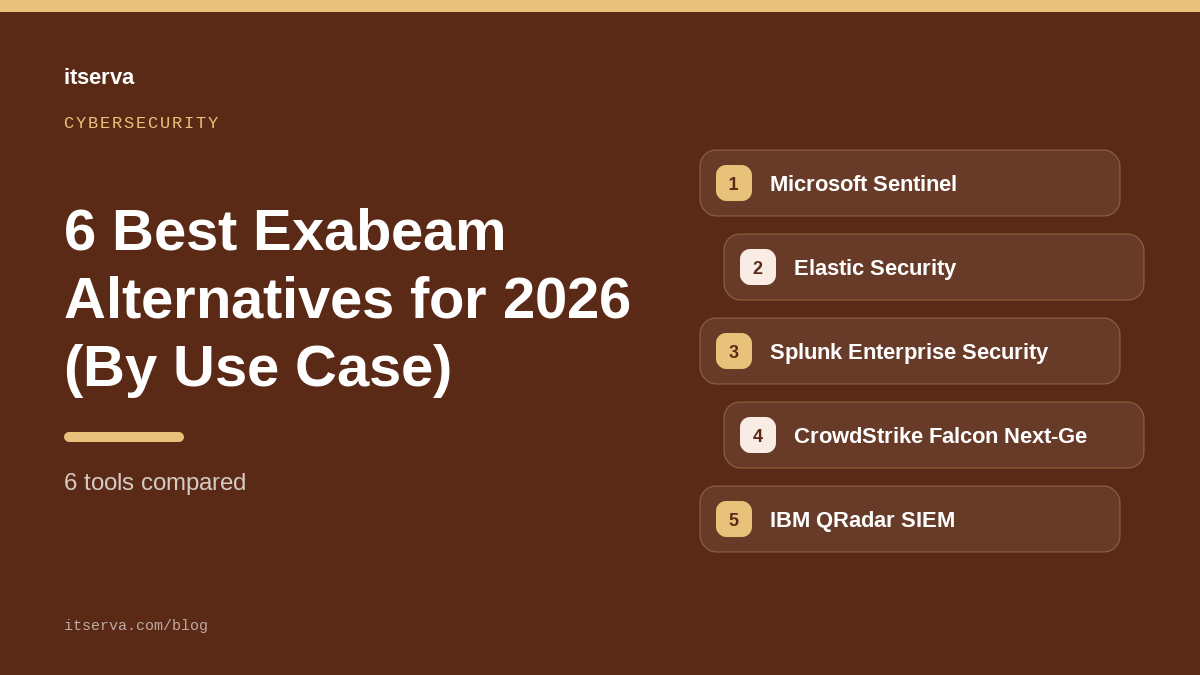
What should an Exabeam alternative replace?
Exabeam is a SIEM and behavior analytics vendor, known for user behavior analytics and insider threat timelines. A replacement therefore needs more than log collection: it needs behavior-based detection, correlation across sources and a clear investigation workflow.
Pricing is the hardest part of the comparison. SIEM vendors charge by ingestion volume, events per second, resources used or a quoted license, so the same estate can cost very different amounts on different models. Model your own log volume first, then compare the pricing model, not just the headline figure.
Quick comparison
| Tool | Best for | Starting price | Free plan |
|---|---|---|---|
| Microsoft Sentinel | Microsoft and Azure estates | Fixed daily fee per commitment tier | No |
| Elastic Security | Engineering-led open SIEM teams | Resource-based pricing (pay monthly or prepaid) | No |
| Splunk Enterprise Security | Mature SOC analytical depth | Custom pricing | No |
| CrowdStrike Falcon Next-Gen SIEM | CrowdStrike Falcon customers | $7.99/device/month (Falcon Go, monthly) | No (15-day trial) |
| IBM QRadar SIEM | Regulated on-premises estates | Custom pricing (EPS/FPM or MVS licensing) | No |
| Google Security Operations | Google Cloud shops and hunt-heavy SOCs | Custom pricing | No |
The 6 best Exabeam alternatives
#1
Microsoft Sentinel
- Best for
- Microsoft and Azure estates
- Starting price
- Fixed daily fee per commitment tier
- Free plan
- No
Microsoft Sentinel is a cloud SIEM that prices ingestion through commitment tiers, which reserve a set amount of daily data ingestion capacity for a fixed, predictable daily fee. The pricing page describes two tiers for different data: an analytics tier for high-value security data such as identity logs and threat intelligence, and a data lake tier for high-volume logs such as network, firewall and proxy logs. A 50 GB commitment tier was available in public preview from 1 October 2025 through 31 December 2026.
The trade-off is commitment. The minimum commitment period before a team can opt out or reduce a capacity reservation is 31 days, and commitment tiers apply at workspace level and cannot be grouped across workspaces or subscriptions. Other Azure services used with Sentinel, such as Azure Log Analytics and Azure Logic Apps, are charged separately. Microsoft Sentinel fits Microsoft and Azure estates that want predictable daily ingestion pricing and long-term log retention for forensics.
What we like
- Fixed daily fee for reserved capacity
- Separate analytics and data lake tiers
- 50 GB commitment tier available
- Long-term retention for forensics
Watch out for
- 31-day minimum commitment period
- Tiers cannot be grouped across workspaces
- Other Azure services charged separately
#2
Elastic Security
- Best for
- Engineering-led open SIEM teams
- Starting price
- Resource-based pricing (pay monthly or prepaid)
- Free plan
- No
Elastic Security is the security solution on Elastic Cloud, offered as hosted, serverless and self-managed deployments. Hosted pricing is resource based and serverless pricing is usage based, with pay-as-you-go monthly billing or prepaid options on both. The pricing page lists 60 regions across AWS, Azure and Google Cloud, and a 99.95% monthly uptime SLA for Platinum and Enterprise subscription tiers.
The trade-off is that Elastic Cloud pricing is driven by the resources and usage a deployment consumes, so a team must model its own search and indexing load before it can predict a monthly bill. Serverless deployments scale automatically with load, while hosted deployments give full control over hardware configuration, cluster size, node count and versions. Elastic Security fits engineering-led teams that want open, resource-based SIEM pricing and control over how their deployment runs.
What we like
- Hosted, serverless and self-managed options
- Resource-based hosted pricing
- Usage-based serverless pricing
- 99.95% uptime SLA on higher tiers
Watch out for
- Monthly cost depends on modelled usage
- Needs Elastic expertise to run well
- No published starting price on the pricing page
#3
Splunk Enterprise Security
- Best for
- Mature SOC analytical depth
- Starting price
- Custom pricing
- Free plan
- No
Splunk Enterprise Security is Splunk's AI-powered security platform, unifying SIEM, SOAR, UEBA, threat intelligence and detection engineering in one product. It comes in two editions, Essentials and Premier, and is available in the cloud and for self-managed or on-premises environments. Pricing is activity-based, workload-based or ingest-based, with unlimited users, and Cloud Flex lets spend move across the Splunk portfolio.
The trade-off is that Enterprise Security pricing is quote-based, with a Get a quote button on both editions and no published rate on the pricing page. SOAR and UEBA are Premier-only, so teams that want automation and behavior analytics must take the higher edition. Splunk Enterprise Security fits mature SOCs that want deep detection engineering and can budget through a sales quote.
What we like
- SIEM, SOAR and UEBA in one platform
- Essentials and Premier editions
- Cloud or self-managed deployment
- Unlimited users
Watch out for
- Quote-only, no published rate
- SOAR and UEBA need Premier
- Needs specialist staffing and tuning
#4
CrowdStrike Falcon Next-Gen SIEM
- Best for
- CrowdStrike Falcon customers
- Starting price
- $7.99/device/month (Falcon Go, monthly)
- Free plan
- No (15-day trial)
CrowdStrike Falcon Next-Gen SIEM is CrowdStrike's SIEM module, listed alongside endpoint detection and response, threat intelligence and hunting, identity protection and IT hygiene on the Falcon pricing page. Falcon Go starts at $7.99 per device per month when billed monthly, or $59.99 per device when billed annually, and a 15-day free trial needs no credit card. The page also lists Falcon Pro at $14.99 per device per month and Falcon Enterprise at $19.99 per device per month.
The trade-off is that the pricing page prices Falcon endpoint bundles, not the SIEM module on its own, so a team must talk to CrowdStrike to price SIEM for its own log volume. Falcon Complete, the fully managed option, is contact sales only. CrowdStrike Falcon Next-Gen SIEM fits CrowdStrike Falcon customers that want endpoint and SIEM data in one console.
What we like
- 15-day free trial, no credit card
- Endpoint and SIEM in one console
- Falcon Go starts at $7.99 per device
- Managed Falcon Complete option
Watch out for
- SIEM not priced separately on the page
- Falcon Complete is contact sales only
- Less value outside Falcon estates
#5
IBM QRadar SIEM
- Best for
- Regulated on-premises estates
- Starting price
- Custom pricing (EPS/FPM or MVS licensing)
- Free plan
- No
IBM QRadar SIEM is IBM's SIEM for centralizing security visibility, real-time threat detection and compliance work. Its product page lists user behavior analytics for insider threats, native support for thousands of open source Sigma rules, and 700 prebuilt integrations and partner extensions. The pricing page offers two licensing models: a Usage model based on events per second and flows per minute, and an Enterprise model based on managed virtual servers.
The trade-off is that no dollar price is published on the IBM pricing page, so budgeting starts with a demo or a sales conversation and a model of event and flow volumes. On-premises deployment is available as hardware or virtual appliances, which suits teams that need local control over infrastructure. IBM QRadar SIEM fits regulated on-premises estates that price by events per second and need local deployment.
What we like
- User behavior analytics included
- Native Sigma rules support
- 700 prebuilt integrations
- Hardware or virtual appliance deployment
Watch out for
- No dollar price published
- Budgeting needs event and flow volumes
- Needs specialist skills
#6
Google Security Operations
- Best for
- Google Cloud shops and hunt-heavy SOCs
- Starting price
- Custom pricing
- Free plan
- No
Google Security Operations is Google Cloud's intelligence-driven security operations platform for detecting, investigating and responding to threats. Its product page describes curated detections maintained by Google threat researchers, Gemini assistance for searching data in natural language, and custom detection authoring in YARA-L. It also includes SOAR capabilities that can orchestrate over 300 tools, including endpoint detection and identity management products.
The trade-off is that the Google Cloud page shows no published price for Security Operations and directs buyers to contact Google, so the real cost only appears after a sales conversation. The platform is cloud-native on Google Cloud, which gives Google Cloud customers the most native integration. Google Security Operations fits Google Cloud shops and hunt-heavy SOCs that want fast search and Gemini-assisted investigation.
What we like
- Curated detections from Google researchers
- Gemini-assisted investigation
- Custom detections in YARA-L
- SOAR orchestrates over 300 tools
Watch out for
- No published price, contact sales
- Most value inside Google Cloud
- Cost only clear after a sales conversation
How we chose
We compared SIEM platforms that could replace Exabeam for behavior analytics, insider threat detection and security correlation, starting from the eight tools on a published alternatives list. We weighted pricing transparency first, then deployment fit, then detection and automation depth. Prices and plan details come from vendor pricing and product pages checked in November 2026, and tools with no published rate are shown as custom pricing. No vendor paid for placement, and we did not run hands-on tests; we compare published information.
How SIEM pricing really works
SIEM vendors do not share one pricing unit. Sentinel reserves daily ingestion capacity for a fixed daily fee, QRadar licenses by events per second and flows per minute, Elastic charges by resources or usage, and Splunk, IBM and Google quote a price after a sales conversation.
Before asking for a quote, measure 30 days of real log volume by source, plus growth and mandated retention. A team that ingests mostly high-volume network logs will pay very differently from a team that ingests mostly identity logs, even on the same platform.
How to choose
Start with your estate, not the feature list. Microsoft and Azure shops should shortlist Sentinel, Google Cloud shops should shortlist Google Security Operations, CrowdStrike shops should shortlist Falcon Next-Gen SIEM, and regulated on-premises estates should shortlist IBM QRadar SIEM.
Next, price your own logs on each candidate's unit. Model daily ingestion for Sentinel, events per second and flows per minute for QRadar, and resource or usage load for Elastic, then add retention, tuning time and any separate services such as Azure Log Analytics.
Finally, run a proof of concept with a real historical incident. Time how long a mid-level analyst takes from alert to a written narrative, check how behavior analytics surfaces insider threats, and confirm who owns the cost when log volume spikes.