
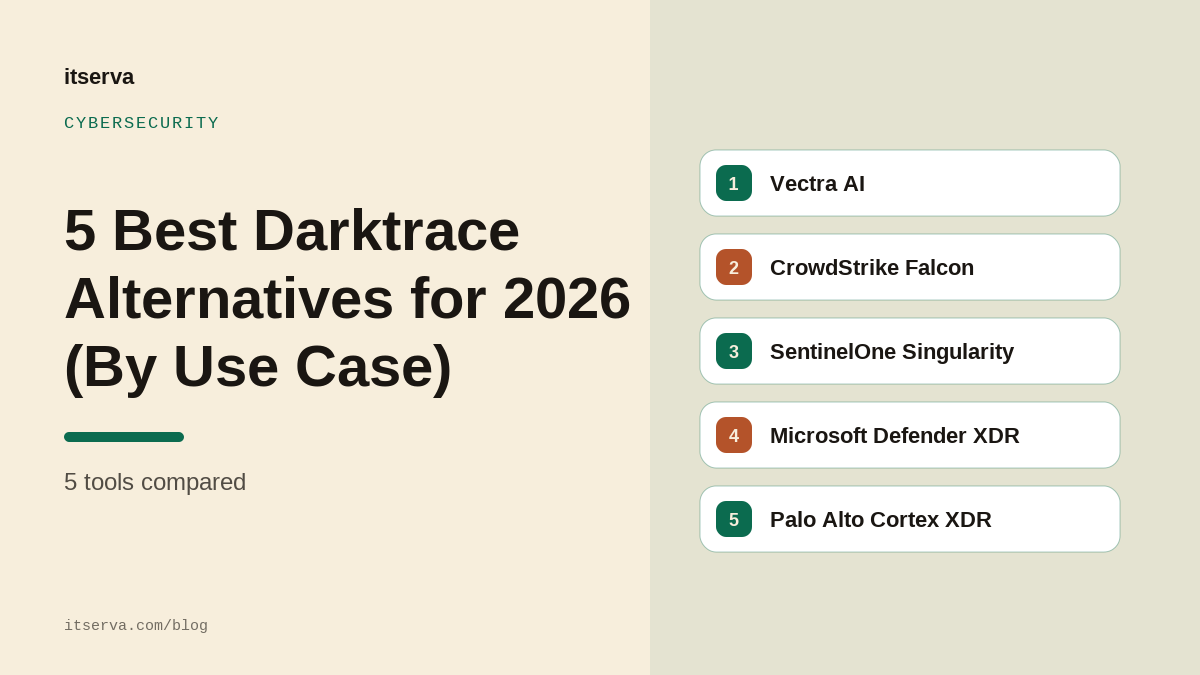
What should a Darktrace alternative actually replace?
Darktrace is a network detection and response platform, so the closest alternatives watch network traffic and identity behavior for attacker activity, not just endpoints. The tools here split into network-first detection, such as Vectra AI, and broader XDR platforms that combine endpoint, cloud, email and identity signals.
That split matters because the two kinds of tool answer different questions. Network tools catch lateral movement and traffic anomalies that endpoints miss, while XDR platforms correlate events across layers and automate response. Most mature teams end up using both, so the choice is about which layer to fix first.
Quick comparison
| Tool | Best for | Starting price | Free plan |
|---|---|---|---|
| Vectra AI | Network and identity detection | Custom pricing | No |
| CrowdStrike Falcon | Cloud-native XDR | $59.99/device/year (Falcon Go, annual billing) | No (15-day trial) |
| SentinelOne Singularity | Autonomous response | Custom pricing | No |
| Microsoft Defender XDR | Microsoft 365 environments | Included in Microsoft 365 E5 (not sold standalone) | No |
| Palo Alto Cortex XDR | Palo Alto network customers | Custom pricing | No |
The 5 best Darktrace alternatives
#1
Vectra AI
- Best for
- Network and identity detection
- Starting price
- Custom pricing
- Free plan
- No
Vectra AI is the closest network-detection replacement for Darktrace on this list. It watches network traffic, identities and cloud logs with AI that flags attacker behavior, including lateral movement that endpoint-only tools can miss. The platform claims more than 90% MITRE ATT&CK coverage and holds 39 AI threat detection patents. Pricing is quote-based, so buyers need a sales conversation before they can budget it.
The trade-off is network depth against endpoint breadth. Vectra sees attacks moving across the network and through stolen credentials, but its endpoint response is thinner than dedicated EDR platforms such as CrowdStrike and SentinelOne. Deployment also needs planning around sensors and traffic capture. Vectra AI fits network-first teams that want AI detection across traffic and identity without replacing their endpoint tools.
What we like
- AI network and identity detection
- Catches lateral movement endpoint tools miss
- More than 90% MITRE ATT&CK coverage
- 39 AI threat detection patents
Watch out for
- Quote-based pricing
- Endpoint response thinner than dedicated EDR
- Sensor deployment needs planning
#2
CrowdStrike Falcon
- Best for
- Cloud-native XDR
- Starting price
- $59.99/device/year (Falcon Go, annual billing)
- Free plan
- No (15-day trial)
CrowdStrike Falcon is the cloud-native XDR pick on this list. Falcon Go starts at $59.99 per device per year on annual billing, or $7.99 per device per month, and covers next-generation antivirus, device control and mobile protection. Falcon Pro adds firewall management and endpoint detection and response at $99.99 per device per year, while Enterprise reaches $184.99. A 15-day free trial needs no credit card.
The trade-off is detection depth against per-endpoint cost. Falcon detects well across endpoints, cloud and identity, but the bill grows with every device, and the fully managed Complete tier is priced on request. Falcon Pro and Enterprise also climb steeply from the Go starting price. CrowdStrike Falcon fits enterprises that need cloud-native XDR with managed options and can fund it at scale.
What we like
- Published per-device pricing
- 15-day free trial, no credit card
- Falcon Complete adds 24/7 managed response
- Go, Pro and Enterprise tiers to grow into
Watch out for
- Cost grows with every device
- Complete tier priced on request
- Enterprise at $184.99 per device per year
#3
SentinelOne Singularity
- Best for
- Autonomous response
- Starting price
- Custom pricing
- Free plan
- No
SentinelOne Singularity is the autonomous response pick. Its Complete tier covers AI-driven endpoint and cloud workload protection with real-time detection and response, an AI security assistant and 14 days of data retention. Commercial adds identity detection and response, 90-day retention and managed threat hunting. Enterprise adds an agentic AI SOC analyst, full visibility and forensics. Pricing is quote-based, with Enterprise listed as contact sales.
The trade-off is automation against price transparency. Singularity prevents, detects and responds on its own, but the pricing page shows no published prices, so buyers cannot compare costs without a sales conversation. Managed detection and response is an add-on on some tiers, and purchases go through an authorized partner. SentinelOne Singularity fits teams that want autonomous response with less analyst toil.
What we like
- Autonomous prevention, detection and response
- AI security assistant on Complete
- 90-day retention on Commercial
- Managed threat hunting available
Watch out for
- No published prices on the pricing page
- Enterprise is contact sales
- Purchases go through an authorized partner
#4
Microsoft Defender XDR
- Best for
- Microsoft 365 environments
- Starting price
- Included in Microsoft 365 E5 (not sold standalone)
- Free plan
- No
Microsoft Defender XDR is the Microsoft 365 pick. It correlates endpoints, identity, email, apps and cloud in one platform, with attack disruption, vulnerability management and advanced hunting in a single console. One user license covers up to 5 devices, and XDR is included with eligible Microsoft plans rather than sold on its own. Standalone XDR needs Defender for Endpoint Plan 2 or Defender for Office 365 Plan 2.
The trade-off is Microsoft value against stack lock-in. Defender XDR is not sold on its own, so buyers reach it through Microsoft 365 E5, the Microsoft Defender Suite or a standalone Plan 2 license. Teams outside Microsoft get less from it, since its strength is correlating signals across Microsoft workloads. Microsoft Defender XDR fits Microsoft 365 environments that want XDR inside the licenses they already hold.
What we like
- One console for endpoints, identity, email and cloud
- One license covers up to 5 devices
- Included with eligible Microsoft plans
- Automatic attack disruption built in
Watch out for
- Not sold standalone
- Deepest value sits inside Microsoft
- Standalone XDR needs Plan 2
#5
Palo Alto Cortex XDR
- Best for
- Palo Alto network customers
- Starting price
- Custom pricing
- Free plan
- No
Palo Alto Cortex XDR is the Palo Alto customer pick. It connects data from endpoint, network, cloud, identity and email sources and applies AI to detect and prioritize attacks, with 87% of attacks spanning multiple vectors according to the vendor. Built-in behavioral analytics stop zero-day and fileless malware, and detection accuracy cuts false positives by 95%. Pricing is quote-based, with a demo offered instead of a price list.
The trade-off is unified depth against premium effort. Cortex XDR unifies detection with a single data lake and one sensor, and Unit 42 services add 24/7 managed detection and response, but the platform is built for enterprises consolidating on Palo Alto. Smaller teams may find the scope and the sales-led buying process heavy. Palo Alto Cortex XDR fits Palo Alto network customers consolidating detection on one platform.
What we like
- AI detection across endpoint, network, cloud, identity and email
- False positives cut by 95%
- Single data lake and one sensor
- Unit 42 MDR available
Watch out for
- Quote-based pricing
- Built for enterprises consolidating on Palo Alto
- Sales-led buying process
How we chose
We compared five alternatives to Darktrace that cover network detection and extended detection and response, ranked by fit for different teams. We weighted detection layer first, then response automation, then existing stack fit, since no single tool leads on all three. Prices come from vendor pricing pages checked in November 2026, and four of the five tools publish no price, so they are listed as custom pricing. No vendor paid for placement, and we did not run hands-on tests; we compare published information.
Why most XDR prices are quotes, not list prices
Only CrowdStrike publishes per-device prices here, at $59.99 per device per year for Falcon Go. The other four tools are quote-based, which means the price depends on endpoint count, contract length and which modules you add. Ask every vendor for a written quote that states the per-endpoint rate, the term and whether managed response is included.
Also check what the headline price leaves out. Managed detection and response, extra data retention and identity modules are often add-ons, and buying through a partner can change the final figure. A proof of concept against your own traffic is worth more than a list price, since detection quality varies by network.
How to choose
Start with your existing stack. Microsoft 365 shops should shortlist Defender XDR first, Palo Alto network customers should shortlist Cortex XDR, and teams already running CrowdStrike or SentinelOne should stay put unless a gap is proven.
Next, match the detection layer to the gap. Network-first teams should shortlist Vectra AI, endpoint-first teams should compare CrowdStrike Falcon and SentinelOne Singularity, and lean teams that need a managed service should ask each vendor what its MDR tier adds and costs.
Finally, model the real cost before you sign. Add managed response, extra retention and any identity modules to the base quote, confirm whether the price is per device or per user, and run a trial or proof of concept on your own traffic before committing.