
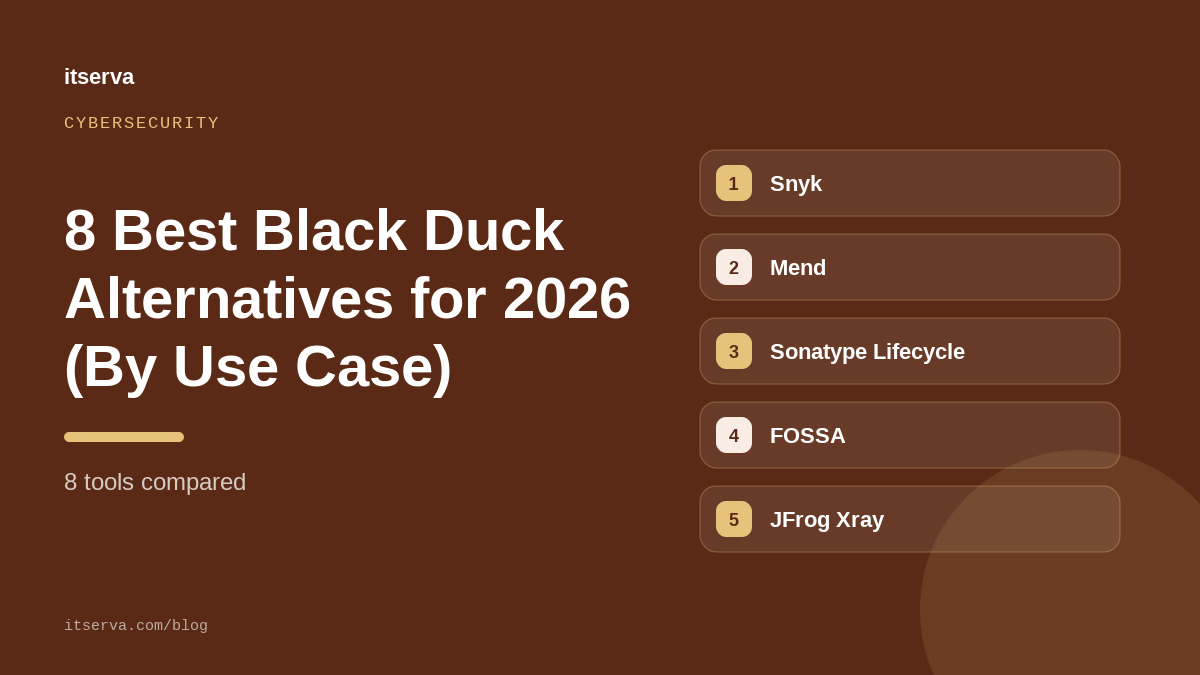
What does a Black Duck alternative need to do?
Black Duck is a software composition analysis tool: it inventories the open source components in a codebase, checks them against vulnerability and license databases, and produces a software bill of materials. An alternative must cover at least one of those jobs well, whether that is finding known vulnerabilities, blocking risky packages, or proving license compliance.
The tools here split by strength. Some lead on developer workflow and fast fixes, others on license depth, repository gates, or cutting alert noise. Price follows the same split: several start free, a few publish a clear monthly figure, and the enterprise platforms are priced by quote.
Quick comparison
| Tool | Best for | Starting price | Free plan |
|---|---|---|---|
| Snyk | Developer-first platform | $25/contributing developer/month (Team) | Yes (free plan) |
| Mend | Remediation automation | Custom pricing | No |
| Sonatype Lifecycle | Repository firewall and policy control | Custom pricing | No |
| FOSSA | License compliance and SBOMs | $20/project/month (Business, billed annually) | Yes (free forever, 5 projects) |
| JFrog Xray | Artifact and container scanning | From $950/month (Enterprise X) | No |
| GitHub Dependabot | Free baseline for GitHub teams | Free | Yes (free for all repositories) |
| Socket | Malicious package detection | $25/dev seat/month (Team) | Yes (free plan, 1,000 scans/month) |
| Endor Labs | Reachability triage | Custom pricing | Yes (free Developer tier) |
The 8 best Black Duck alternatives
#1
Snyk
- Best for
- Developer-first platform
- Starting price
- $25/contributing developer/month (Team)
- Free plan
- Yes (free plan)
Snyk is a developer-first security platform that scans open source dependencies, containers, infrastructure as code, and first-party code from one workspace. Its free plan costs $0 per month, while the Team plan starts at $25 per contributing developer per month. Snyk Open Source checks dependencies against known vulnerabilities, and fix pull requests open directly in the developer workflow. Integrations cover IDEs, repositories, and CI pipelines, so findings appear where developers already work.
The trade-off is the jump beyond small teams. Team covers a limited number of contributing developers, and larger teams move to credit-based Enterprise pricing, where each capability draws credits at a published rate. License compliance depth is also thinner than in license-first tools. Snyk fits development teams that want developers to fix open source vulnerabilities themselves with minimal friction.
What we like
- Free plan at $0 per month
- Fix pull requests in the developer workflow
- Covers open source, containers, code and infrastructure as code
- Clear Team price of $25 per contributing developer
Watch out for
- Enterprise pricing is credit-based, not a flat seat price
- License depth is thinner than license-first tools
- Team plan suits smaller teams
#2
Mend
- Best for
- Remediation automation
- Starting price
- Custom pricing
- Free plan
- No
Mend is an application security platform built around fixing open source risk at scale. Mend AppSec combines Mend SCA for open source risk, Mend SAST for source code security, and container scanning, with AI-powered fix suggestions and automated dependency updates. Mend Renovate Enterprise automates dependency updates across repositories, with Merge Confidence ratings that predict whether an update is safe to merge. Pricing is per contributing developer, with no limits stated on code size, scan count, or application count.
The trade-off is that Mend publishes no list price, so budgeting needs a sales quote based on developer count and product mix. There is also no free plan on its pricing page, which makes it a poor first step for a small team. Mend fits mid-market and enterprise teams whose bottleneck is fixing vulnerabilities across many repositories, not finding them.
What we like
- Renovate automates dependency updates at scale
- Merge Confidence ratings predict update safety
- SCA, SAST and container scanning in one platform
- No stated limits on scans or applications
Watch out for
- No published list price
- No free plan on the pricing page
- Quote depends on developer count and product mix
#3
Sonatype Lifecycle
- Best for
- Repository firewall and policy control
- Starting price
- Custom pricing
- Free plan
- No
Sonatype Lifecycle is a software composition analysis and policy platform that controls open source risk across the development lifecycle. Its Repository Firewall blocks vulnerable or non-compliant components at the repository, before developers download them into a build. Lifecycle applies security and license policies to components, and it works across more than 50 languages and integrations with IDEs, source repositories, and CI pipelines. All Lifecycle capabilities now sit inside Sonatype Guide for new customers.
The trade-off is pricing transparency. Sonatype uses consumption-based pricing for new customers, with usage terms defined in a quote, and products are billed annually. Setup can also be heavy for smaller teams that only need a scanner. Sonatype Lifecycle fits regulated organizations that want policy gates at the repository and a single control point for open source risk.
What we like
- Repository Firewall blocks bad packages at ingestion
- Security and license policy enforcement in one platform
- Works across 50+ languages and integrations
- Advanced Legal and AI Developer add-ons available
Watch out for
- Consumption-based pricing needs a quote
- No list price on the pricing page
- Lifecycle now requires Sonatype Guide for new customers
#4
FOSSA
- Best for
- License compliance and SBOMs
- Starting price
- $20/project/month (Business, billed annually)
- Free plan
- Yes (free forever, 5 projects)
FOSSA is a license-first open source management platform that scans dependencies at any depth and checks licenses against a policy the team defines. Its free plan covers 5 projects and 10 contributing developers, and Business costs $20 per project per month when billed annually. Business adds automated license and vulnerability scanning, unlimited imported SBOMs, and multi-project reporting. FOSSA also exports SBOMs and produces attribution notices, which matter when customers or auditors ask for proof.
The trade-off is that pricing is primarily based on contributing developers, so the monthly figure moves as the team grows. Snippet scanning and binary scanning are paid add-ons, and the deepest enterprise features sit on the custom-priced Enterprise plan. FOSSA fits teams whose main risk is license exposure and customer SBOM requests, not just known vulnerabilities.
What we like
- Free plan for 5 projects and 10 contributing developers
- Clear Business price of $20 per project per month
- SBOM export and attribution notices
- Automated license and vulnerability scanning on Business
Watch out for
- Bill grows with contributing developer count
- Snippet and binary scanning are paid add-ons
- Enterprise plan is custom priced
#5
JFrog Xray
- Best for
- Artifact and container scanning
- Starting price
- From $950/month (Enterprise X)
- Free plan
- No
JFrog Xray is a software composition analysis tool that scans source code and binaries for vulnerabilities, malicious packages, and license risks. It is a core part of the JFrog Platform, alongside Artifactory, and it scans artifacts and container layers with policy-based blocking and SBOM generation. Xray is included in the Pro X, Enterprise X, and Enterprise+ subscriptions, and the cloud Enterprise X tier starts at $950 per month. Contextual analysis prioritizes vulnerabilities by whether they are actually exploitable.
The trade-off is that Xray is not sold on its own, so the cheapest route in is a full JFrog Platform tier. The entry Pro plan at $150 per month covers Artifactory only, without Xray. JFrog Xray fits organizations already running JFrog Artifactory that want scanning, policy gates, and SBOMs from the same platform.
What we like
- Deep scanning of artifacts and container layers
- Policy-based blocking and SBOM generation
- Contextual analysis cuts exploitable-first noise
- Native to the JFrog Platform and Artifactory
Watch out for
- Not sold on its own
- Cheapest Xray tier starts at $950 per month
- Best value inside the JFrog ecosystem
#6
GitHub Dependabot
- Best for
- Free baseline for GitHub teams
- Starting price
- Free
- Free plan
- Yes (free for all repositories)
GitHub Dependabot is the free baseline for dependency security on GitHub. It is included on the GitHub Free plan, which costs $0 and covers unlimited public and private repositories with Dependabot security and version updates. Dependabot opens automated pull requests for known vulnerabilities, with grouped security updates that batch related fixes, and it can keep dependencies up to date with version updates. The dependency graph and SBOM export give every repository a basic inventory of its components.
The trade-off is depth. License compliance is limited, there is no reachability analysis to show which vulnerabilities code actually calls, and Dependabot only works inside GitHub. Teams that need policy enforcement or license reporting will outgrow it. GitHub Dependabot fits any team already on GitHub that wants a free baseline before paying for a deeper scanner.
What we like
- Free on the GitHub Free plan
- Automated fix pull requests for known vulnerabilities
- Grouped security updates batch related fixes
- Dependency graph and SBOM export included
Watch out for
- License compliance is limited
- No reachability analysis
- GitHub only
#7
Socket
- Best for
- Malicious package detection
- Starting price
- $25/dev seat/month (Team)
- Free plan
- Yes (free plan, 1,000 scans/month)
Socket is a supply chain security tool that watches open source packages for malicious behavior, not just known vulnerabilities. Its free plan costs $0 per developer seat per month and includes 1,000 scans per month, detection across more than 70 risk types, and automatic blocking of malicious dependencies. The Team plan costs $25 per developer seat per month and adds precomputed reachability analysis, risk-based priority scoring, and Slack security alerts. Socket also adds AI-powered risk analysis to flag suspicious install scripts and typosquatting.
The trade-off is scope. Socket is narrower than a full software composition analysis platform, with thinner license and vulnerability depth than FOSSA or Snyk. The free plan also caps API requests at 500, so heavy automation needs a paid tier. Socket fits teams worried about supply chain attacks on open source packages, as a specialized layer beside a broader scanner.
What we like
- Free plan with 1,000 scans per month
- Blocks malicious dependencies automatically
- Detects more than 70 risk types
- Reachability analysis on the Team plan
Watch out for
- Narrower than full SCA platforms
- License depth is thinner than FOSSA
- Free plan caps API requests at 500
#8
Endor Labs
- Best for
- Reachability triage
- Starting price
- Custom pricing
- Free plan
- Yes (free Developer tier)
Endor Labs is an application security platform built around reachability: it checks whether a vulnerable function in a dependency is actually called by your code. Its free Developer tier runs AURI, a local scanner for AI-assisted code, with no account required and read-only access to Endor Labs vulnerability data. The paid Core and Pro tiers add reachability-based scanning, prioritization, policy enforcement, and SBOM and VEX generation, with seats counted by contributing developer. Endor Open Source also includes malicious package detection and AI model governance.
The trade-off is that Core and Pro publish no list prices, so teams need a sales quote, and seats are counted by contributing developers who committed in the last 90 days. The free tier has no UI, policies, or scan history, so it cannot replace a team platform. Endor Labs fits teams drowning in SCA alerts that want to fix the reachable vulnerabilities first.
What we like
- Free Developer tier with no account required
- Reachability analysis cuts alert noise
- SBOM and VEX generation on paid tiers
- Malicious package detection included
Watch out for
- Paid tiers are quote only
- Free tier has no UI, policies or scan history
- Seats counted by contributing developers
How we chose
We compared software composition analysis tools that scan open source dependencies for vulnerabilities, licenses, or malicious packages, and ranked them by fit for a specific job rather than by overall size. We weighted developer workflow and remediation first, then license depth, repository control, and alert triage, because most teams buy for one of those jobs. Prices come from vendor pricing pages checked in November 2026. No vendor paid for placement, and we did not run hands-on tests; we compare published information.
How SCA pricing really works
Most of these tools charge by a different unit, so headline prices do not compare directly. Snyk and Socket charge per contributing developer or developer seat, FOSSA charges per project, JFrog charges per platform tier, and Mend, Sonatype and Endor Labs charge by quote.
Count your real units before you buy: contributing developers, projects, and repositories. A small team with many repositories pays very differently from a large team with few, and a quote-only tool can cost far more than its cheapest published rival once the quote arrives.
How to choose
Start with the risk you most need to cover. Teams worried about known vulnerabilities and fast fixes should shortlist Snyk and Mend, teams worried about license exposure should shortlist FOSSA, and teams worried about bad packages entering builds should shortlist Sonatype Lifecycle and Socket.
Next, place the tool in the pipeline rather than in a quarterly report. New vulnerabilities appear every week, so the scanner belongs in pull requests and CI, where it can block a risky merge or open a fix pull request. Trial two tools with real repositories and check whether developers trust the alerts enough to act on them.
Finally, model cost by the right unit and keep the free baseline. Add seats, projects, or platform tiers for your real counts, get a written quote for any quote-only tool, and keep GitHub Dependabot enabled as a free baseline regardless of which paid tool you choose.