
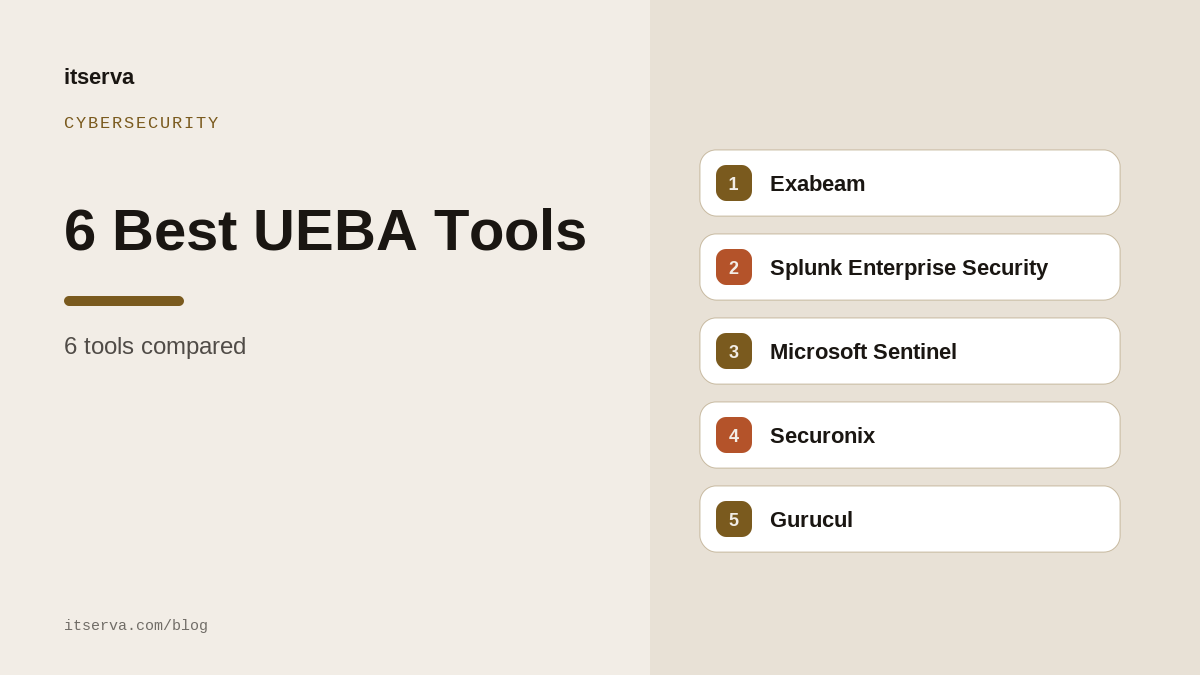
What does a UEBA tool actually do?
A UEBA tool builds a baseline of normal behavior for each user and device, then flags activity that breaks the pattern, such as odd login times, unusual file access or a sudden jump in data movement. The point is to catch compromised accounts and insider misuse that look legitimate to rule-based alerts.
Pricing is the hard part of this market. Five of the six tools below are quote-based, so the real comparison is deployment fit, data sources and investigation workflow, not a price table. Ask each vendor for a quote based on your user count and daily log volume before you shortlist.
Quick comparison
| Tool | Best for | Starting price | Free plan |
|---|---|---|---|
| Exabeam | Best dedicated UEBA platform | Custom pricing | No (demo on request) |
| Splunk Enterprise Security | Best UEBA for teams already on Splunk | Custom pricing | No (quote required) |
| Microsoft Sentinel | Best UEBA for Microsoft environments | Pay-as-you-go (per GB ingested) | No (free trial available) |
| Securonix | Best UEBA plus SIEM at enterprise scale | Custom pricing | No (demo on request) |
| Gurucul | Best explainable UEBA models | Custom pricing | No |
| Rapid7 InsightIDR | Best asset-based SIEM pricing with UEBA | Custom pricing | No (demo available) |
The 6 best UEBA tools
#1
Exabeam
- Best for
- Best dedicated UEBA platform
- Starting price
- Custom pricing
- Free plan
- No (demo on request)
Exabeam is a dedicated behavior-analytics platform built around baselines for users, devices and now AI agents. Its UEBA and Agent Behavior Analytics models learn normal activity and flag anomalies, while AI agent-powered threat detection, investigation and response builds machine-made timelines for analysts. The open platform includes data pipeline management that lets teams search data in place and use low-cost storage.
The trade-off is that Exabeam publishes no price list, so budgeting starts with a demo and a vendor quote rather than a number on a page. Its enterprise focus also means smaller teams may find the platform more than they need. Exabeam fits security teams that want a dedicated UEBA platform and will invest time in tuning behavior baselines.
What we like
- Dedicated UEBA and agent behavior analytics
- Machine-built investigation timelines
- Open platform with data pipeline controls
- Baselines cover humans and AI agents
Watch out for
- No public price list
- Quote needed to budget
- Enterprise-scale platform
#2
Splunk Enterprise Security
- Best for
- Best UEBA for teams already on Splunk
- Starting price
- Custom pricing
- Free plan
- No (quote required)
Splunk Enterprise Security is the security platform that adds UEBA to Splunk data, unifying SIEM, SOAR, threat intelligence and detection engineering in one product. It comes in two editions, Essentials and Premier, and UEBA is included only in Premier. Pricing is activity-based, workload-based or ingest-based, and Cloud Flex lets teams move spend across Splunk products.
The trade-off is cost and lock-in. Both editions are sold by quote, so there is no public price to compare, and UEBA requires the higher Premier edition. Splunk Enterprise Security fits organizations already running Splunk that want behavior analytics on data they already collect.
What we like
- UEBA on top of existing Splunk data
- SIEM, SOAR and threat intelligence in one product
- Two editions to match maturity
- Cloud Flex spend reallocation
Watch out for
- UEBA needs the Premier edition
- No public pricing
- Best value inside Splunk
#3
Microsoft Sentinel
- Best for
- Best UEBA for Microsoft environments
- Starting price
- Pay-as-you-go (per GB ingested)
- Free plan
- No (free trial available)
Microsoft Sentinel is Microsoft's cloud SIEM, priced by the volume of security data ingested, with commitment tiers that reserve daily capacity for a fixed, predictable daily fee. Its analytics tier covers high-value data such as identity logs, threat intelligence and endpoint alerts for real-time detection, while a data lake tier holds high-volume logs for long-term retention and forensics.
The trade-off is that ingestion costs can grow quickly, since every gigabyte counts and the minimum commitment period is 31 days before capacity can be reduced. Extra Azure services used with Sentinel are billed separately. Microsoft Sentinel fits organizations standardized on Microsoft 365 and Azure that want behavior signals inside their SIEM.
What we like
- Pay-as-you-go pricing by data volume
- Commitment tiers for predictable costs
- Analytics and data lake tiers
- Free trial to start
Watch out for
- Costs rise with ingestion volume
- 31-day minimum commitment period
- Extra Azure services billed separately
#4
Securonix
- Best for
- Best UEBA plus SIEM at enterprise scale
- Starting price
- Custom pricing
- Free plan
- No (demo on request)
Securonix is a cloud-native platform that pairs its Unified Defense SIEM with Advanced Behavioral Analytics, spotting unusual activity across users, identities and AI agents. Behavioral baselines and dynamic risk scoring connect related events into prioritized threat chains, and the Sam AI SOC analyst handles routine triage, evidence collection and investigation preparation.
The trade-off is implementation scale. There is no public price, so costs come from a vendor quote, and the platform is built for large estates with skilled analysts to work the alerts. Securonix fits large enterprises that want SIEM and UEBA unified in one cloud platform.
What we like
- Behavioral baselines with dynamic risk scoring
- Threat chains link related events
- Sam AI analyst handles routine triage
- Unified SIEM and UEBA in one platform
Watch out for
- No public pricing
- Built for large estates
- Needs skilled analysts
#5
Gurucul
- Best for
- Best explainable UEBA models
- Starting price
- Custom pricing
- Free plan
- No
Gurucul is the vendor that pioneered the UEBA category, and its platform now runs more than 5,000 glass-box machine learning models inside an Entity Intelligence Engine. Every AI verdict is explainable, with a proof chain analysts can inspect, and its Native Data Optimizer cuts ingestion by up to 40% out of the box. Deployments typically go live in 4 to 6 weeks with hundreds of prebuilt connectors.
The trade-off is that Gurucul publishes no price list, so every deal is a quote, and the platform's breadth across SIEM, UEBA and insider risk means buyers should confirm which modules their quote covers. Gurucul fits enterprises that want explainable behavior models and deployment flexibility across cloud and on-premises.
What we like
- Pioneered the UEBA category
- 5,000+ explainable ML models
- Data Optimizer cuts ingestion up to 40%
- Live in 4 to 6 weeks
Watch out for
- No public pricing
- Quote needed for every deal
- Confirm which modules the quote covers
#6
Rapid7 InsightIDR
- Best for
- Best asset-based SIEM pricing with UEBA
- Starting price
- Custom pricing
- Free plan
- No (demo available)
Rapid7 InsightIDR is the cloud SIEM behind Rapid7's tiered Incident Command packages, sold with transparent, predictable asset-based pricing. The price per asset falls as the asset count rises, every plan is an annual subscription, and a fair-use monthly data policy scales with the asset tier without throttling based on consumption.
The trade-off is that no per-asset rate is published, so the actual price comes from a custom quote, and managed detection and response is priced separately. Rapid7 InsightIDR fits teams that want SIEM and behavior detection together on predictable asset-based pricing.
What we like
- Asset-based pricing with volume discounts
- Annual subscription with fair-use data policy
- Support and documentation included
- No throttling on data consumption
Watch out for
- No published per-asset rate
- Custom quote needed
- Managed detection priced separately
How we chose
We compared UEBA tools that build behavior baselines for users and entities and flag deviations, ranking dedicated UEBA depth first, then platform fit, data source breadth and investigation workflow. Prices come from each vendor's own pricing page, checked in November 2026, and most vendors publish no list price, so those tools are listed as quote-based. We also weighed trial and demo availability, since a short pilot shows whether baselines fit your data before you commit. No vendor paid for placement, and we did not run hands-on tests; we compare published information.
Why most UEBA prices are quotes, not list prices
Five of the six tools on this list publish no list price, because UEBA pricing depends on user count, daily log volume, retention and the modules you buy. A quote for 500 users can look nothing like a quote for 10,000, so compare vendors on the same user count and the same daily ingestion volume.
Ask what the quote leaves out. Data ingestion overages, extra storage, premium support and managed services are common add-ons, and Rapid7 prices managed detection separately while Sentinel bills extra Azure services on top. Get the full first-year total in writing before you sign.
How to choose
Start with the platform you already run. Splunk shops should price Enterprise Security Premier first, Microsoft shops should model Sentinel ingestion costs, and teams with no SIEM should shortlist Exabeam, Securonix or Gurucul as dedicated platforms.
Next, price a realistic month. Count your users and daily log volume, then ask each vendor for a quote on the same numbers, including retention and support, so the totals are comparable.
Finally, run a short pilot on one use case, such as privileged account abuse, and watch how many alerts need tuning before you judge the tool. A UEBA platform earns its keep when analysts trust its risk scores, not when it generates the most alerts.