
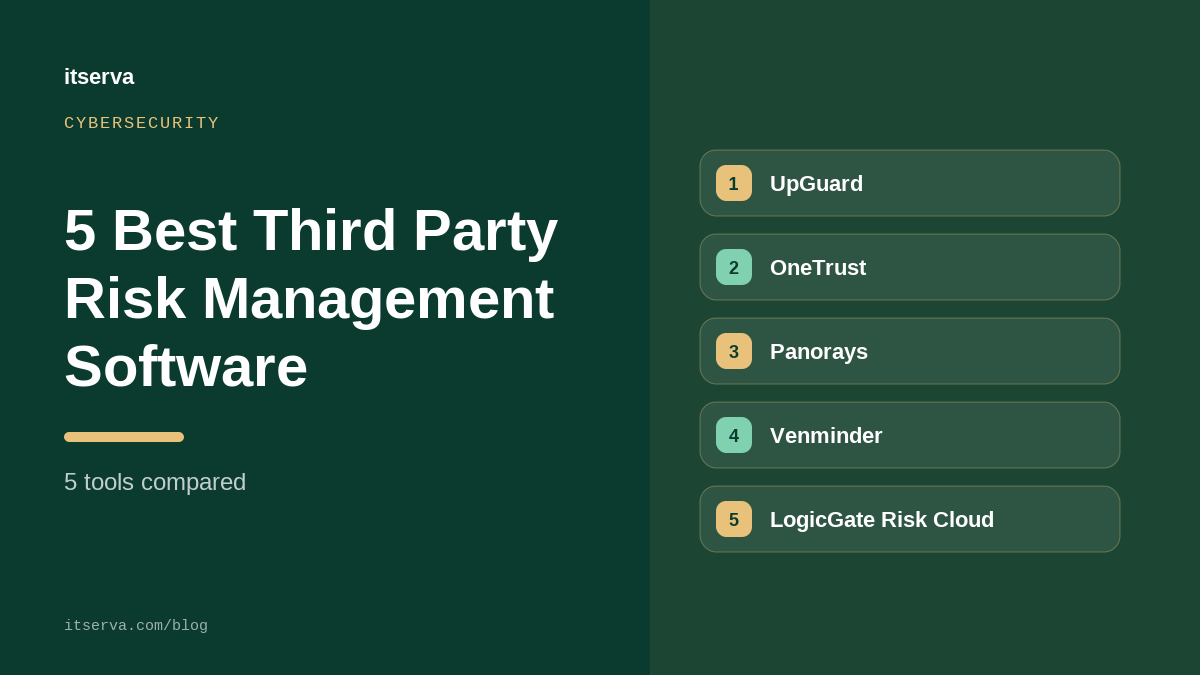
What does third-party risk management software actually do?
Third-party risk management software tracks the vendors, suppliers and partners that can put your business at risk, from onboarding and security questionnaires through continuous monitoring to offboarding. It replaces spreadsheets and email chases with one inventory, risk scores and a record of every assessment.
The category splits into three families that are often confused: full vendor lifecycle platforms, security ratings services that score vendors from outside, and broad GRC suites where vendor risk is one module. Knowing which family you need matters more than comparing feature lists, because each one solves a different problem.
Quick comparison
| Tool | Best for | Starting price | Free plan |
|---|---|---|---|
| UpGuard | Best overall third-party risk platform | $1,750/month (Vendor Risk Standard, billed annually) | Yes (Trust Exchange free plan) |
| OneTrust | Privacy-plus-vendor-risk platform | Custom pricing | No |
| Panorays | Automated vendor assessments | Custom pricing | No (demo available) |
| Venminder | Managed vendor risk services | Custom pricing | No (demo available) |
| LogicGate Risk Cloud | Configurable GRC workflows | Custom pricing | No |
The 5 best third party risk management tools
#1
UpGuard
- Best for
- Best overall third-party risk platform
- Starting price
- $1,750/month (Vendor Risk Standard, billed annually)
- Free plan
- Yes (Trust Exchange free plan)
UpGuard is the most transparent third-party risk platform on this list. Vendor Risk Standard starts at $1,750 per month billed annually and combines security ratings, attack surface monitoring and automated questionnaires in one platform. Trust Exchange, its free plan for sharing security posture with customers and vendors, costs nothing, and higher tiers are priced on request.
The trade-off is the entry price. At $1,750 a month, Vendor Risk Standard is out of reach for small companies, and the Professional, Corporate and Enterprise tiers all need a sales conversation. UpGuard fits mid-market and enterprise teams that want ratings plus questionnaires with published pricing.
What we like
- Only published enterprise price here
- Ratings plus questionnaires in one platform
- Free Trust Exchange plan
- 14-day trial
Watch out for
- $1,750 a month entry price
- Higher tiers are quote-based
- Ratings alone do not replace assessments
#2
OneTrust
- Best for
- Privacy-plus-vendor-risk platform
- Starting price
- Custom pricing
- Free plan
- No
OneTrust is the broadest platform on this list, combining privacy management, data governance, GRC and third-party risk on shared data. Its third-party risk module builds a vendor inventory, automates assessments with out-of-the-box templates or custom questions, and continuously monitors vendors to trigger reassessments. More than 14,000 customers use OneTrust across its products.
The trade-off is weight. Pricing is customized per organization and metered on admin users and the size of the inventory managed, so budgeting needs a sales conversation, and implementations are a significant project. OneTrust fits large organizations that want vendor risk inside a wider trust and governance program.
What we like
- Privacy, GRC and vendor risk on one platform
- Automated assessments with templates
- Continuous monitoring with reassessments
- 14,000-plus customers
Watch out for
- Customized, quote-based pricing
- Steep learning curve
- Implementation is a significant project
#3
Panorays
- Best for
- Automated vendor assessments
- Starting price
- Custom pricing
- Free plan
- No (demo available)
Panorays is the assessment specialist on this list, built to automate the middle of vendor risk: sending questionnaires, chasing responses and validating answers with outside-in scanning. Its pricing is built from three evaluation bundles, Inventory, Assessment and Monitoring, so buyers pick the depth of evaluation each vendor risk profile needs. The Monitoring bundle adds dark web monitoring, cyber alerts and continuous remediation.
The trade-off is that nothing is priced in public. Every bundle is quoted to the buyer's risk strategy and assessment mix, so two buyers can pay very different amounts for the same platform, and the narrowest bundle covers inventory only. Panorays fits security teams drowning in vendor questionnaires that want the assessment work automated.
What we like
- Automated assessment workflows
- Three bundles matched to risk level
- Dark web monitoring on the top bundle
- 4th-party auto discovery
Watch out for
- Quote-based pricing
- Inventory bundle covers little
- Narrower than full GRC suites
#4
Venminder
- Best for
- Managed vendor risk services
- Starting price
- Custom pricing
- Free plan
- No (demo available)
Venminder is the managed-services option on this list, pairing software with analysts who do the assessment work for you. Its Vendiligence service orders due diligence assessments on vendors, with qualified risk ratings and reviews from Venminder experts, while Venmonitor adds real-time monitoring across multiple risk domains. More than 1,200 customers use the platform to run the full vendor lifecycle from onboarding to offboarding.
The trade-off is control and cost. The services model costs more than software alone, pricing is quoted per organization, and handing assessments to outside analysts means less direct control over the process. Venminder fits regulated firms that need a vendor risk program but lack the staff to run one.
What we like
- Analysts run assessments for you
- Full vendor lifecycle coverage
- Real-time monitoring with Venmonitor
- Strong for regulated industries
Watch out for
- Quote-based pricing
- Services model costs more
- Less direct control than DIY tools
#5
LogicGate Risk Cloud
- Best for
- Configurable GRC workflows
- Starting price
- Custom pricing
- Free plan
- No
LogicGate Risk Cloud is the configurable GRC platform on this list, built around no-code workflow design that adapts to your risk processes instead of forcing a vendor template. Third-party risk is one application among several, alongside enterprise risk, cyber risk, controls compliance and AI governance, so vendor risk sits inside a broader customized program. Only Power User licenses are paid; Standard and External users are included at no extra cost.
The trade-off is the effort that flexibility demands. Someone on your team must design the workflows, out-of-the-box vendor-risk content is thinner than the specialists offer, and pricing is quoted per application, so costs grow with each area you add. LogicGate Risk Cloud fits teams with defined processes that off-the-shelf tools do not match.
What we like
- No-code workflow design
- Vendor risk inside a wider GRC program
- Standard and External users included free
- Purpose-built applications per use case
Watch out for
- Quote-based pricing
- Needs internal design effort
- Thinner vendor-risk content than specialists
How we chose
We compared third-party risk management tools that cover vendor onboarding, assessments and continuous monitoring, ranked by overall fit for teams buying their first or next platform. We weighted published pricing first, then lifecycle coverage, then how much of the work the platform automates. Prices come from vendor pricing pages checked in November 2026. Four of the five tools publish no price, so we treated quote-based pricing as a cost and favored the one platform with a public starting price. No vendor paid for placement, and we did not run hands-on tests; we compare published information.
Ratings, lifecycle tools and GRC suites are three different buys
The most common buying mistake in this category is comparing tools from different families as if they were rivals. A security ratings service scores vendors from outside and never runs a questionnaire, while a lifecycle platform manages onboarding to offboarding and a GRC suite treats vendor risk as one module among many. Each answers a different question, so a shortlist that mixes them will produce a winner that solves the wrong problem.
Price transparency is the second trap. Only one tool on this list publishes a starting price, so four out of five purchases begin with a sales conversation and a quote shaped by vendor count, user count and modules. Ask every vendor for the same scope in writing, number of vendors, assessments per year and named users, or the quotes will not be comparable.
How to choose
Start with the family, not the vendor. If you need continuous visibility into vendor security posture, shortlist a ratings service; if you need questionnaires, onboarding and offboarding in one place, shortlist a lifecycle platform; if vendor risk is one workstream in a wider governance program, shortlist a GRC suite.
Next, count your vendors and your assessments. A program with 50 vendors and quarterly assessments needs automation and a clear per-vendor cost, while a program with 500 vendors needs bulk onboarding, tiering by criticality and monitoring that runs without manual effort. Ask each vendor how the quote changes as those numbers grow.
Finally, trial the questionnaire workflow with a real vendor. Check how long an assessment takes from send to signed-off risk rating, whether vendors can answer without creating accounts, and how remediation tasks are tracked when a vendor fails a control.