
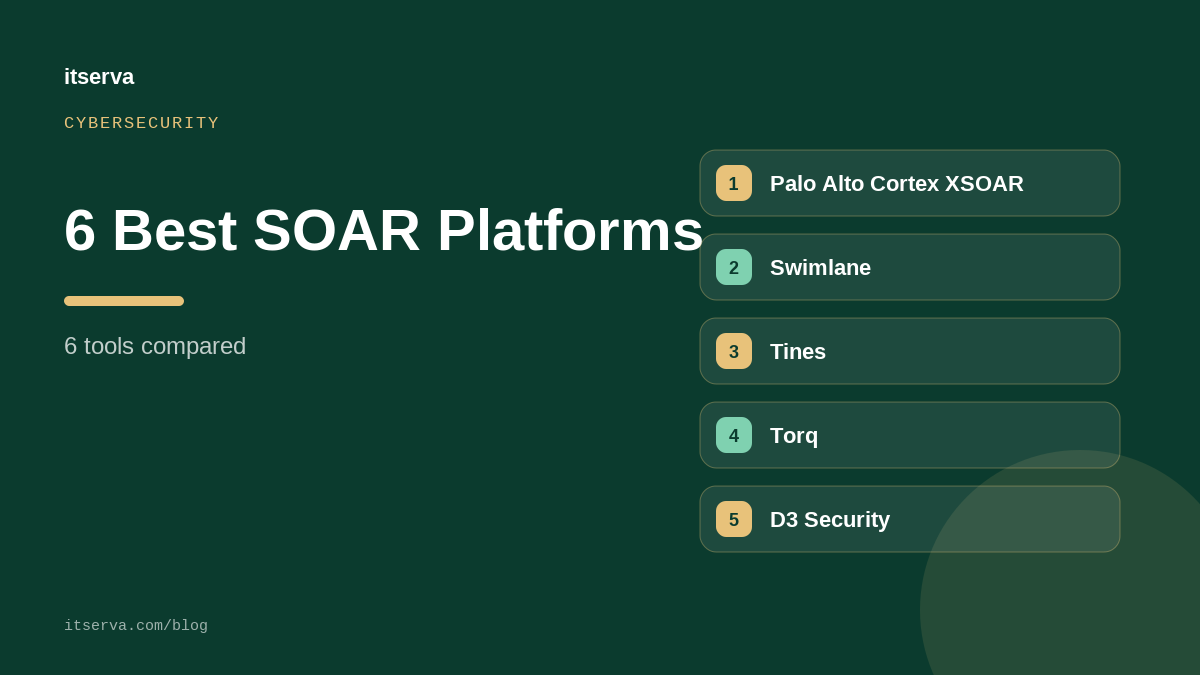
What does a SOAR platform actually automate?
A SOAR platform connects the tools in a security operations centre and runs response playbooks across them. It enriches alerts with threat intelligence, opens tickets, isolates hosts and notifies analysts, so repetitive triage happens in seconds rather than hours.
The category has shifted in 2026 from static playbooks toward AI agents that investigate alerts and propose actions. Pricing has not followed: almost every vendor still sells by quote, sized by seats, alert volume or automated actions.
Quick comparison
| Tool | Best for | Starting price | Free plan |
|---|---|---|---|
| Palo Alto Cortex XSOAR | Best SOAR platform overall | Custom pricing | No |
| Swimlane | Best for volume-based agentic automation | Custom pricing | No |
| Tines | Best no-code automation beyond the SOC | Custom pricing | Yes (free edition, 3 live workflows) |
| Torq | Best for replacing legacy SOAR with AI | Custom pricing | No |
| D3 Security | Best for regulated enterprises needing governed AI | Custom pricing | No |
| Fortinet FortiSOAR | Best for Fortinet shops | Custom pricing | No |
The 6 best SOAR platforms
#1
Palo Alto Cortex XSOAR
- Best for
- Best SOAR platform overall
- Starting price
- Custom pricing
- Free plan
- No
Palo Alto Cortex XSOAR is the most established SOAR platform on this list. It combines playbook automation, case management and threat intelligence in one workspace, with 900+ prebuilt integration and automation packs and thousands of security actions for do-it-yourself playbooks. A visual editor builds playbooks without code, and a virtual war room brings incident data, indicators and chat together for analysts.
The trade-off is the effort needed to run it well. A library of that size needs ongoing maintenance, integrations need care, and full value usually takes dedicated staff plus professional services at the start. Palo Alto Cortex XSOAR fits large SOCs standardising on the Cortex platform that want depth, content and a mature case workflow.
What we like
- 900+ integration and automation packs
- Visual playbook editor
- Virtual war room for investigations
- Threat intelligence built in
Watch out for
- Commercial pricing is quote-only
- Needs dedicated staff to run well
- Implementation takes professional services
#2
Swimlane
- Best for
- Best for volume-based agentic automation
- Starting price
- Custom pricing
- Free plan
- No
Swimlane is an agentic AI automation platform built on its Turbine engine, with five enterprise tiers sized by daily automation volume. Starter allows 50,000 actions a day for 5 users, with 37,500 Hero AI credits a month and 100,000 records retained for a year. Higher tiers rise to 500,000 actions a day, and user-based pricing is available through sales.
The trade-off is that no dollar price is published. Buyers must get a quote sized to daily actions, users and AI credits, and the credit allowance is a separate figure to model alongside actions. Swimlane fits enterprises and MSSPs moving to agentic automation that want volume-based pricing rather than per-seat licences.
What we like
- Action-volume pricing, not per seat
- 50,000 actions a day on Starter
- Hero AI credits included
- Five tiers up to 500,000 actions a day
Watch out for
- No dollar price published
- AI credits are a separate allowance to model
#3
Tines
- Best for
- Best no-code automation beyond the SOC
- Starting price
- Custom pricing
- Free plan
- Yes (free edition, 3 live workflows)
Tines is a no-code automation platform built for security teams that want analysts, not engineers, building workflows. The free edition covers unlimited users, spaces and connectors, with 3 live workflows and a one-time $50 AI allowance. Paid editions add unlimited workflows, flexible deployment and the option to bring your own AI model.
The trade-off is that paid prices are not published. Business and Enterprise editions are sold through the Tines team, so budgeting needs a direct quote, and classic case management is thinner than on the older SOAR platforms. Tines fits security teams that want no-code automation beyond the SOC, from phishing response to access reviews.
What we like
- Free edition with 3 live workflows
- No-code builder analysts can use
- Unlimited users on the free edition
- Works beyond the SOC
Watch out for
- Paid prices not published
- Less classic case management depth
#4
Torq
- Best for
- Best for replacing legacy SOAR with AI
- Starting price
- Custom pricing
- Free plan
- No
Torq is an AI SOC platform built around AI agents that triage, investigate and respond to alerts. Its agents de-duplicate events, filter false positives, chase down answers on prioritised cases and record evidence, timelines and recommended actions. Socrates, its natural-language agent, can remediate critical threats autonomously, with human oversight and a manual override.
The trade-off is that Torq publishes no pricing page. There is no list price, tier table or free plan on its site, so every cost figure comes from a sales conversation that starts with a demo. Torq fits teams replacing legacy SOAR with AI-driven automation that want fast deployment and agent-led triage.
What we like
- AI agents on every workflow
- Socrates agent for autonomous remediation
- Transparent audit logs
- Manual override for analysts
Watch out for
- No pricing page published
- No free plan
#5
D3 Security
- Best for
- Best for regulated enterprises needing governed AI
- Starting price
- Custom pricing
- Free plan
- No
D3 Security is a governed AI SOC platform, sold as Morpheus, with a built-in SOAR engine and case management across 800+ apps. It is priced as a fixed annual subscription tied to a daily alert volume tier of 500 to 10,000 alerts per day, with custom pricing above that tier. All AI token costs are included, with no per-token, per-investigation or metered usage fees inside a tier.
The trade-off is that no dollar rate is published. The structure is clear, but the actual annual figure depends on alert volume and named user licences, so buyers need a quotation, and alerts above a tier are billed at a flat per-alert rate. D3 Security fits regulated enterprises needing governed, auditable AI automation with one audit trail per incident.
What we like
- Fixed annual subscription
- AI token costs included
- 800+ integrations
- One audit trail per incident
Watch out for
- No dollar rate published
- Enterprise sales process
#6
Fortinet FortiSOAR
- Best for
- Best for Fortinet shops
- Starting price
- Custom pricing
- Free plan
- No
Fortinet FortiSOAR is the automation layer of the Fortinet Security Fabric, combining playbook automation with agentic AI. Its fused agentic AI and SOAR automation pair the intelligence of AI with the certainty of playbooks and the controls of a dedicated operations platform. It supports over 700 API connections and MCP-based communications, with solution packs for incident, vulnerability and compliance work.
The trade-off is that no public price exists. Editions, seats, action allowances and support all move the quote, and value is highest inside the Fortinet ecosystem, so teams on other stacks should confirm integration coverage first. Fortinet FortiSOAR fits Fortinet shops that want automation inside the Security Fabric without adding a separate platform.
What we like
- Over 700 API and MCP connections
- Agentic AI with playbook controls
- Incident, vulnerability and compliance packs
- Part of the Fortinet Security Fabric
Watch out for
- No public price
- Best inside the Fortinet ecosystem
How we chose
We compared SOAR platforms that orchestrate security workflows across a SOC tool stack, ranked by fit for large security teams. We weighted playbook depth and integration breadth first, then case management, then how clearly each vendor publishes its pricing. Prices come from vendor pricing and product pages checked in November 2026, and every platform here is sold by quote, with no public dollar price. No vendor paid for placement, and we did not run hands-on tests; we compare published information.
Why SOAR pricing is almost always a quote
No platform on this list publishes a dollar price. Vendors size contracts by analyst seats, daily alert volume or automated actions, and most add professional services for the first deployment.
Ask every vendor for the same written quote: the same playbook count, the same daily action or alert volume, and the same AI usage. Without matched quotes, a lower headline figure can hide a higher total once services and overages are added.
How to choose
Start with the stack you already run. Palo Alto and Fortinet shops get the most from their own vendor's SOAR, while vendor-neutral teams should shortlist Swimlane, Tines, Torq or D3 Security.
Next, count what you will automate. Estimate daily alerts, actions and AI-assisted investigations, then ask each vendor to price that exact volume, including overages and professional services.
Finally, run a proof of concept on your own alerts. Check how fast analysts can build a playbook without vendor help, how cases are tracked, and whether every automated action leaves a clear audit trail.