
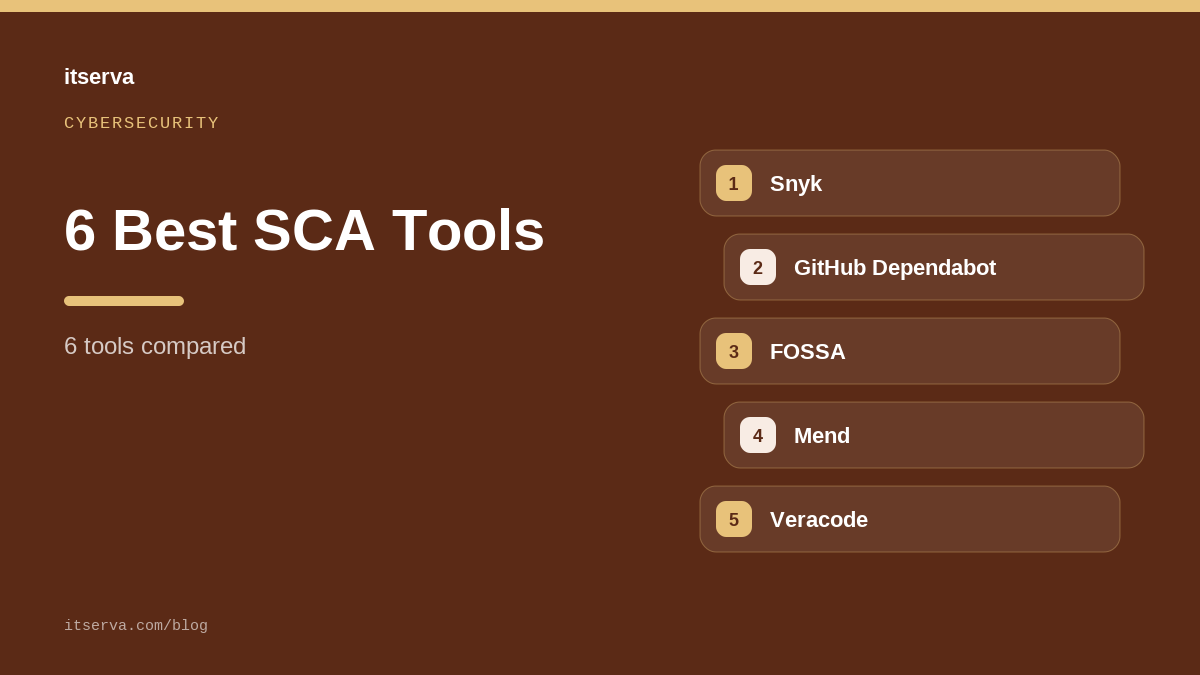
What does an SCA tool actually check?
Software composition analysis, or SCA, scans the open source libraries in your code for known vulnerabilities and license risks. It lists the components you use, flags the ones with published flaws, and shows which licenses apply to each one.
That matters because most modern applications are built largely from open source code. A vulnerability in one shared library can affect many products at once, so SCA belongs in pull requests and CI pipelines, where it can catch a risky update before it reaches production.
Quick comparison
| Tool | Best for | Starting price | Free plan |
|---|---|---|---|
| Snyk | Best SCA tool overall | $25/month (starting price) | Yes (free starting option) |
| GitHub Dependabot | Best free SCA for GitHub teams | Free (included in GitHub Free) | Yes (free) |
| FOSSA | Best SCA for license compliance | $20/project/month (Business, yearly) | Yes (free plan, 5 projects) |
| Mend | Best SCA for automated remediation | Priced per contributing developer (no public starting price) | No free plan listed |
| Veracode | Best SCA inside a full AppSec platform | No public starting price | No free plan listed |
| JFrog Xray | Best SCA for artifact scanning | $950/month (Enterprise X starting price, includes SCA) | No free plan listed |
The 6 best SCA tools
#1
Snyk
- Best for
- Best SCA tool overall
- Starting price
- $25/month (starting price)
- Free plan
- Yes (free starting option)
Snyk is a developer-focused security platform that scans open source dependencies, containers, code, infrastructure as code and secrets for known vulnerabilities. Its pricing page lists a starting price of $25 per month and a free starting option, and its Enterprise plan uses credits that apply across the platform. Open Source scanning is charged at 1.0 credit per active contributor per day, while container scanning is charged at 0.33 credits per monitored image per day.
The trade-off is that the credit model takes time to understand. Teams must track how different capabilities draw from one credit balance, and costs can rise as more contributors and images are added. Snyk fits development teams that want security checks inside pull requests, editors and CI pipelines rather than in a separate reporting tool.
What we like
- Free starting option
- Covers open source, code, containers and infrastructure as code
- Credits work across the whole platform
- Scanning fits into developer workflows
Watch out for
- Credit pricing takes time to model
- Costs grow with contributors and images
- Enterprise pricing needs a sales conversation
#2
GitHub Dependabot
- Best for
- Best free SCA for GitHub teams
- Starting price
- Free (included in GitHub Free)
- Free plan
- Yes (free)
GitHub Dependabot is a free dependency update and vulnerability alert service built into GitHub. GitHub Free costs $0 and includes Dependabot security and version updates, unlimited public and private repositories, and 2,000 CI/CD minutes per month. It monitors dependencies, alerts teams to known vulnerabilities, and opens pull requests that update libraries to fixed versions.
The trade-off is depth and scope. Dependabot covers known vulnerabilities well but offers less license analysis and policy control than a dedicated SCA vendor, and it only works inside GitHub. GitHub Dependabot fits small and mid-size teams that already host code on GitHub and want solid, free vulnerability coverage without buying a separate platform.
What we like
- Free on GitHub Free
- Automatic update pull requests
- Unlimited public and private repositories
- Easy setup for GitHub teams
Watch out for
- License reporting is basic
- Less policy control than dedicated vendors
- Only works inside GitHub
#3
FOSSA
- Best for
- Best SCA for license compliance
- Starting price
- $20/project/month (Business, yearly)
- Free plan
- Yes (free plan, 5 projects)
FOSSA is a software supply chain platform that scans dependencies for license and vulnerability risks and builds software bills of materials. Its Business plan costs $20 per project per month when billed annually, and its Free plan is free forever for up to 5 projects and 10 contributing developers. Business adds automated license and vulnerability scanning, multi-project reporting, unlimited imported SBOMs and priority support.
The trade-off is vulnerability depth at the lower tiers. FOSSA leads on license inventories, attribution notices and policy rules, but its vulnerability scanning is thinner than some developer-focused rivals. FOSSA fits companies whose main worry is open source license compliance and legal review, with vulnerability scanning as a supporting check.
What we like
- Free plan for up to 5 projects
- Strong license scanning and attribution reports
- SBOM exports included
- Business plan from $20 per project per month
Watch out for
- Vulnerability depth trails some rivals
- Business limits are 10 projects and 10 developers
- Enterprise plan is custom priced
#4
Mend
- Best for
- Best SCA for automated remediation
- Starting price
- Priced per contributing developer (no public starting price)
- Free plan
- No free plan listed
Mend is an application security platform whose Mend SCA product manages open source risk and container scanning. Its pricing page prices Mend AppSec per contributing developer, with no limit stated on code size, number of scans or number of applications. Mend SCA includes reachability-aware prioritization, AI-powered fix suggestions and automated dependency updates through Mend Renovate.
The trade-off is that budgeting needs a sales conversation. No starting price is published, and some advanced features sit on higher tiers, so small teams cannot price it from the website alone. Mend fits teams that want automated fixes and fewer noisy alerts in their pipelines rather than a report they must triage by hand.
What we like
- Reachability-aware prioritization
- AI-powered fix suggestions
- Automated dependency pull requests
- No stated limit on scans or applications
Watch out for
- No public starting price
- No free plan listed
- Some advanced features need higher tiers
#5
Veracode
- Best for
- Best SCA inside a full AppSec platform
- Starting price
- No public starting price
- Free plan
- No free plan listed
Veracode is a full application risk management platform that includes software composition analysis alongside static and dynamic testing. Its platform page lists code-to-cloud scanning covering SAST, DAST, SCA, infrastructure as code and container scans, plus AI-powered remediation and integrations with more than 40 tools. Results from different test types sit in one view, which helps security teams report risk in one place.
The trade-off is focus and cost. SCA is one module inside a large platform, so teams that only need SCA may pay for more than they use, and no starting price is published. Veracode fits enterprises that want one vendor for SCA, static analysis and dynamic testing instead of a standalone SCA tool.
What we like
- SCA plus static and dynamic testing in one platform
- AI-powered remediation
- Integrations with more than 40 tools
- Strong reporting in one view
Watch out for
- No public starting price
- SCA is one part of a large platform
- Setup takes planning
#6
JFrog Xray
- Best for
- Best SCA for artifact scanning
- Starting price
- $950/month (Enterprise X starting price, includes SCA)
- Free plan
- No free plan listed
JFrog Xray is an artifact and binary scanning product that checks containers, binaries and build artifacts for vulnerabilities and license issues. It is included in the JFrog Enterprise X plan, which starts at $950 per month and also includes code and binary SCA, JFrog Advanced Security and JFrog Curation. Xray pairs with JFrog Artifactory and can block promotion of risky artifacts to production.
The trade-off is fit and cost. Xray works best inside a JFrog setup, the entry price is high for small teams, and tuning needs JFrog knowledge. JFrog Xray fits teams that already use Artifactory and want artifact-level scanning across the build pipeline.
What we like
- Scans binaries and artifacts, not only source
- Pairs with Artifactory
- Can block risky artifacts from production
- Includes JFrog Advanced Security on Enterprise X
Watch out for
- High starting price at $950 per month
- Best with JFrog Artifactory
- Setup needs JFrog knowledge
How we chose
We compared SCA tools that scan open source dependencies for known vulnerabilities and license risks, ranked by overall fit for development and security teams. We weighted developer workflow fit first, then vulnerability and license coverage, then fix guidance and policy control. Prices come from vendor pricing pages checked in November 2026, and tools without a published starting price are shown that way rather than given an estimated figure. No vendor paid for placement, and we did not run hands-on tests; we compare published information.
Why most SCA prices are not published
Only 3 of the 6 tools on this list publish a clear starting price. Snyk starts at $25 per month, FOSSA Business costs $20 per project per month, and GitHub Dependabot is free, while Mend and Veracode publish no starting price and JFrog Xray is bundled in a $950 per month plan.
That gap matters for budgeting. Ask each vendor for a quote based on the same inputs: number of developers, number of repositories, and number of artifacts scanned. Without matching inputs, two quotes cannot be compared fairly.
How to choose
Start with your stack and your pipeline. List the languages, package managers and repositories you use, then check that each shortlisted tool covers them and runs where you need it, in pull requests, CI or the artifact repository.
Next, trial one tool on a real repository and judge alert quality, not alert volume. Look for reachability analysis and clear fix advice, because a tool that reports every flaw with equal urgency will soon be ignored by developers.
Finally, decide where enforcement belongs and who owns license review. Repository-level policy suits firms that want to block risky components early, while pull request scanning suits teams that prefer developer fixes, and legal review should be part of the trial if you ship commercial software.