
What is RASP, and how is it different from a WAF?
RASP, or runtime application self-protection, runs inside the application itself, so it sees code execution, data flow and user input with full context. A web application firewall sits in front of the app and judges requests from outside, which is why it can miss attacks that only make sense once the code runs.
That inside view lets a RASP agent block exploits such as injection and unsafe deserialization even when no patch exists yet. The trade is deployment effort: every protected application needs an agent, and teams should start in monitor mode before turning on blocking.
Quick comparison
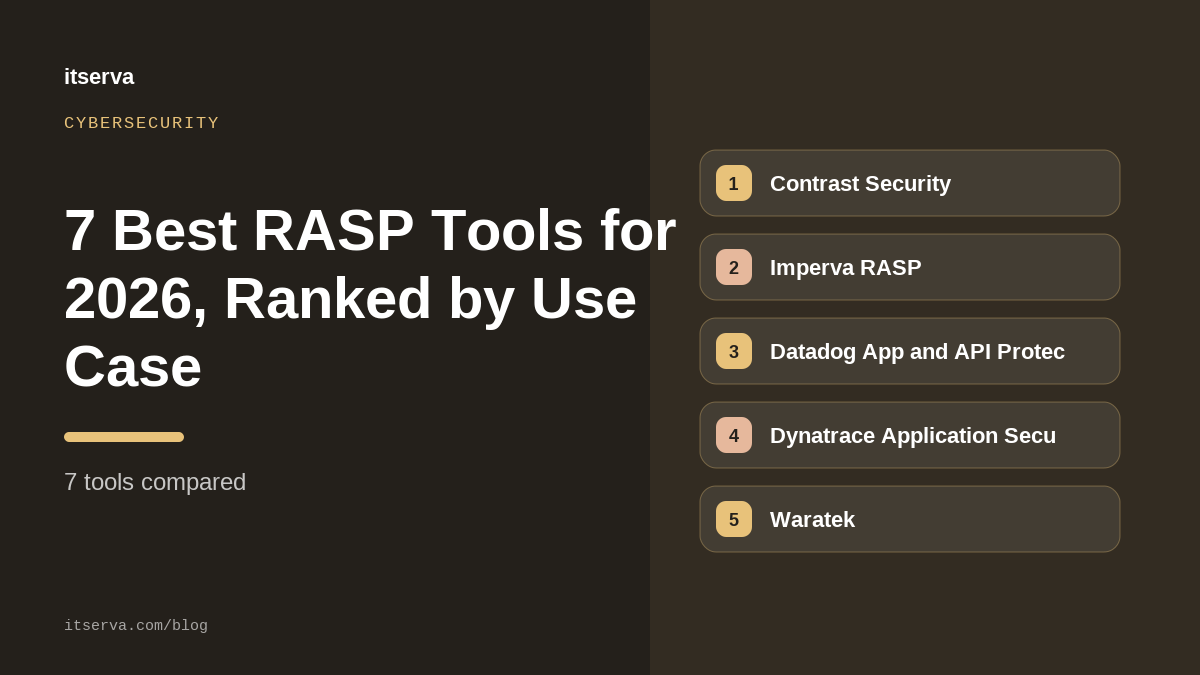
| Tool | Best for | Starting price | Free plan |
|---|---|---|---|
| Contrast Security | Dedicated RASP for enterprises | $750/month (Pro, billed annually) | Yes (free tier, 2 apps) |
| Imperva RASP | Regulated enterprises that need runtime blocking without code changes | Custom pricing | No (30-day free trial) |
| Datadog App and API Protection | Teams already running Datadog APM | $31/host/month (billed annually) | No free plan |
| Dynatrace Application Security | Dynatrace customers adding runtime security | $0.00225 per memory-GiB-hour (Runtime Application Protection) | No free plan |
| Waratek | Java enterprises protecting legacy applications | Custom pricing | Yes (free trial) |
| OpenRASP | Developers and small teams that want free runtime protection | Free (open source) | Yes (open source, free) |
| Guardsquare | Mobile publishers needing app shielding and runtime monitoring | Custom pricing | No free plan |
The 7 best RASP tools
#1
Contrast Security
- Best for
- Dedicated RASP for enterprises
- Starting price
- $750/month (Pro, billed annually)
- Free plan
- Yes (free tier, 2 apps)
Contrast Security is the most dedicated RASP product on this list, built around an agent that runs inside the live application. Its free tier monitors 2 applications and up to 12 services at no cost, with a 14-day history and no credit card required, all in observation mode. Pro costs $750 per month billed annually, covers 8 applications and up to 50 services, and switches on active blocking.
The trade-off is that blocking is not free, and the paid tier is still rolling out. Contrast says Pro will be available soon, Enterprise pricing is a custom quote based on production hosts, and CVE Shield supports Java at launch, with .NET and Python planned next. Contrast Security fits enterprises that want a dedicated runtime agent with developer context for their most important applications.
What we like
- Free tier covers 2 applications at no cost
- Blocking uses live exploit context, not signatures
- Free and Pro tiers share one agent install
- No code changes or restarts after setup
Watch out for
- Pro blocking is not generally available yet
- Enterprise pricing is a custom quote
- Java only at launch for CVE Shield
#2
Imperva RASP
- Best for
- Regulated enterprises that need runtime blocking without code changes
- Starting price
- Custom pricing
- Free plan
- No (30-day free trial)
Imperva RASP is a server-side agent that protects applications from inside, with no code changes from developers. It uses Language Theoretic Security to judge how a payload will execute in context, so it can block known and zero-day attacks without signatures or a learning phase. It also covers third-party libraries and open-source dependencies, and its JSON logs feed SIEM tools.
The trade-off is price transparency. Imperva publishes no RASP price, so buyers must request a quote, and the best value usually comes when RASP sits beside Imperva WAF and API security, which adds stack complexity. Teams should confirm language coverage and agent overhead on a production-like workload first. Imperva RASP fits regulated enterprises that must protect applications they cannot rewrite or patch quickly.
What we like
- No code changes required
- Blocks zero-day attacks without signatures
- No learning phase or rule tuning
- Detailed JSON logs for SIEM tools
Watch out for
- No published price; quote only
- Strongest value inside a wider Imperva stack
- Agent overhead needs testing on real workloads
#3
Datadog App and API Protection
- Best for
- Teams already running Datadog APM
- Starting price
- $31/host/month (billed annually)
- Free plan
- No free plan
Datadog App and API Protection is the runtime security add-on for teams that already run Datadog. It costs $31 per AAP host per month on annual billing, or $36 month to month, with Fargate at $2 per task per month and serverless at $10 per 1 million traced invocations. The per-host model is simple to forecast, but AAP is billed separately from infrastructure monitoring and APM, so buyers should total the full Datadog bill.
The trade-off is that blocking depth varies by language and setup, and the bill grows with every Datadog product added to the same hosts. Buyers should count protected hosts carefully and confirm blocking support for each language before promising coverage. Datadog App and API Protection fits teams that already run Datadog APM and want runtime security in the same agent.
What we like
- Published per-host pricing
- Annual billing cuts the host rate to $31
- Fargate and serverless rates published
- Runs on the Datadog platform teams already operate
Watch out for
- No free plan
- Billed separately from infrastructure and APM
- Blocking depth varies by language
#4
Dynatrace Application Security
- Best for
- Dynatrace customers adding runtime security
- Starting price
- $0.00225 per memory-GiB-hour (Runtime Application Protection)
- Free plan
- No free plan
Dynatrace Application Security is the runtime security capability of the Dynatrace platform, priced from its public rate card rather than named plans. Runtime Application Protection costs $0.00225 per memory-GiB-hour, the same rate as Runtime Vulnerability Analytics, while Security Posture Management costs $0.007 per host-hour. Dynatrace describes its pricing as hourly, with no surprises and no high-water mark.
The trade-off is that security is only one line on a platform bill. Teams without Dynatrace should compare the full platform cost with a dedicated RASP tool before choosing it for security alone, and the per-GiB-hour math needs a host memory count to forecast. Dynatrace Application Security fits Dynatrace customers who want runtime security from the agent they already run.
What we like
- Published hourly rate card
- Protection and vulnerability analytics share one rate
- Posture management priced separately per host
- Hourly billing with no high-water mark
Watch out for
- No free plan
- Security value is strongest inside Dynatrace
- Per-GiB-hour math needs host memory counts
#5
Waratek
- Best for
- Java enterprises protecting legacy applications
- Starting price
- Custom pricing
- Free plan
- Yes (free trial)
Waratek is a compiler-based RASP and IAST platform for Java and .NET runtimes, built for applications that cannot be rewritten. Its RASP cover is priced per app and agent, with volume pricing on request, while its IAST Team plan costs $2,499 per month plus $833 per additional application. Waratek blocks common CWEs and known exploits at runtime and remediates Java 6+ and .NET Core CVEs scored 7.0 or higher, with no tuning, downtime or code changes.
The trade-off is language scope and sales process. Waratek is Java focused, so polyglot estates need another tool alongside it, and RASP pricing is quote based, priced per app and agent. Buyers should run a proof of concept on their exact Java versions and frameworks before committing. Waratek fits Java enterprises protecting legacy or hard-to-patch applications.
What we like
- Protects apps that cannot be rewritten
- Virtual patching without code changes
- Free trial on the Starter IAST plan
- Covers Java 6+ and .NET Core CVEs
Watch out for
- RASP pricing is quote based
- Java focused; polyglot estates need more
- Enterprise IAST is custom priced
#6
OpenRASP
- Best for
- Developers and small teams that want free runtime protection
- Starting price
- Free (open source)
- Free plan
- Yes (open source, free)
OpenRASP is an open-source RASP solution from Baidu that integrates its protection engine directly into the application server by instrumentation. It monitors database queries, file operations and network requests, and can block attacks such as SQL injection and deserialization exploits. Agents cover Java and PHP, with tested support for Tomcat 6 to 9 and Spring Boot 1 and 2, plus a management console.
The trade-off is support and staying power. OpenRASP needs someone on your team to deploy, update and tune it, and there is no vendor service level agreement behind it. Coverage is also narrower than commercial tools, so check compatibility before planning a rollout. OpenRASP fits developers and small teams that want free runtime protection for non-critical applications.
What we like
- Free and open source
- Agent-based protection for Java and PHP
- Rules can be inspected and adjusted
- Good way to prove the value of RASP
Watch out for
- Community support rather than vendor support
- Narrower language and framework coverage
- No service level agreement
#7
Guardsquare
- Best for
- Mobile publishers needing app shielding and runtime monitoring
- Starting price
- Custom pricing
- Free plan
- No free plan
Guardsquare is a mobile application security platform built around DexGuard for Android and iXGuard for iOS, with AppSweep for testing and ThreatCast for real-time threat monitoring. Its plans run in three tiers, Core, Control and Command, and pricing is by request rather than published. Guardsquare says more than 900 customers worldwide rely on its platform to protect mobile apps and SDKs.
The trade-off is scope and price clarity. Guardsquare protects mobile apps only, so web and API estates need a separate tool, and buyers must go through sales to learn what a tier costs for their app count. Hardening can also affect debugging, crash reporting and app size, so trial it in a staging build first. Guardsquare fits mobile publishers that need app shielding plus runtime threat monitoring.
What we like
- Code hardening and obfuscation for Android and iOS
- Runtime threat monitoring with ThreatCast
- AppSweep testing in the same platform
- More than 900 customers worldwide
Watch out for
- Mobile only coverage
- Pricing is quote based
- Hardening can affect debugging and app size
How we chose
We compared RASP tools that protect applications from inside the runtime, covering server-side agents, Java specialists, an open-source option and mobile shielding. We weighted dedicated runtime protection first, then language coverage, then price transparency. Prices come from vendor pricing pages checked in November 2026, and quote-based tools are labelled Custom pricing rather than given an invented figure. Free plans and trials are noted where the vendor publishes them. No vendor paid for placement, and we did not run hands-on tests; we compare published information.
Quote-based pricing: how to compare RASP tools fairly
Most dedicated RASP tools do not publish a price, so headline comparisons mislead. Ask every vendor for a quote on the same basis: the same applications, the same host or JVM count, and the same blocking mode, and ask whether professional services and onboarding are included.
Also ask what happens after year one. Some quotes bundle the agent, console and support, while others charge services separately, and per-application pricing can grow fast when a team protects dozens of small services instead of a few large ones.
How to choose
Start with your application estate, not the vendor list. Java-only shops should shortlist Waratek, mobile publishers should shortlist Guardsquare, and teams already on Datadog or Dynatrace should price the runtime add-on before buying a separate agent.
Next, run a pilot in monitor mode on one or two real applications. Measure false positives, check the performance overhead on production-like traffic, and confirm blocking works for each language you run before you promise coverage to the business.
Finally, get quotes on identical terms. Compare per-application and per-host costs, ask what onboarding and support cost, and confirm what happens when an application is added mid-contract, so the cheapest first quote does not become the most expensive rollout.