
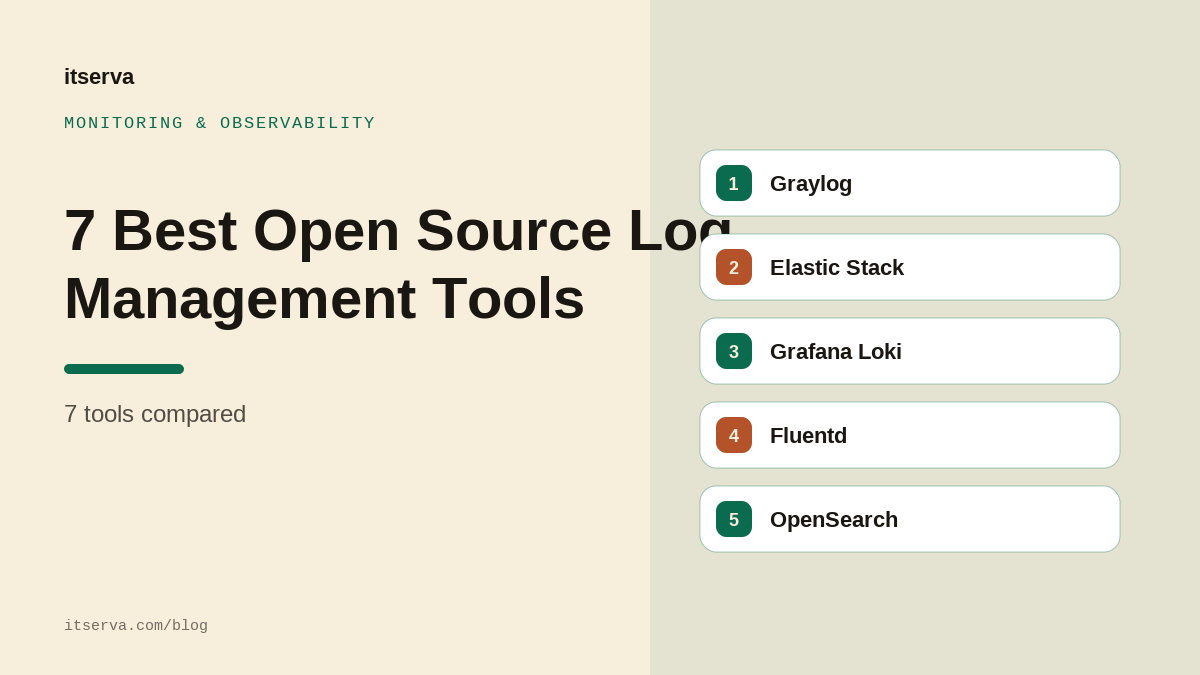
What counts as an open source log management tool?
An open source log management tool collects logs from your systems, stores them, and lets you search, alert and build dashboards on them, with the source code available to download and run yourself. The real difference from SaaS log platforms is where the bill lands: the software is free, but you pay for servers, storage and the engineer who keeps the cluster healthy.
Licenses matter too. Some tools here are fully open source under Apache 2.0 or AGPL, while others, such as Graylog Open and Elasticsearch, are source-available under the Server Side Public License, which restricts offering them as a managed service. Check the license before you build a product on top of one.
Quick comparison
| Tool | Best for | Starting price | Free plan |
|---|---|---|---|
| Graylog | Best open source log platform overall | Free (Graylog Open); paid annual licenses from 10 GB/day | Yes (Graylog Open, no ingest cap) |
| Elastic Stack | Best log search ecosystem | Free (self-managed); Elastic Cloud usage-based | Yes (self-managed) |
| Grafana Loki | Best for Kubernetes teams on Grafana | Free (open source); Grafana Cloud from $0.05/GB | Yes (open source; Grafana Cloud free tier 50 GB/month) |
| Fluentd | Best log collection and routing | Free (open source) | Yes |
| OpenSearch | Best fully open source Elasticsearch alternative | Free (Apache 2.0) | Yes |
| SigNoz | Best logs, metrics and traces in one place | $49/month (Cloud Teams, includes $49 usage) | Yes (self-hosted Community Edition) |
| Wazuh | Best open source SIEM with log management | Free (open source) | Yes (plus Wazuh Cloud free trial) |
The 7 best open source log management tools
#1
Graylog
- Best for
- Best open source log platform overall
- Starting price
- Free (Graylog Open); paid annual licenses from 10 GB/day
- Free plan
- Yes (Graylog Open, no ingest cap)
Graylog is the most complete open source log platform on this list, covering collection, parsing, search, dashboards, alerting and reporting in one system. Graylog Open is free permanently, with no daily ingest cap and no volume limit, and it is licensed under the Server Side Public License. The paid Enterprise tier adds data tiering and access controls, while Graylog Security adds SIEM detection content, anomaly detection and risk scoring.
The trade-off is the split between the open edition and the paid tiers. Advanced correlation, maintained detection content and some compliance features sit behind paid licenses, which are annual subscriptions starting at 10 GB per day or 100 Graylog Consumption Units. Graylog fits teams that want a full log platform and built-in SIEM without paying per gigabyte.
What we like
- Complete pipeline from collection to alerting
- Graylog Open is free with no ingest cap
- Built-in SIEM in the Security tier
- Licensed by processed volume, not device count
Watch out for
- Advanced features sit in paid tiers
- No published dollar prices for paid licenses
- Large estates need careful cluster design
#2
Elastic Stack
- Best for
- Best log search ecosystem
- Starting price
- Free (self-managed); Elastic Cloud usage-based
- Free plan
- Yes (self-managed)
Elastic Stack is the combination of Elasticsearch, Logstash or Beats for collection, and Kibana for search and dashboards. The self-managed stack is free to download, and the same platform stretches from operational logs to security monitoring with Elastic Security. Elastic Cloud adds hosted and serverless options with usage-based pricing, plus a 99.95% monthly uptime SLA on the Platinum and Enterprise tiers.
The trade-off is licensing and appetite for hardware. Since 2021 Elasticsearch has shipped under the Server Side Public License and the Elastic License, which are source-available rather than OSI-approved open source, and running it well needs real memory and disk. Elastic Stack fits organizations that want the largest log search ecosystem and can staff a cluster.
What we like
- Unmatched full-text search
- Largest ecosystem of integrations and talent
- Kibana dashboards and Elastic Security included
- Hosted and serverless cloud options
Watch out for
- Source-available license, not OSI open source
- Resource-hungry at scale
- License restricts managed-service use
#3
Grafana Loki
- Best for
- Best for Kubernetes teams on Grafana
- Starting price
- Free (open source); Grafana Cloud from $0.05/GB
- Free plan
- Yes (open source; Grafana Cloud free tier 50 GB/month)
Grafana Loki is a log aggregation system built for teams that already live in Grafana and Prometheus. Instead of indexing every word, Loki indexes metadata labels and compresses the log chunks, which keeps storage costs low. The open source project is free, and Grafana Cloud offers a free tier with 50 GB of logs ingested per month and 14 days of retention.
The trade-off is the query model. Loki answers label-based questions such as logs for one service in one namespace quickly, but it is weaker at ad-hoc full-text search across every log line ever written. Grafana Loki fits Kubernetes and cloud-native teams that already use Grafana dashboards and Prometheus labels.
What we like
- Label indexing keeps storage costs low
- Native fit with Grafana and Prometheus
- Free tier with 50 GB of logs per month
- AGPL open source with a large community
Watch out for
- Weaker for ad-hoc full-text search
- High-cardinality labels can hurt performance
- Paid cloud pricing is usage-based and complex
#4
Fluentd
- Best for
- Best log collection and routing
- Starting price
- Free (open source)
- Free plan
- Yes
Fluentd is an open source data collector that moves logs from servers, containers and applications into one unified pipeline. Its 500-plus plugins connect nearly any source to nearly any destination, and its largest user collects logs from more than 50,000 servers. Fluentd is a Cloud Native Computing Foundation project and is free to download and run.
The trade-off is that Fluentd stores and searches nothing. It is the collector and router, so you still need a backend such as Graylog, OpenSearch, Loki or Elasticsearch for storage, search and dashboards. Fluentd fits teams standardizing collection across a messy estate that want to swap backends later without touching every application.
What we like
- 500-plus plugins for sources and outputs
- CNCF project with a long production record
- Decouples collection from storage
- Free with no license cost
Watch out for
- Collector only, not a search or dashboard tool
- Configuration has a learning curve
- Needs a separate storage backend
#5
OpenSearch
- Best for
- Best fully open source Elasticsearch alternative
- Starting price
- Free (Apache 2.0)
- Free plan
- Yes
OpenSearch is the open source search and observability engine created as a fork of Elasticsearch, now governed by the OpenSearch Software Foundation under the Linux Foundation. It is fully Apache 2.0 licensed from ingest to dashboard, and it includes security analytics and observability features. Its Elasticsearch-compatible APIs make migration from Elasticsearch deliberately straightforward.
The trade-off is ecosystem size. Elasticsearch still has more integrations, more documentation and more engineers who know it, while some newer Elastic features have no OpenSearch equivalent. OpenSearch fits teams that need Elasticsearch-style search under a true open source license or that want alignment with AWS.
What we like
- Fully Apache 2.0 licensed
- Elasticsearch-compatible APIs ease migration
- Linux Foundation governance
- Security analytics built in
Watch out for
- Smaller ecosystem than Elasticsearch
- Some newer Elastic features have no equivalent
#6
SigNoz
- Best for
- Best logs, metrics and traces in one place
- Starting price
- $49/month (Cloud Teams, includes $49 usage)
- Free plan
- Yes (self-hosted Community Edition)
SigNoz is an open source observability platform that puts logs, metrics and traces in one interface, built on OpenTelemetry ingestion and ClickHouse storage. The self-hosted Community Edition is free, while SigNoz Cloud Teams starts at $49 per month and includes $49 of usage, with logs billed at $0.30 per GB beyond that. There is no per-seat or per-host pricing on the cloud plan.
The trade-off is maturity. SigNoz is a newer project than Graylog or Elasticsearch, so its integration catalog is thinner and the self-hosted route means operating ClickHouse yourself. SigNoz fits teams standardizing on OpenTelemetry that want logs, traces and metrics in one queryable place.
What we like
- One UI for logs, traces and metrics
- OpenTelemetry-native ingestion
- No per-seat or per-host pricing
- Self-hosted edition is free
Watch out for
- Newer project with a thinner integration catalog
- Self-hosting means operating ClickHouse
- Enterprise starts at $4,000 per month
#7
Wazuh
- Best for
- Best open source SIEM with log management
- Starting price
- Free (open source)
- Free plan
- Yes (plus Wazuh Cloud free trial)
Wazuh is a free open source SIEM and XDR platform that collects logs from endpoints and cloud workloads, correlates them against threat detections and adds active response. It is used by more than 100,000 enterprises and protects more than 15 million endpoints, according to its own homepage. A managed Wazuh Cloud option is available, with a free trial.
The trade-off is perspective. Wazuh thinks like a security operations tool, so developers tracing a latency spike will find its observability experience less polished than Grafana or SigNoz, and tuning detection rules takes security expertise. Wazuh fits security teams that need SIEM, intrusion detection and log management without a six-figure license.
What we like
- Free open source SIEM and XDR
- Log collection with detection and response
- More than 15 million protected endpoints
- Managed Wazuh Cloud option available
Watch out for
- Security-first design, less polished for ops logs
- Detection tuning takes security expertise
How we chose
We compared seven open source log management tools that cover collection, storage, search and alerting, ranked by overall fit for teams that want to run their own logs. We weighted completeness of the log pipeline first, then license openness, then the real cost of running the tool at scale. Prices come from vendor pricing pages and project homepages checked in November 2026, and self-hosted editions are free unless stated otherwise. No vendor paid for placement, and we did not run hands-on tests; we compare published information.
The real cost of free log software
Every tool on this list is free to download, and every one of them will send you an infrastructure bill. Log costs are driven by daily ingestion volume, index storage and retention period: a team generating 100 GB a day that keeps a year of logs stores about 36 TB before replication.
Measure your daily volume in GB and set a retention policy before you choose, such as 30 days hot and a year cold. If nobody on your team wants to own upgrades, index tuning and the 3 a.m. page, a managed cloud tier such as SigNoz Cloud or Grafana Cloud may cost less than the outage.
How to choose
Start with your main use case. Teams that need a complete log platform with built-in SIEM should shortlist Graylog or Wazuh, Kubernetes teams already on Grafana should start with Loki, and teams standardizing on OpenTelemetry should look at SigNoz first.
Next, check the license against your plans. If you might resell or embed the tool, Apache 2.0 options such as OpenSearch and Fluentd are the safest, while the Server Side Public License on Graylog Open and Elasticsearch restricts managed-service use.
Finally, price the infrastructure, not the software. Estimate daily GB, multiply by retention days, and add the engineer's time for upgrades and tuning before you compare the free software against a managed cloud tier.