
What is a bug bounty platform, and how does it charge?
A bug bounty platform invites vetted security researchers to test your websites, apps and APIs, then routes their reports through triage so your team sees valid findings first. A vulnerability disclosure program is the simpler starting point: it gives researchers a safe channel to report flaws without a cash reward.
Most commercial platforms in this category do not publish a price. You pay a platform fee plus the bounties you award for valid findings, so the total depends on scope, reward levels and report volume. That is why a quote, a private program and a clear scope matter more than a headline price.
Quick comparison
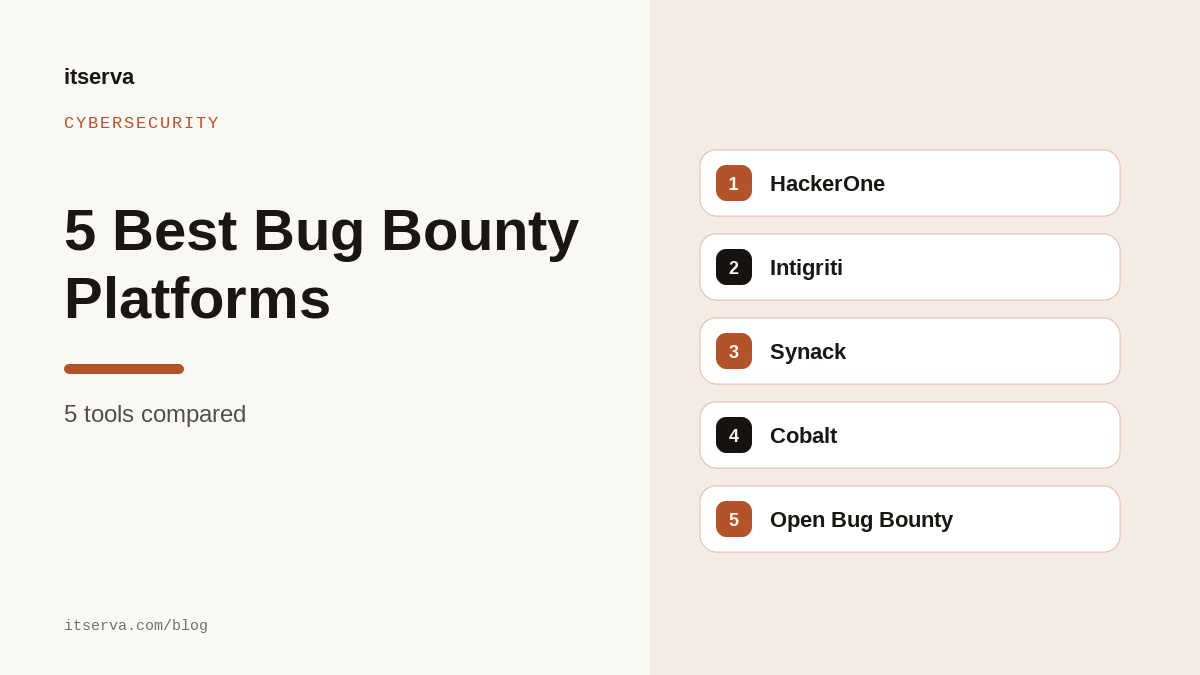
| Tool | Best for | Starting price | Free plan |
|---|---|---|---|
| HackerOne | Best bug bounty platform overall | Custom pricing | No |
| Intigriti | Best pay-for-results bug bounty platform | Custom pricing | No |
| Synack | Best continuous pentesting platform | Custom pricing | No |
| Cobalt | Best pentesting platform for compliance needs | Custom pricing | No |
| Open Bug Bounty | Best free coordinated disclosure option | Free | Yes |
The 5 best bug bounty platforms
#1
HackerOne
- Best for
- Best bug bounty platform overall
- Starting price
- Custom pricing
- Free plan
- No
HackerOne is a bug bounty platform with more than 1,300 enterprise customers and 40% of the Fortune 50 among its users. Its Professional tier includes an always-on vulnerability disclosure program, asset inventory and discovery, AI-assisted validation, real-time dashboards and up to 5,000 automations a month. Enterprise adds proactive alerts, executive reporting, benchmarking and unlimited automations.
The trade-off is that HackerOne publishes no price and expects a sales conversation, so budgeting takes a quote and a defined scope. Report volume can also be high, which means your team needs capacity to fix and retest findings at pace. HackerOne fits large companies that want a full exposure-management platform with AI-assisted validation.
What we like
- Elite researcher community
- Always-on disclosure on Professional
- AI-assisted validation and prioritization
- Up to 5,000 automations a month
Watch out for
- No published price; quote required
- High report volume needs internal capacity
- Enterprise features sit on higher tiers
#2
Intigriti
- Best for
- Best pay-for-results bug bounty platform
- Starting price
- Custom pricing
- Free plan
- No
Intigriti is a bug bounty platform built around pay-for-validated-findings pricing, so you pay for vulnerabilities its triage team confirms rather than for time spent looking. Its Core package covers private and public bug bounty programs, a vulnerability disclosure program, attack surface mapping and tailored researcher matching. Native Slack and Jira integrations, single sign-on and a researcher VPN are included.
The trade-off is that Intigriti publishes no prices, so Core, Premium and Enterprise all need a request for pricing and a discussion of scope. Premium is described as its most popular package, so buyers still need to compare Core against Premium before choosing. Intigriti fits teams that want pay-for-results pricing, a disclosure program and pentesting from one supplier.
What we like
- Pay only for validated vulnerabilities
- Bug bounty, disclosure and pentesting in one place
- Tailored researcher matching
- Slack and Jira integrations
Watch out for
- No published prices
- No free plan or trial shown on the pricing page
#3
Synack
- Best for
- Best continuous pentesting platform
- Starting price
- Custom pricing
- Free plan
- No
Synack is a continuous pentesting platform rather than an open bug bounty crowd, and it connects customers to its vetted Synack Red Team researchers through one platform. Testing is bought with credits, and any Synack product except the platform subscription can be bought that way, from a continuous Synack365 pentest to a one-off test for a specific CVE. The platform subscription covers access to findings, coverage analytics, patch verification and retesting.
The trade-off is that Synack publishes no dollar price, so credits and the platform subscription both need a sales quote. Credits also expire 1 year after purchase, which rewards teams that plan testing across the year rather than buying in a rush. Synack fits mid-size and large companies that want continuous testing from vetted testers on a regular schedule.
What we like
- Vetted Red Team researchers
- Continuous pentesting, not one-off tests
- Flexible credits across test types
- Retesting and patch verification included
Watch out for
- No published price
- Credits expire after 1 year
- No open bounty crowd
#4
Cobalt
- Best for
- Best pentesting platform for compliance needs
- Starting price
- Custom pricing
- Free plan
- No
Cobalt is a pentesting platform built around an on-demand consumption model, with Standard, Premium and Enterprise packages for teams that need a scheduled test. Findings arrive with recommended fixes, testers collaborate with your team in real time through Slack and the platform, and retesting is free. Native Jira and GitHub integrations, customizable reports and an insights dashboard are also included.
The trade-off is that Cobalt publishes no prices, so each package needs a quote based on scope and testing frequency. It is also primarily scheduled, expert-led testing rather than an always-on bounty crowd, so coverage between tests is thinner. Cobalt fits growing companies that need a scheduled pentest for a compliance need, with direct access to the testers.
What we like
- Real-time collaboration with testers
- Free retesting
- Findings include recommended fixes
- Jira and GitHub integrations
Watch out for
- No published prices
- Scheduled testing, not continuous bounty coverage
- Start times vary by test type
#5
Open Bug Bounty
- Best for
- Best free coordinated disclosure option
- Starting price
- Free
- Free plan
- Yes
Open Bug Bounty is a free coordinated vulnerability disclosure project, not a commercial bounty platform, and it gives researchers a channel to report website flaws to operators at no charge. Researchers submit reports, the project coordinates disclosure, and site operators are notified so they can fix the issue. Its homepage lists open programs and recent disclosures from a wide range of organizations.
The trade-off is that Open Bug Bounty pays no bounties and offers no managed triage, scope control or guaranteed response time, so it cannot replace a commercial program. Report quality also varies, because anyone can submit a flaw and operators decide how to act. Open Bug Bounty fits small teams and website owners that want a free disclosure channel while they build a formal security program.
What we like
- Free to use
- Coordinated disclosure for any website
- Open programs listed on the homepage
- No sales process
Watch out for
- No cash bounties
- No managed triage or scope control
- Report quality varies
How we chose
We compared bug bounty and pentesting platforms that run researcher-led programs, disclosure channels or continuous testing, and ranked them by fit for different team sizes and needs. We weighted researcher quality and triage first, then program flexibility, then total cost for a typical first program. Prices come from vendor pricing pages checked in November 2026, and every commercial platform here uses custom, quote-based pricing. No vendor paid for placement, and we did not run hands-on tests; we compare published information.
Why most bug bounty prices are custom, not listed
A bounty program has two costs that move independently: the platform fee and the bounties themselves. Reward levels depend on severity, asset value and how attractive your program is to researchers, so a vendor cannot publish one price that fits a startup and a bank. Ask for the platform fee, the expected bounty budget for your scope and any triage or retesting charges before you sign.
A second trap is scope. A wide public scope brings more reports, including duplicates and low-severity issues, while a narrow private scope brings fewer, higher-quality reports. Start private, set clear rules for in-scope assets and out-of-scope findings, and expand only after your team can fix and retest at the pace reports arrive.
How to choose
Start with your goal, not the platform. If you need a compliance pentest, shortlist Cobalt or Synack; if you need continuous crowd coverage, shortlist HackerOne or Intigriti; if you only need a disclosure channel, start with Open Bug Bounty.
Next, ask each vendor for the same quote in writing: platform fee, triage included, bounty budget guidance, retesting terms and contract length. Compare those totals for a realistic first year, not a single test, and check whether credits expire or roll over.
Finally, run a private program first. Invite a small group of researchers, fix the first findings, test your triage workflow and then widen the scope. A public launch before your team can keep up creates a backlog that researchers notice quickly.