
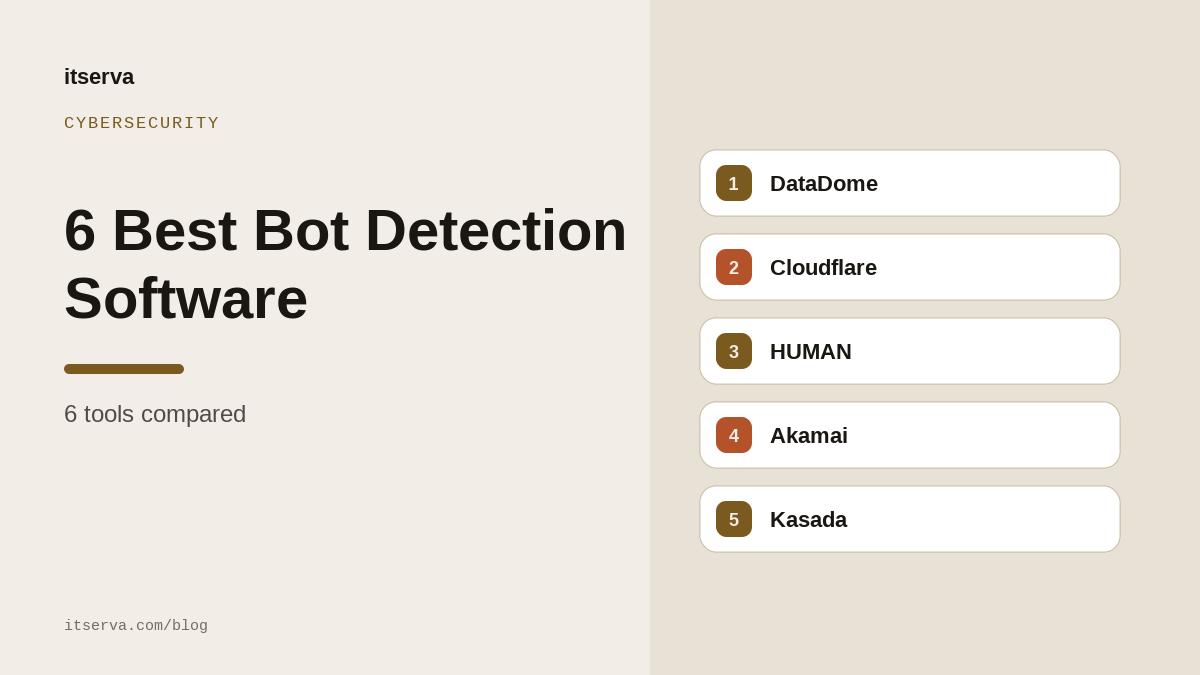
What does bot detection software actually do?
Bot detection software separates real visitors from automated traffic before that traffic reaches your login, checkout or API. It looks for signs of scraping, credential stuffing, fake account creation and ad fraud, then allows, challenges or blocks each request in real time.
The main choice is architectural. Some tools sit at the edge with a CDN, some work as a dedicated platform across web, mobile and APIs, and some detect bots server-side without code on your pages. Price follows that choice, and most vendors in this category sell by quote rather than by a public plan.
Quick comparison
| Tool | Best for | Starting price | Free plan |
|---|---|---|---|
| DataDome | Dedicated bot defense for web, mobile and APIs | $3,830/month (Essentials) | No |
| Cloudflare | Free starting point for teams already on Cloudflare | $0/month (Free plan) | Yes ($0 Free plan) |
| HUMAN | Bot defense plus fraud protection for enterprises | Custom pricing | No |
| Akamai | Bot management for enterprises on Akamai's edge | Custom pricing | No |
| Kasada | Invisible bot defense without CAPTCHAs | Custom pricing | No (demo on request) |
| Netacea | Tailored bot detection for high-traffic sites | Custom pricing | No |
The 6 best bot detection software
#1
DataDome
- Best for
- Dedicated bot defense for web, mobile and APIs
- Starting price
- $3,830/month (Essentials)
- Free plan
- No
DataDome is a dedicated bot and fraud protection platform with published pricing, which is rare in this category. Essentials starts at $3,830 per month for websites and web APIs, with AI-powered bot and fraud protection, a general endpoint AI detection model, pre-built integrations and 99.9% availability. Advanced adds mobile apps and APIs at $8,670 per month, while Premium reaches $10,160 per month.
The trade-off is the entry cost and the volume-based model. Pricing is set by event volume per month, so a high-traffic site pays more than the headline plan suggests, and the fullest protection sits on Enterprise from $13,270 per month. DataDome fits mid-market and enterprise teams whose bots threaten revenue through scraping, credential stuffing or fake accounts.
What we like
- Published pricing with four clear tiers
- Covers websites, mobile apps and APIs
- 99.9% availability on every plan
- Endpoint-specific AI detection on Advanced
Watch out for
- Essentials starts at $3,830 per month
- Pricing scales with event volume
- No free plan
#2
Cloudflare
- Best for
- Free starting point for teams already on Cloudflare
- Starting price
- $0/month (Free plan)
- Free plan
- Yes ($0 Free plan)
Cloudflare is the only tool here with a usable free plan, and that makes it the natural starting point. The Free plan costs $0 per month, Pro costs $20 per month billed annually or $25 billed monthly, and Business costs $200 per month billed annually or $250 billed monthly. Every plan includes unmetered DDoS protection, a CDN and a web application firewall, so basic protection arrives with infrastructure many teams already use.
The trade-off is depth on lower plans. The most advanced bot controls sit on the Contract plan, which is custom priced and billed annually, so a team on Free, Pro or Business gets a blunter tool than an enterprise buyer. Cloudflare fits teams already on its network that want solid baseline protection without adding a new vendor.
What we like
- Free plan at $0 per month
- No extra deployment for existing users
- Unmetered DDoS protection on all plans
- WAF and CDN included
Watch out for
- Advanced bot controls need the custom Contract plan
- Business plan costs $200 per month billed annually
- No dedicated bot-only plan
#3
HUMAN
- Best for
- Bot defense plus fraud protection for enterprises
- Starting price
- Custom pricing
- Free plan
- No
HUMAN is a unified platform for bot defense, fraud prevention and ad fraud protection, rather than a single-purpose bot tool. Its Decision Engine examines 2,500-plus signals per interaction, using 400-plus algorithms and adaptive machine-learning models, and it verifies more than 20 trillion digital interactions weekly across 3 billion unique devices. Its Satori threat research team tracks new attack methods as they emerge.
The trade-off is the buying process. HUMAN publishes no starting price, so every deal runs through sales with a quote, and evaluation is a proof of concept rather than a self-serve trial. HUMAN fits large enterprises that want one vendor across bot management, account abuse and advertising fraud.
What we like
- 2,500-plus signals examined per interaction
- Covers bots, fraud and ad abuse in one platform
- Large Satori threat research team
- Named a Leader in the Forrester Wave Q2 2026
Watch out for
- Custom pricing only, with no published starting price
- Sales-led evaluation, no self-serve trial
- Enterprise scale and budget needed
#4
Akamai
- Best for
- Bot management for enterprises on Akamai's edge
- Starting price
- Custom pricing
- Free plan
- No
Akamai is an edge platform whose bot management runs alongside its CDN, web application firewall and DDoS protection. Its pricing page asks buyers to describe what they need and says it will handle the pricing, with a contact-us route rather than a published Bot Manager price. That makes sense for a platform sold as part of a wider application security portfolio, where bot defense is one module among several.
The trade-off is that standalone buyers get little to compare. There is no published starting price, no free plan and no self-serve route, so the value depends heavily on whether you already run on Akamai. Akamai fits large enterprises already committed to its edge platform that want bot defense bundled with it.
What we like
- Bot defense on a large global edge network
- Bundled with CDN, WAF and DDoS protection
- Suits a consolidated security stack
Watch out for
- Custom pricing only, through contact with sales
- No free plan or published starting price
- Best value for existing Akamai customers
#5
Kasada
- Best for
- Invisible bot defense without CAPTCHAs
- Starting price
- Custom pricing
- Free plan
- No (demo on request)
Kasada is a bot defense platform built around invisible protection, so real customers move through without facing challenges. It covers account takeover, scraping, guest checkout fraud, SMS toll fraud, promo abuse and AI agent abuse, and its homepage says it protects $150 billion of eCommerce and 250 million people daily. It also reports $6.8 million in cost savings and business benefits over three years for a composite enterprise.
The trade-off is the sales-led route. Kasada publishes no price and offers a demo rather than a trial, so building a business case means going through its team first. Kasada fits ecommerce, ticketing and SaaS companies where user experience matters as much as security.
What we like
- Invisible defenses with no CAPTCHA friction
- Covers account takeover, scraping and promo abuse
- Reports $6.8 million in savings over three years
- 40% less time spent fighting bots, per its homepage
Watch out for
- Custom pricing only, with no published price
- Demo-led evaluation, no trial
- Enterprise budgets needed
#6
Netacea
- Best for
- Tailored bot detection for high-traffic sites
- Starting price
- Custom pricing
- Free plan
- No
Netacea is a bot protection vendor whose pricing is built around each buyer rather than a fixed plan list. Its pricing page says its solutions are bespoke, calibrated to a buyer's exact needs, and priced on monthly web traffic, web infrastructure and integration points. Buyers request pricing through its team, which fits a product aimed at sites where bot traffic varies widely by season and attack type.
The trade-off is the lack of a public anchor. With no starting price and no free plan, comparing Netacea with a published-price rival takes a sales conversation first. Netacea fits high-traffic teams that want a tailored quote matched to their traffic and infrastructure.
What we like
- Pricing tailored to traffic and infrastructure
- Bespoke solutions for each buyer
- Suits sites with variable bot traffic
Watch out for
- Custom pricing only, with no published starting price
- No free plan
- Quote requires a sales conversation
How we chose
We compared bot detection vendors that protect websites, mobile apps or APIs against scraping, credential stuffing and fake accounts, and kept the six with a live vendor site and a pricing or product page we could open in November 2026. We weighted published pricing first, then breadth of coverage across web, mobile and APIs, then whether a free plan or demo was available. Prices come from vendor pricing pages checked in November 2026. No vendor paid for placement, and we did not run hands-on tests; we compare published information.
Why most bot detection prices are custom quotes
Only two tools here publish a starting price: DataDome from $3,830 per month and Cloudflare from $0 per month. The rest price by traffic volume, endpoints and risk, so a quote for a small site and a quote for a large retailer can differ by an order of magnitude.
Ask every vendor the same questions before you compare quotes: what counts as a billable event or request, whether mobile apps and APIs cost extra, and what happens to the price when traffic spikes. A low headline quote that bills every API call can cost more than a higher flat plan.
How to choose
Start with where your bots actually hurt. If scraping steals prices or content, shortlist a dedicated platform such as DataDome; if logins and checkouts are attacked, weigh HUMAN or Kasada; if you already run on Cloudflare or Akamai, test what your current platform already blocks first.
Next, price a realistic month, not a quiet one. Use your peak traffic, count API calls as well as page views, and ask whether the quote covers mobile apps. A vendor that charges by event volume needs your busiest month in the model, or the first spike will break the budget.
Finally, run a short proof of concept with real traffic. Check false positives on real customers, how quickly new attacks are blocked, and whether reports show which bots were stopped and why. A tool that blocks bots but also blocks buyers is not a saving.