
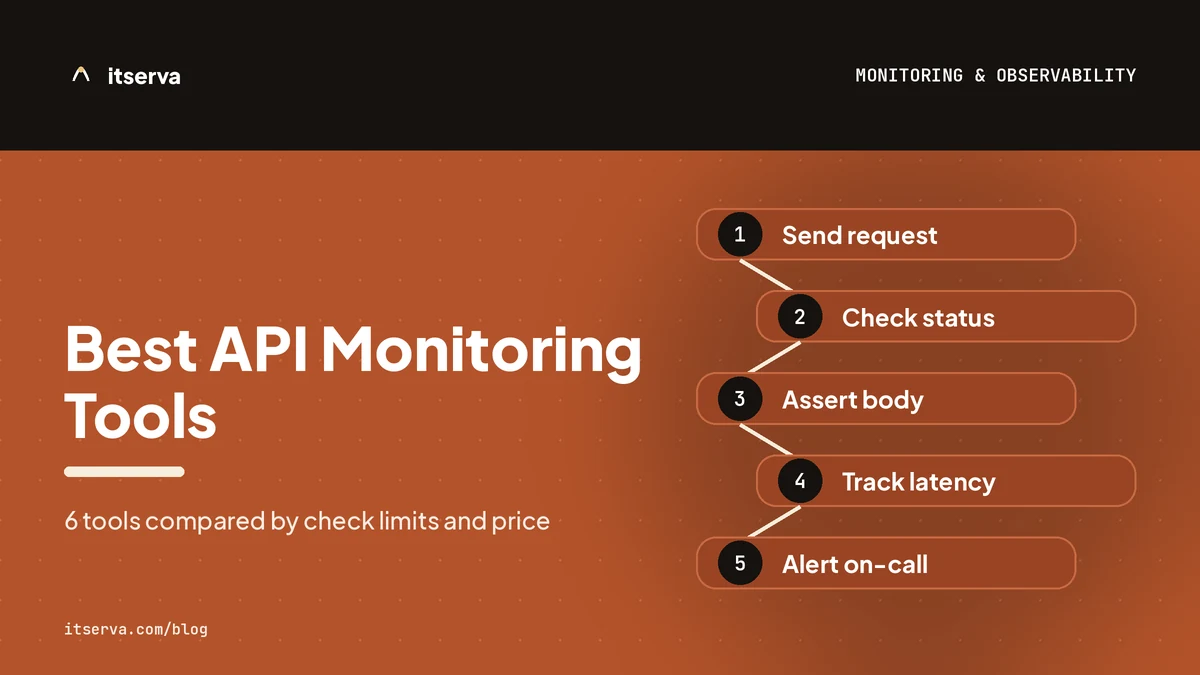
What does an API monitoring tool actually check?
An API monitor sends scheduled requests to your endpoints and checks the answer. At minimum it confirms the status code and response time; better tools also assert on the body, chain requests and test authenticated flows.
There are two styles. Uptime monitors ping a URL every few minutes and alert when it fails. Synthetic API checks run scripted multi-step calls, which catch broken logic that a simple ping would miss.
Quick comparison
| Tool | Best for | Starting price | Free plan |
|---|---|---|---|
| Checkly | Best API monitoring overall | $24/month (Starter) | Yes (Hobby plan) |
| Postman | Teams already using Postman collections | $9/user/month (Solo, yearly) | Yes (1 user) |
| Better Stack | Monitoring with on-call alerts | From $29/responder/month | Yes (10 monitors) |
| UptimeRobot | Cheapest way to watch many endpoints | $12/month (Solo, yearly) | Yes (50 monitors) |
| StatusCake | Uptime checks at scale | From $20.41/month (Superior) | Yes (10 monitors) |
| Site24x7 | API checks plus server monitoring | $9/month (Web Uptime, yearly) | Yes (up to 50 resources) |
The 6 best API monitoring tools
#1
Checkly
- Best for
- Best API monitoring overall
- Starting price
- $24/month (Starter)
- Free plan
- Yes (Hobby plan)
Checkly is built for developers who want monitoring as code. The free Hobby plan includes 10,000 API check runs and 1,000 browser check runs a month, and Starter at $24 per month raises that to 25,000 API runs. API checks can run as often as every 10 seconds.
The trade-off is the hard cap on usage. Hobby limits are fixed, and 30-second uptime monitors need the $64 Team plan. Checkly fits engineering teams that want API and browser checks stored in the same repo as their code.
What we like
- 10,000 free API check runs a month
- API checks as often as every 10 seconds
- API and browser checks in one tool
- Monitoring as code workflow
Watch out for
- Hobby usage caps are hard limits
- 30-second uptime checks need Team
#2
Postman
- Best for
- Teams already using Postman collections
- Starting price
- $9/user/month (Solo, yearly)
- Free plan
- Yes (1 user)
Postman is the obvious choice if your API tests already live in Postman collections. Monitors reuse those collections, the free plan includes 1,000 monitoring requests a month, and the Solo plan at $9 per user per month billed yearly raises that to 10,000.
The trade-off is volume. Team at $19 per user per month still includes 10,000 monitoring requests per team, so frequent checks on many endpoints use that up fast. Postman fits teams that design and test APIs in Postman and want light scheduled checks.
What we like
- Reuses existing API collections
- Free plan for one user
- Low entry price
- Covers design, testing and monitoring
Watch out for
- Only 1,000 free monitoring requests
- Monitoring volume stays at 10,000 on Team
#3
Better Stack
- Best for
- Monitoring with on-call alerts
- Starting price
- From $29/responder/month
- Free plan
- Yes (10 monitors)
Better Stack combines uptime and API checks with incident management and status pages. The free plan covers 10 monitors and heartbeats with 1 status page, checks can run as often as every 30 seconds, and paid responder licenses start at $29 per month.
The trade-off is how costs grow. Extra monitors are sold in packs of 50 for about $21 to $25 a month, and logs are billed separately at $0.15 per GB ingested. Better Stack fits small teams that want checks, on-call and a status page in one product.
What we like
- Free status page included
- On-call scheduling built in
- Checks down to 30 seconds
- Logs in the same product
Watch out for
- Free plan limited to 10 monitors
- Monitors and logs billed separately
#4
UptimeRobot
- Best for
- Cheapest way to watch many endpoints
- Starting price
- $12/month (Solo, yearly)
- Free plan
- Yes (50 monitors)
UptimeRobot is the budget pick for simple endpoint checks. The free plan covers 50 monitors at a 5-minute interval, including HTTP and keyword checks, and Solo at $12 per month billed yearly moves checks to every 60 seconds.
The trade-off is depth. UptimeRobot checks availability and keywords rather than running scripted multi-step API flows, and 30-second checks need the $33 Team plan. UptimeRobot fits small teams and agencies that need many basic API health checks for little money.
What we like
- 50 free monitors
- Keyword checks on the free plan
- Low paid entry price
- Fast intervals on Scale (15 seconds)
Watch out for
- No scripted multi-step API tests
- Free checks run only every 5 minutes
#5
StatusCake
- Best for
- Uptime checks at scale
- Starting price
- From $20.41/month (Superior)
- Free plan
- Yes (10 monitors)
StatusCake is a straightforward uptime monitor with room to grow. The free plan covers 10 uptime monitors at a 5-minute interval, Superior starts at $20.41 per month for 100 monitors at 1-minute checks, and Business covers 300 monitors at 30 seconds.
The trade-off is billing clarity. The pricing page shows two prices per plan without naming the billing term, so confirm the final figure at checkout. StatusCake fits teams that need a large number of endpoint checks rather than scripted API tests.
What we like
- 100 monitors on Superior
- 30-second checks on Business
- Free plan available
Watch out for
- Pricing page shows two figures per plan
- Focused on uptime, not API logic
#6
Site24x7
- Best for
- API checks plus server monitoring
- Starting price
- $9/month (Web Uptime, yearly)
- Free plan
- Yes (up to 50 resources)
Site24x7 is a broad monitoring suite from Zoho that includes website and API checks. Web Uptime costs $9 per month billed yearly for 25 websites with 1-minute polling, and Web Perf at $36 adds 8 transaction monitors and 8 check locations.
The trade-off is focus. Web Uptime checks from a single location, and the suite covers far more than APIs, which makes setup busier than a dedicated tool. Site24x7 fits IT teams that want API, website and server monitoring under one bill, with a 30-day trial and no card required.
What we like
- Free plan for up to 50 resources
- 30-day trial with no card
- Transaction monitors on Web Perf
- Server monitoring in the same suite
Watch out for
- Web Uptime checks from one location
- Busy interface for API-only needs
How we chose
We compared tools that check API endpoints on a schedule and alert when they fail, ranked by overall fit for software and IT teams. We weighted free usage and check limits first, then scripted API testing, then cost as you add endpoints. Prices and limits come from each vendor's pricing page, checked in November 2026. No vendor paid for placement, and we did not run hands-on tests; we compare published information.
Uptime checks vs synthetic API checks
An uptime check asks one question: did the endpoint answer in time with the right status code? It is cheap and catches outages, which is why UptimeRobot and StatusCake can offer dozens of monitors on low plans.
A synthetic API check runs a script, such as log in, create an order, then read it back. That catches broken logic and expired tokens, but each run costs more, which is why Checkly and Postman meter check runs or requests.
How to choose
Start with how you write tests today. If your team already keeps collections in Postman, monitor from there; if you prefer tests in code, Checkly is the closer match.
Next, count endpoints and intervals. Twenty endpoints checked every minute is about 864,000 runs a month, so price the plan that covers that volume, not the headline tier. Teams that also need internal tickets for outages can read our guide on what a ticketing system is.
Finally, decide where alerts go. Better Stack includes on-call scheduling and status pages, while the others send alerts to tools you already use.