
What is a data observability service?
Data observability watches the data itself rather than the servers. It tracks freshness, volume, schema changes and unusual values in warehouse tables, then alerts when a pipeline delivers late, empty or broken data.
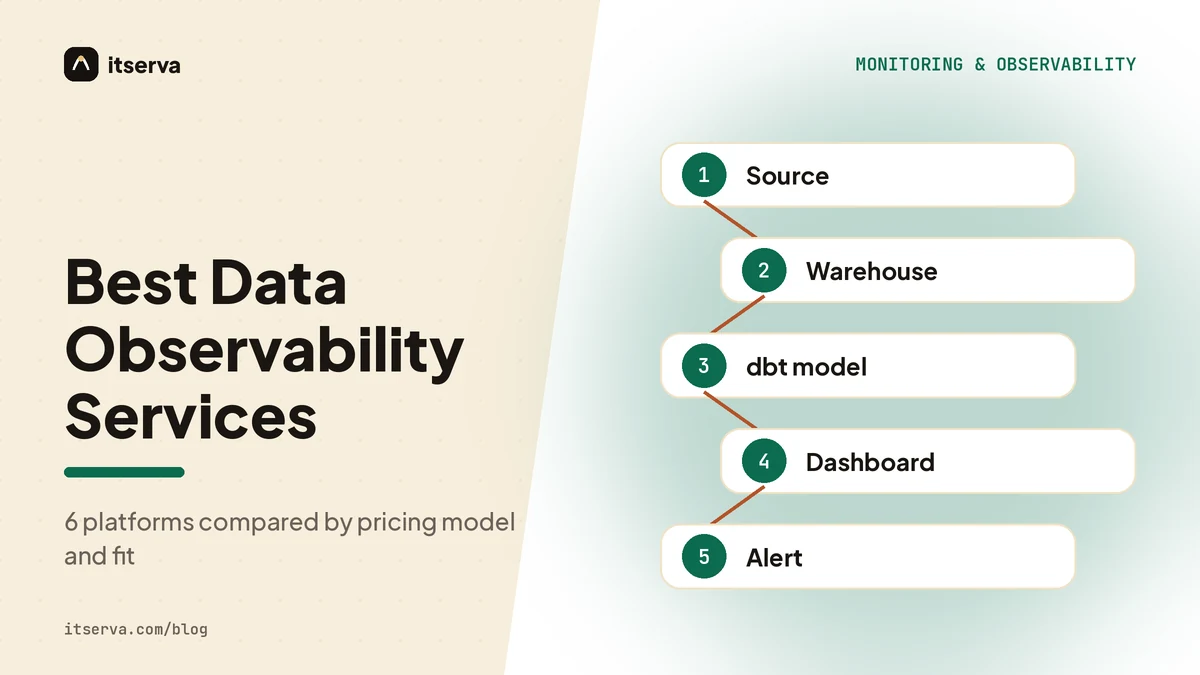
Lineage is the second half. When a table breaks, lineage shows which upstream job caused it and which dashboards and models it affects, so teams fix the source instead of patching each report.
Quick comparison
| Tool | Best for | Starting price | Free plan |
|---|---|---|---|
| Monte Carlo | Best data observability overall | Credit-based, on request | No (demo) |
| Metaplane | Small teams starting out | Usage-based per table (Pro) | Yes (10 tables) |
| Soda | Data quality checks on a budget | $750/month (Team) | Yes (Free plan) |
| Elementary | dbt-native teams | Seats and environments, on request | Yes (open source) |
| Bigeye | Column-level lineage | On request | No (demo and product tour) |
| Sifflet | Business-aware lineage and catalog | Tiered by assets, via sales | No (demo) |
The 6 best data observability services
#1
Monte Carlo
- Best for
- Best data observability overall
- Starting price
- Credit-based, on request
- Free plan
- No (demo)
Monte Carlo is the best-known data observability platform and now also covers AI agent and ML observability. The Start tier includes incident triage, root cause analysis, up to 10 users and up to 1,000 monitors, and Scale adds SSO, PII filtering, audit logs and data mesh support.
The trade-off is pricing opacity. Monte Carlo sells credits consumed at published rates, but the cost per credit depends on tier and is shared only on request. Monte Carlo fits mid-size and enterprise data teams that need broad coverage and mature incident workflows.
What we like
- Mature incident and root cause tools
- Agent and ML observability included
- Strong enterprise governance on higher tiers
- Lake and warehouse integrations
Watch out for
- Prices only on request
- Start tier caps users at 10
#2
Metaplane
- Best for
- Small teams starting out
- Starting price
- Usage-based per table (Pro)
- Free plan
- Yes (10 tables)
Metaplane, which has joined forces with Datadog, monitors volume, schema, freshness, nulls and distributions with automatic anomaly detection. The free plan covers 10 monitored tables and 3 custom SQL monitors, and every sign-up gets all features for 14 days.
The trade-off is that Pro is billed per monitored table without a published rate, and column-level lineage starts on Pro. Metaplane fits small data teams on dbt and a cloud warehouse that want anomaly alerts in Slack, email or Teams.
What we like
- Free plan for 10 tables
- 14-day full trial with no card
- dbt and Airflow job monitoring
- Slack, email and Teams alerts on Free
Watch out for
- Pro per-table rate not public
- Lineage needs Pro
#3
Soda
- Best for
- Data quality checks on a budget
- Starting price
- $750/month (Team)
- Free plan
- Yes (Free plan)
Soda focuses on data quality checks that engineers define and run alongside pipelines. The Free plan has unlimited users with pay-as-you-go processing units, and Team costs $750 per month with annual billing and volume discounts available.
The trade-off is that Soda is more check-driven than fully automatic, so you write more rules up front. Soda fits data engineering teams that want quality tests in code and a clear published price for the paid plan.
What we like
- Free plan with unlimited users
- Published Team price
- Check-as-code approach
Watch out for
- More manual rule writing
- Dataset limits not listed
#4
Elementary
- Best for
- dbt-native teams
- Starting price
- Seats and environments, on request
- Free plan
- Yes (open source)
Elementary is built around dbt. Its package writes run results and metadata to a schema in your warehouse, and a free open-source version can be self-hosted. The cloud product has a 30-day trial with no limits on seats or tables.
The trade-off is focus and price visibility. Paid plans are quoted by seats and environments, with Scale covering up to 10 editor seats and 1,000 tables. Elementary fits analytics engineering teams whose pipelines live in dbt.
What we like
- Free open-source version
- Native dbt integration
- Cloud never reads raw data
- SOC 2 Type II
Watch out for
- Strongest only for dbt users
- Paid prices on request
#5
Bigeye
- Best for
- Column-level lineage
- Starting price
- On request
- Free plan
- No (demo and product tour)
Bigeye combines monitoring with column-level lineage that traces outputs back to source data. Modules cover pipeline monitoring, anomaly detection, cost anomaly detection and monitoring as code, plus newer controls for AI agent data access.
The trade-off is that Bigeye publishes no plans or prices and starts with a demo. Bigeye fits enterprise data teams with complex lineage needs and AI governance concerns.
What we like
- Column-level lineage
- Cost anomaly detection
- Monitoring as code
Watch out for
- No published pricing
- Enterprise-oriented
#6
Sifflet
- Best for
- Business-aware lineage and catalog
- Starting price
- Tiered by assets, via sales
- Free plan
- No (demo)
Sifflet pairs data observability with a catalog and business-aware lineage. Every plan includes freshness, schema and volume monitoring, automated root cause analysis and AI-powered incident management, and plans are sized by assets: up to 500 on Entry and 1,000 on Growth.
The trade-off is that prices are not published in dollars and require sales contact, though Snowflake credits can be used toward Sifflet. Sifflet fits teams that want observability and a data catalog in one tool.
What we like
- Catalog included
- Automated root cause analysis
- Snowflake credits usable
Watch out for
- No public prices
- Entry capped at 500 assets
How we chose
We compared vendors that monitor the health of data in warehouses and pipelines, ranked by overall fit for data engineering and analytics teams. We weighted automated monitoring and lineage first, then free plans and pricing transparency, then integrations. Plans and prices come from each vendor's pricing page, checked in November 2026. No vendor paid for placement, and we did not run hands-on tests; we compare published information.
Data observability vs application observability
Application observability tools such as Datadog or New Relic watch servers, services and requests. They tell you a job failed, not that it loaded half the usual rows.
Data observability tools watch the tables themselves. Many teams need both: one to keep pipelines running, the other to confirm the data they produce is complete and correct.
How to choose
Start with your stack. Teams on dbt should look first at Elementary and Metaplane, while teams with many sources and lakes get broader coverage from Monte Carlo, Bigeye or Sifflet.
Next, count the tables or assets that matter. Pricing on this list is tied to tables, assets, monitors or credits, so a shortlist of critical tables keeps costs down. Application-side monitoring is covered in our guide to cloud monitoring software.
Finally, run a trial on your most fragile pipeline and check how quickly each tool flags a real issue.