
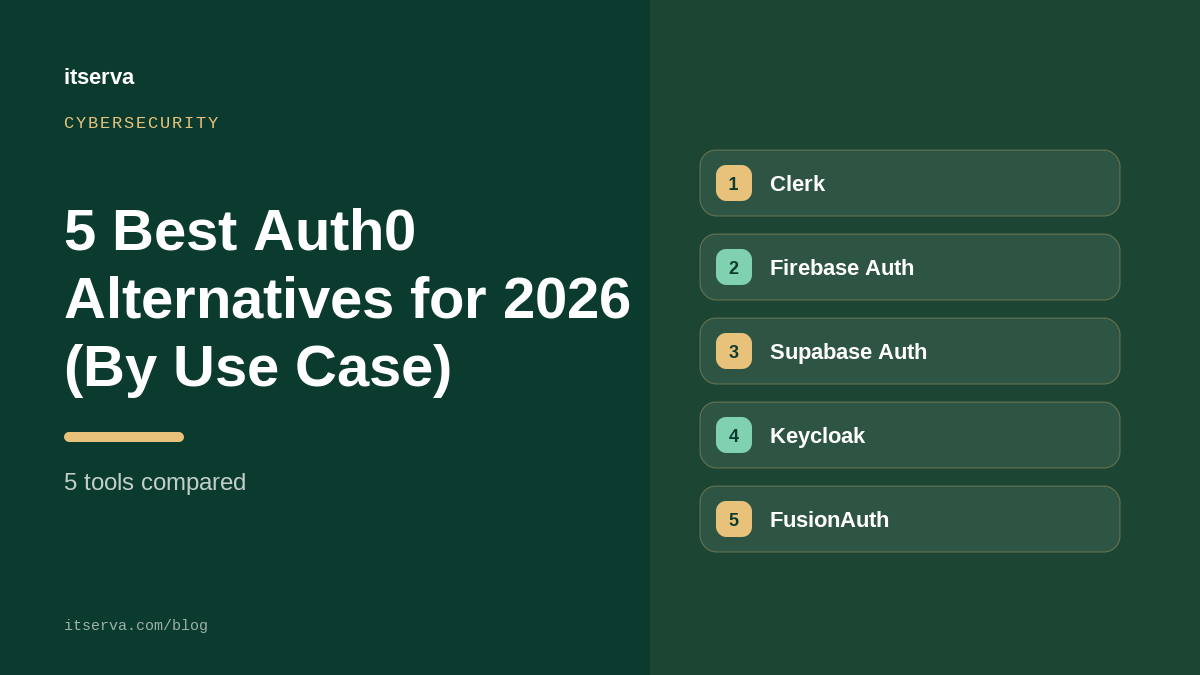
What makes a good Auth0 alternative?
Auth0 is a hosted identity service, so a replacement must cover sign-in, sign-up, social login and user management without forcing a rebuild of your whole app. The best alternatives split into hosted services that charge per user, cloud-priced services that bill by usage, and self-hosted platforms with no licence fee.
Pricing follows that split. Hosted tools such as Clerk start free and charge past a user allowance, Firebase Auth and Supabase Auth stay free to 50,000 users, and self-hosted Keycloak costs nothing for the software. Compare the free allowance and the per-user rate before you compare headline prices.
Quick comparison
| Tool | Best for | Starting price | Free plan |
|---|---|---|---|
| Clerk | Fastest launch for React and Next.js apps | $20/month (Pro, billed annually) | Yes (up to 50,000 retained users) |
| Firebase Auth | Mobile-first consumer apps | Free up to 50,000 MAUs | Yes (up to 50,000 MAUs) |
| Supabase Auth | Postgres-backed apps | $25/month (Pro) | Yes (up to 50,000 MAUs) |
| Keycloak | Free self-hosting with full data control | Free (open source, self-hosted) | Yes (free, self-hosted) |
| FusionAuth | Self-hosting without per-user fees | $162/month (Starter) | Yes (Community, self-hosted) |
The 5 best Auth0 alternatives
#1
Clerk
- Best for
- Fastest launch for React and Next.js apps
- Starting price
- $20/month (Pro, billed annually)
- Free plan
- Yes (up to 50,000 retained users)
Clerk is a hosted authentication service built for React and Next.js teams. Its free Hobby plan covers 50,000 monthly retained users per app with prebuilt sign-up, sign-in and user-profile components, a custom domain and up to 3 dashboard seats. Pro adds multi-factor authentication, passkeys, branding removal and 1 enterprise SSO connection.
The trade-off is usage billing past the free allowance. Extra retained users cost $0.02 each per month, each additional enterprise connection costs $75 per month, and the SOC 2 report needs the $250-per-month Business plan. Clerk fits product teams shipping a React or Next.js app who want sign-in live in hours rather than days.
What we like
- Prebuilt sign-up and sign-in components
- Free to 50,000 retained users per app
- MFA and passkeys on Pro
- One enterprise SSO connection included on Pro
Watch out for
- Extra users cost $0.02 each past 50,000
- Extra SSO connections cost $75 per month each
- SOC 2 report needs Business
#2
Firebase Auth
- Best for
- Mobile-first consumer apps
- Starting price
- Free up to 50,000 MAUs
- Free plan
- Yes (up to 50,000 MAUs)
Firebase Auth is Google's sign-in service for mobile and web apps. Email, social and anonymous sign-in are free for the first 50,000 monthly active users, and the service ships SDKs for iOS, Android and the web alongside the rest of Firebase. Phone sign-in is billed per SMS sent, with the first 10 messages each day free.
The trade-off is enterprise depth and lock-in. SAML and OIDC sign-in are free for only 50 users and then cost $0.015 per user, advanced features such as multi-factor authentication need the Identity Platform upgrade, and heavy use ties you to Google Cloud. Firebase Auth fits mobile-first consumer apps that want free auth at small scale.
What we like
- Free to 50,000 monthly active users
- SDKs for iOS, Android and web
- Phone sign-in built in
- Part of the wider Firebase platform
Watch out for
- SAML and OIDC cost $0.015 per user past 50
- Phone sign-in billed per SMS
- Deep use ties you to Google Cloud
#3
Supabase Auth
- Best for
- Postgres-backed apps
- Starting price
- $25/month (Pro)
- Free plan
- Yes (up to 50,000 MAUs)
Supabase Auth is the sign-in layer of Supabase, an open-source backend built on Postgres. Auth ships with the database, storage, realtime updates and edge functions in one project, and the free plan includes 50,000 monthly active users. Pro costs $25 per month and covers 100,000 users, with extra users at $0.00325 each.
The trade-off is that Auth is part of a platform, not a standalone product. The $25 fee covers the project bundle with a $10 compute credit, so database, storage and egress can add usage charges, and business features such as SAML SSO are metered separately. Supabase Auth fits teams whose app already runs on Postgres and want auth with their backend.
What we like
- Auth bundled with Postgres, storage and realtime
- Free to 50,000 monthly active users
- Open source and self-hostable
- Spend caps on by default on Pro
Watch out for
- Pro is charged up front each month
- Usage past plan limits adds to the bill
- Self-hosting needs Docker or the CLI
#4
Keycloak
- Best for
- Free self-hosting with full data control
- Starting price
- Free (open source, self-hosted)
- Free plan
- Yes (free, self-hosted)
Keycloak is an open-source identity platform you run on your own servers. It covers single sign-on, SAML, OIDC and social login with user federation, and it charges no licence fee per user, so the software cost is zero whatever your user count. Regulated teams keep user data in-house because nothing leaves their infrastructure.
The trade-off is operations. You own installation, upgrades, theming and uptime, and setup takes expertise that a hosted service would handle for you. Community support is the default unless you buy help elsewhere. Keycloak fits teams that want zero licence cost and full control over their user data.
What we like
- No licence fee at any user count
- Full control over user data
- SSO, SAML, OIDC and social login included
- User federation built in
Watch out for
- You own upgrades, theming and uptime
- Setup takes identity expertise
- Support is community-based by default
#5
FusionAuth
- Best for
- Self-hosting without per-user fees
- Starting price
- $162/month (Starter)
- Free plan
- Yes (Community, self-hosted)
FusionAuth is a customer identity platform you can self-host or run in its cloud. The free Community edition covers core authentication with unlimited users when you host it yourself, and hosted Starter starts at $162 per month with premium features such as advanced multi-factor authentication, breached password detection and basic hosting included.
The trade-off is price and complexity. Hosted Starter is priced by monthly active users, so the bill rises as you grow, and the licence is not open source, which matters to strict open-source policies. FusionAuth fits regulated teams that want to self-host without per-user billing.
What we like
- Community edition free and unlimited when self-hosted
- Passkeys and advanced MFA on paid plans
- Breached password detection included on Starter
- Basic hosting included on Starter
Watch out for
- Hosted price rises with monthly active users
- Licence is not open source
- Enterprise pricing is by quote
How we chose
We compared hosted and self-hosted Auth0 alternatives that cover sign-in, single sign-on and user management for consumer or workforce apps. We weighted the free allowance first, then the paid starting price and what it includes, then hosting control and enterprise sign-in costs. Prices come from each vendor's own pricing page, checked in November 2026, and free tiers are stated as published. Two enterprise platforms were left out because their pricing pages would not load. No vendor paid for placement, and we did not run hands-on tests; we compare published information.
How per-user auth pricing really adds up
Most auth tools bill per monthly active user, so the free allowance matters more than the headline price. Clerk counts retained users who return a day after signing up, Firebase Auth and Supabase Auth count monthly active users, and FusionAuth prices hosted plans by the same measure.
Model the bill at 10,000 and 50,000 users before you choose. A platform that is free at 10,000 users can cost hundreds a month at 50,000, while a flat monthly fee such as FusionAuth Starter stays predictable until its user band changes.
How to choose
Start with your user type. Consumer apps suit Firebase Auth, Clerk or Supabase Auth, Postgres-backed apps suit Supabase Auth, and teams that must host data themselves should shortlist Keycloak or FusionAuth.
Next, price a realistic month. Add the plan fee, the per-user charge past the free allowance and any enterprise SSO connection fees, then compare totals rather than headline prices. If your buyers need enterprise SSO, check connection pricing first, since Clerk charges $75 per month for each extra connection.
Finally, test migration before you commit. Export your users, confirm whether password hashes move with them, and run a pilot with one customer segment before switching your whole login flow.