
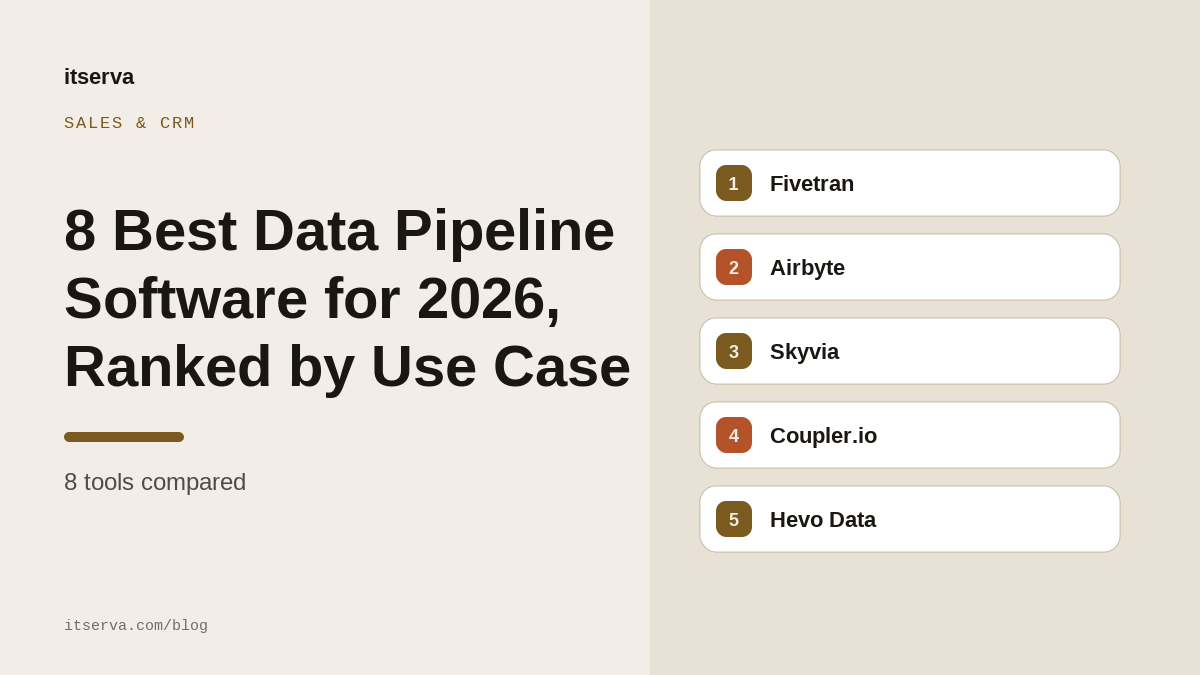
What does data pipeline software do for a sales team?
Data pipeline software moves records out of CRMs, ad platforms and databases and loads them into a warehouse or spreadsheet where teams can report on them. For sales and revenue teams, that usually means syncing Salesforce or HubSpot data into a place where it can be joined with marketing spend and product usage.
The billing model matters as much as the connector list. Row-based pricing stays cheap at low volume but jumps when a busy CRM table updates daily, while credit, record-tier and flat-fee plans keep bills more predictable as volume grows.
Quick comparison
| Tool | Best for | Starting price | Free plan |
|---|---|---|---|
| Fivetran | Best data pipeline software overall | $5/month base (pay-as-you-go) | Yes (up to 500,000 monthly active rows) |
| Airbyte | Open-source flexibility and custom APIs | $20/month (Cloud Standard, 5 credits) | Yes (self-hosted Core) |
| Skyvia | Budget no-code CRM and database sync | $79/month billed annually ($99 monthly) | Yes (2 scheduled integrations, daily runs) |
| Coupler.io | Spreadsheet and BI dashboard reporting | $24/month billed annually | Yes (1 user, 1 source, 1 destination) |
| Hevo Data | No-code warehouse ELT with live chat support | $265/month billed annually ($299 monthly) | Yes (1 million events per month) |
| dbt | SQL-first in-warehouse transformation | $100/user/month (Starter) | Yes (Developer, 1 seat, 3,000 models/month) |
| Prefect | Python workflow orchestration and retries | $100/month (Starter) | Yes (Hobby, 2 users, 5 deployments) |
| Integrate.io | Fixed-fee unlimited high-volume ETL | $1,999/month billed annually | No (14-day trial) |
The 8 best data pipeline software tools
#1
Fivetran
4.3/5 on G2 (857 reviews, checked Nov 2026)
- Best for
- Best data pipeline software overall
- Starting price
- $5/month base (pay-as-you-go)
- Free plan
- Yes (up to 500,000 monthly active rows)
Fivetran is a fully managed ELT platform that moves data from 700+ SaaS apps, databases and event streams into cloud warehouses with automatic schema drift handling. Its permanent free plan covers up to 500,000 monthly active rows for connections, plus 3,500 monthly active rows for activations and 5,000 monthly model runs with 15-minute syncs.
The trade-off is per-row billing on high-churn tables. Pay-as-you-go Standard connections start at a $5 per month minimum base charge, and annual contracts start at a $12,000 minimum commit. Fivetran fits teams that want zero connector maintenance across CRM, advertising and database sources.
What we like
- 700+ prebuilt connectors with automated schema updates
- Permanent free tier up to 500,000 monthly active rows
- Historical syncs do not count toward monthly active rows
- Built-in dbt Core orchestration and 200+ activation targets
Watch out for
- Row pricing climbs fast on frequently updated tables
- Annual contracts need a $12,000 minimum commitment
- Limited visual transformation inside the ingestion layer
#2
Airbyte
4.4/5 on G2 (81 reviews, checked Nov 2026)
- Best for
- Open-source flexibility and custom APIs
- Starting price
- $20/month (Cloud Standard, 5 credits)
- Free plan
- Yes (self-hosted Core)
Airbyte is an open-source data movement platform supporting ELT and log-based change data capture across 700+ connectors, plus an AI-assisted Connector Builder for niche REST APIs. Teams can self-host Airbyte Core for free under Elastic License 2.0, or start Airbyte Cloud Standard at $20 per month for 5 credits, roughly 1 GB of syncs, with hourly syncs.
The trade-off is that self-hosting needs your own Docker or Kubernetes infrastructure. Airbyte Cloud jumps to $189 per month on Plus for SSO and 15-minute syncs, and community-maintained long-tail connectors vary in stability. Airbyte fits engineering teams wanting open-source control or low-cost cloud ingestion without vendor lock-in.
What we like
- Free self-hosted Core with full source visibility
- Low $20 per month cloud entry tier with no annual contract
- No-code and Python Connector Builder for niche APIs
- Hybrid and on-prem deployment options on enterprise tiers
Watch out for
- Community long-tail connectors vary in stability
- 15-minute syncs and SSO need the $189 per month Plus plan
- Self-hosted setups need ongoing DevOps maintenance
#3
Skyvia
4.8/5 on G2 (326 reviews, checked Nov 2026)
- Best for
- Budget no-code CRM and database sync
- Starting price
- $79/month billed annually ($99 monthly)
- Free plan
- Yes (2 scheduled integrations, daily runs)
Skyvia is a browser-based no-code data integration platform built for syncing CRMs, cloud apps and relational databases without scripting. Its free plan includes 2 scheduled integrations with daily runs and unlimited users, while Data Integration Basic costs $79 per month billed annually for 5 million records and 5 scheduled jobs.
The trade-off is sync frequency on lower tiers. Basic limits schedules to once per day, and the Standard plan at $159 per month billed annually is needed for hourly schedules. Skyvia fits RevOps and small analytics teams connecting Salesforce, HubSpot, QuickBooks and SQL databases on a tight budget.
What we like
- 4.8 out of 5 rating across 326 G2 reviews
- Unlimited users and unlimited source and target connections on every plan
- Bi-directional CRM sync, replication and import and export
- Predictable record tiers with a permanent free tier
Watch out for
- Free and Basic tiers restrict syncs to once daily
- 1-minute sync intervals need the $399 per month Professional tier
- Smaller connector library than enterprise ELT platforms
#4
Coupler.io
4.8/5 on G2 (104 reviews, checked Nov 2026)
- Best for
- Spreadsheet and BI dashboard reporting
- Starting price
- $24/month billed annually
- Free plan
- Yes (1 user, 1 source, 1 destination)
Coupler.io is a no-code data integration and reporting platform that pulls data from 400+ marketing, sales and finance apps into Google Sheets, Excel, Power BI, Looker Studio and cloud warehouses. Its free plan covers 1 user, 1 source and 1 destination with manual refresh, while Starter costs $24 per month billed annually for 3 accounts and daily refreshes.
The trade-off is volume limits on Starter. Imports are capped at 5,000 rows per run with 1 destination, so teams needing hourly refreshes or unlimited volume must upgrade to Pro at $199 per month billed annually. Coupler.io fits marketing, finance and RevOps teams automating spreadsheet and BI dashboards.
What we like
- All 400+ data sources unlocked on every paid tier
- Flat pricing without per-seat fees on higher plans
- Built-in data blending, filters and 200+ dashboard templates
- 4.8 out of 5 rating on G2 across 104 reviews
Watch out for
- Starter limits transfers to 5,000 rows per run
- Hourly refreshes need the $199 per month Pro plan
- Not built for high-volume database change data capture
#5
Hevo Data
4.4/5 on G2 (297 reviews, checked Nov 2026)
- Best for
- No-code warehouse ELT with live chat support
- Starting price
- $265/month billed annually ($299 monthly)
- Free plan
- Yes (1 million events per month)
Hevo Data is a managed no-code ELT pipeline tool built to replicate SaaS apps and databases into warehouses like Snowflake, BigQuery and Redshift. Its permanent free tier includes 1 million events per month across free sources, while Starter costs $265 per month billed annually for 5 million events, 10 users and 1-hour syncs.
The trade-off is a steeper entry price than row-based rivals once you pass the 1 million free event mark. Streaming syncs require the $750 per month Professional plan, and its connector library is smaller than Fivetran or Airbyte. Hevo Data fits mid-sized teams that value responsive 24/7 live chat support and zero-maintenance warehouse loads.
What we like
- Permanent free tier with 1 million monthly events
- In-app live chat support included on all paid plans
- Unlimited sources and dbt integration on Starter
- Automatic schema mapping and pre-load Python transforms
Watch out for
- Paid plans start at $265 per month billed annually
- Sub-hourly streaming needs the $750 per month tier
- Fewer niche connectors than Fivetran or Airbyte
#6
dbt
4.7/5 on G2 (211 reviews, checked Nov 2026)
- Best for
- SQL-first in-warehouse transformation
- Starting price
- $100/user/month (Starter)
- Free plan
- Yes (Developer, 1 seat, 3,000 models/month)
dbt is the standard transformation layer for modern data pipelines, turning raw warehouse tables into tested, documented analytics models using modular SQL and Git workflows. Its Developer plan is free forever for 1 seat and 3,000 successful model builds per month, while Starter costs $100 per user per month for up to 5 seats and 15,000 model builds.
The trade-off is that dbt handles the transform step inside your warehouse rather than extracting data from CRMs or APIs, so you must pair it with an ingestion tool. Per-seat Starter pricing also adds up for larger teams. dbt fits analytics engineers and SQL-savvy teams building governed data models.
What we like
- 4.7 out of 5 rating on G2 across 211 reviews
- Free Developer tier plus open-source dbt Core
- Built-in data quality tests, lineage graphs and Git CI/CD
- Native integrations with Fivetran, Airbyte, Dagster and Prefect
Watch out for
- Does not extract or ingest data from external SaaS apps
- Per-seat Starter pricing adds up for larger teams
- Requires SQL proficiency and warehouse compute
#7
Prefect
4.5/5 on G2 (125 reviews, checked Nov 2026)
- Best for
- Python workflow orchestration and retries
- Starting price
- $100/month (Starter)
- Free plan
- Yes (Hobby, 2 users, 5 deployments)
Prefect is a Python-native workflow orchestration platform that schedules, monitors and recovers custom data and AI pipelines with automatic retries and state tracking. Its free Hobby tier supports 2 users, 5 deployments and 500 minutes of managed serverless compute, while Starter costs $100 per month for 3 users, 20 deployments and 75 serverless hours.
The trade-off is that Prefect orchestrates Python code rather than providing out-of-the-box SaaS connectors. Moving to the Team plan jumps to $100 per user per month, and audit logs need that tier too. Prefect fits data engineering teams running custom Python scripts, ML pipelines and multi-step jobs.
What we like
- Turns standard Python functions into monitored pipelines with decorators
- Generous free Hobby tier with 500 serverless compute minutes
- Flat $100 per month Starter tier covers 3 users and webhooks
- 4.5 out of 5 G2 rating with strong observability and alerting
Watch out for
- Needs Python engineering skills, not a no-code connector tool
- Audit logs and service accounts need the $100 per user per month Team plan
- 7-day run history retention on Hobby and Starter tiers
#8
Integrate.io
4.4/5 on G2 (213 reviews, checked Nov 2026)
- Best for
- Fixed-fee unlimited high-volume ETL
- Starting price
- $1,999/month billed annually
- Free plan
- No (14-day trial)
Integrate.io is a low-code ETL, ELT and reverse ETL platform offering 200+ connectors, 220+ drag-and-drop transformations and 60-second sync intervals. Its Core plan is priced at a flat $1,999 per month billed annually, with unlimited data volume, unlimited pipelines, unlimited users and 30-day onboarding with a solutions engineer.
The trade-off is the $23,988 annual entry cost with no permanent free tier, only a 14-day trial. Role-based access control and HIPAA compliance sit in a quote-based tier, which excludes small teams. Integrate.io fits mid-market and enterprise teams moving massive row volumes that want predictable flat billing.
What we like
- Flat $1,999 per month fee with unlimited rows, pipelines and users
- Combines ETL, ELT, reverse ETL and 220+ visual transforms in one UI
- 60-second sync frequency and 24/7 live support included
- Dedicated 30-day onboarding with a solutions engineer
Watch out for
- High $23,988 per year entry price excludes small teams
- No permanent free plan beyond a 14-day trial
- Role-based access control and HIPAA need a custom enterprise quote
How we chose
We compared leading ETL, ELT, transformation and workflow orchestration platforms listed on G2 and Capterra for sales, CRM and analytics teams. We weighted connector coverage and managed sync reliability first, then total cost at realistic row and event volumes, then free-plan generosity. Prices come from vendor pricing pages and G2 product profiles, checked in November 2026. We also checked sync frequency, schema drift handling and transformation support, since those decide how much maintenance each pipeline needs in practice. No vendor paid for placement, and we did not run hands-on tests; we compare published information.
How data pipeline pricing models compare
Usage-based tools like Fivetran and Hevo Data meter monthly active rows or destination events. They offer permanent free tiers for low volume, making them economical for early-stage reporting, but costs can spike when upstream CRMs or databases update millions of records.
Credit and record-tier platforms like Airbyte, Skyvia and Coupler.io give predictable monthly caps starting between $20 and $79 per month. Flat-fee enterprise platforms like Integrate.io remove volume metering altogether at $1,999 per month for teams tired of row-count surprises.
How to choose
Start with your sources and destinations. List every CRM, ad platform and database you need to extract from, and check whether your destination is a spreadsheet like Google Sheets or a warehouse like Snowflake or BigQuery.
Next, match the tool to your team's technical skills. Choose no-code platforms like Skyvia, Coupler.io or Hevo Data if analysts own reporting, or pick Airbyte, dbt and Prefect if engineers prefer SQL and Python. Then model your monthly row or event volume so row-based pricing does not trigger unexpected overages.
Finally, test schema changes during a free tier or trial. Connect one live source and destination on a free plan to verify how the tool handles custom fields, API rate limits and error alerts before you commit.