
What makes a project management tool agile?
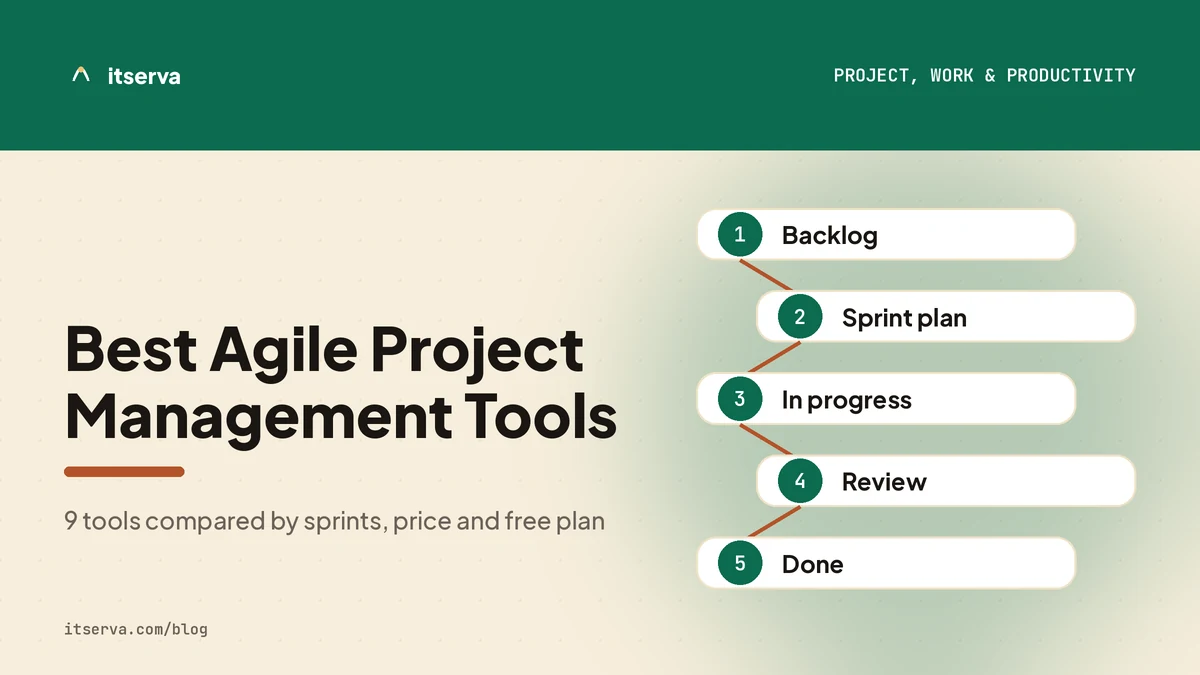
An agile tool is built around short, repeated cycles of work. At minimum that means a backlog, Scrum or Kanban boards, sprints or cycles, and reports such as burndown or velocity that show whether the team is on pace.
General work-management apps can run agile projects too, but they often lack sprint views out of the box. The tools here range from developer trackers like Jira, Linear and Shortcut to broader platforms like monday.com, ClickUp and Asana.
Quick comparison
| Tool | Best for | Starting price | Free plan |
|---|---|---|---|
| Jira | Best agile tool overall | $9.70/user/month (Standard) | Yes (up to 10 users) |
| monday.com | Visual agile planning | $9/user/month (Basic, yearly, 3-seat minimum) | Yes (up to 2 seats) |
| ClickUp | All-in-one agile value | $12/user/month (Core) | Yes (Free Forever) |
| Linear | Product and engineering teams | $10/user/month (Basic, yearly) | Yes (2 teams, 250 issues) |
| Asana | Cross-team agile work | $10.99/user/month (Starter, yearly) | Yes (2 users) |
| Wrike | Large teams and portfolios | $10/user/month (Team, yearly) | Yes |
| Zoho Sprints | Budget Scrum tool | $1/user/month (Starter) | Yes (up to 3 users) |
| YouTrack | Low-cost tracker with a helpdesk | $4.50/user/month (Cloud, yearly) | Yes (up to 10 users) |
| Shortcut | Lightweight developer tracker | $8.50/user/month (Team) | Yes (up to 10 users) |
The 9 best agile project management tools
#1
Jira
4.4/5 on Capterra (15,776 reviews, checked Nov 2026)
- Best for
- Best agile tool overall
- Starting price
- $9.70/user/month (Standard)
- Free plan
- Yes (up to 10 users)
Jira is the reference agile tool for software teams. It ships with Scrum and Kanban boards, backlogs, sprints and burndown reports, and the free plan covers up to 10 users. Standard costs $9.70 per user a month for the first 100 users on monthly billing and adds 250 GB of storage and 400 automation steps per user a month.
The trade-off is weight. Setup takes time to get right, the interface can feel heavy for small teams, and the per-user price climbs as headcount grows. Jira fits engineering teams that want mature Scrum reporting and can invest in configuration.
What we like
- Full Scrum and Kanban toolset
- Free plan for 10 users
- Burndown and sprint reports built in
- Huge Capterra review base
Watch out for
- Setup takes real effort
- Heavy for small teams
- Costs grow with headcount
#2
monday.com
4.7/5 on G2 (17,975 reviews, checked Nov 2026)
- Best for
- Visual agile planning
- Starting price
- $9/user/month (Basic, yearly, 3-seat minimum)
- Free plan
- Yes (up to 2 seats)
monday.com is the most visual planner on this list. The free plan covers 2 seats and 3 boards, and Basic costs $9 per user a month billed yearly, with a 3-seat minimum. Basic adds unlimited boards and items, free viewers and 5 GB of file storage.
The trade-off is that timeline views and automations need Standard at $12, and its agile reporting is lighter than Jira's. monday.com fits mixed teams that care more about clear boards than deep sprint metrics.
What we like
- Very clear visual boards
- Free viewers on Basic
- Highest G2 rating here
- Unlimited boards on paid plans
Watch out for
- 3-seat minimum
- Timelines and automations need Standard
- Lighter agile reports than Jira
#3
ClickUp
4.6/5 on G2 (15,874 reviews, checked Nov 2026)
- Best for
- All-in-one agile value
- Starting price
- $12/user/month (Core)
- Free plan
- Yes (Free Forever)
ClickUp puts tasks, docs, chat, goals and sprints in one app. Its Free Forever plan already includes unlimited tasks, Kanban boards, sprint management and time tracking. Core is listed at $9 per user a month against a regular price of $12, and adds unlimited storage, Gantt charts and 1,000 automations a month.
The trade-off is that dashboards, webhooks and timesheets sit on Business, so reporting-heavy teams need to step up. ClickUp fits small and mid-size teams that want sprints plus docs and chat without paying for several tools.
What we like
- Sprints on the free plan
- Docs, chat and goals built in
- 1,000 automations on Core
- Unlimited storage on Core
Watch out for
- Dashboards need Business
- Discounted Core price may not last
#4
Linear
4.6/5 on G2 (128 reviews, checked Nov 2026)
- Best for
- Product and engineering teams
- Starting price
- $10/user/month (Basic, yearly)
- Free plan
- Yes (2 teams, 250 issues)
Linear is a fast issue tracker with cycles, projects and roadmaps built in, plus GitHub and GitLab integration. The free plan allows unlimited members but caps you at 2 teams and 250 issues. Basic costs $10 per user a month billed yearly, removes the issue cap, raises the team limit to 5 and adds unlimited file uploads.
The trade-off is reporting. Analytics are thin until you move to Business, and its G2 review base is small. Linear fits product teams that want a quick, opinionated tracker tied to their code.
What we like
- Cycles and roadmaps built in
- Tight GitHub and GitLab links
- Unlimited members on free
Watch out for
- 250-issue cap on free
- Thin reporting without Business
#5
Asana
4.4/5 on G2 (14,143 reviews, checked Nov 2026)
- Best for
- Cross-team agile work
- Starting price
- $10.99/user/month (Starter, yearly)
- Free plan
- Yes (2 users)
Asana is strong when agile work spans marketing, operations and product. The Personal plan is free for 2 users with unlimited tasks and projects, and Starter costs $10.99 per user a month billed yearly. Starter adds timeline and Gantt views, dashboards, custom fields and unlimited automations.
The trade-off is that Asana has no built-in sprint or burndown view, so Scrum teams track velocity with custom fields. Advanced reporting also needs the $24.99 plan. Asana fits Kanban-style teams that coordinate across departments.
What we like
- Unlimited automations on Starter
- Timeline and Gantt views
- Easy for non-technical teams
Watch out for
- No native sprints or burndown
- Advanced reports cost $24.99
#6
Wrike
4.2/5 on G2 (4,648 reviews, checked Nov 2026)
- Best for
- Large teams and portfolios
- Starting price
- $10/user/month (Team, yearly)
- Free plan
- Yes
Wrike is used by more than 20,000 organizations and has a free plan. Team costs $10 per user a month billed annually for 2 to 15 users and adds interactive Gantt charts, shareable dashboards, custom fields and 2 GB of storage per user.
The trade-off is a sharp price step. The 16th user moves the whole team to Business at $25 per user, and automations are capped at 50 per seat a month. Wrike fits larger organizations that need structured planning across many projects.
What we like
- Interactive Gantt charts
- Shareable dashboards
- Free plan available
Watch out for
- 16th user forces Business at $25
- Automations capped at 50 per seat
- Lowest G2 rating here
#7
Zoho Sprints
4.5/5 on G2 (186 reviews, checked Nov 2026)
- Best for
- Budget Scrum tool
- Starting price
- $1/user/month (Starter)
- Free plan
- Yes (up to 3 users)
Zoho Sprints is the cheapest dedicated Scrum tool here. The free plan covers 3 users and 3 projects, and Starter costs $1 per user a month for teams of 12 to 100 users. Starter adds 50 projects, 20 GB of storage, timesheets and meetings.
The trade-off is reach. Release management sits on the Premier plan at $5, and the integration list is shorter than Jira's or ClickUp's. Zoho Sprints fits cost-conscious teams that want real Scrum features, especially those already on Zoho apps.
What we like
- $1 per user on Starter
- Timesheets included
- Free plan for 3 users
Watch out for
- Release management needs Premier
- Fewer integrations than rivals
#8
YouTrack
4.5/5 on Capterra (95 reviews, checked Nov 2026)
- Best for
- Low-cost tracker with a helpdesk
- Starting price
- $4.50/user/month (Cloud, yearly)
- Free plan
- Yes (up to 10 users)
YouTrack from JetBrains packs agile boards, Gantt charts, time tracking, a knowledge base and a helpdesk with 3 free agents into one tracker. The free plan covers up to 10 users with every feature and 30 GB of storage, and Cloud costs $4.50 per user a month billed annually after that.
The trade-off is the learning curve. Its query language and permission setup take time, and the integration library is smaller than Jira's. YouTrack fits technical teams that also want a light help desk next to their sprint board.
What we like
- Every feature free for 10 users
- Helpdesk with 3 free agents
- Low per-user price
- 30 GB of storage on free
Watch out for
- Query language takes time to learn
- Smaller integration library
#9
Shortcut
4.4/5 on G2 (177 reviews, checked Nov 2026)
- Best for
- Lightweight developer tracker
- Starting price
- $8.50/user/month (Team)
- Free plan
- Yes (up to 10 users)
Shortcut keeps agile simple with stories, epics, iterations, roadmaps and a clean Kanban view. The free plan covers up to 10 users and includes sprint planning, docs and GitHub, Slack and Figma integrations. Team costs $8.50 per user a month and adds custom workflows and automations.
The trade-off is scope. There are no docs or goals beyond the core tracker on lower plans, and OKRs plus unlimited workspaces need Business. Shortcut fits small dev teams that find Jira too heavy.
What we like
- Free for 10 users
- GitHub, Slack and Figma on free
- Simple, fast Kanban view
Watch out for
- OKRs need Business
- Narrow scope beyond the tracker
How we chose
We compared project management tools that support agile work, ranked by how well they handle backlogs, sprints and boards for a typical team. We weighted native Scrum and Kanban features first, then free plan limits, then cost per user as the team grows. Prices come from vendor pricing pages and ratings from G2 or Capterra with review counts, checked in November 2026. No vendor paid for placement, and we did not run hands-on tests: we compare published information.
Scrum vs Kanban: which board does your team need?
Scrum works in fixed sprints, usually one to four weeks, with a planned backlog and a review at the end. It needs sprint views and burndown reports, which Jira, ClickUp, Zoho Sprints and Linear's cycles provide.
Kanban is a continuous flow with limits on work in progress and no fixed sprint. Almost every tool here supports it, which is why Asana or monday.com can work well for Kanban teams even without native sprint metrics.
How to choose
Start with your method. If you run real Scrum with velocity tracking, shortlist Jira, ClickUp, Zoho Sprints or YouTrack, since Asana lacks native sprints.
Next, price the team you will have next year, not today. Wrike's jump at 16 users and monday.com's 3-seat minimum can change the total more than the headline rate.
Finally, check who else will use it. Developer trackers like Linear and Shortcut are fast for engineers, while monday.com, ClickUp and Asana are easier for marketing or operations colleagues who share the same board.