
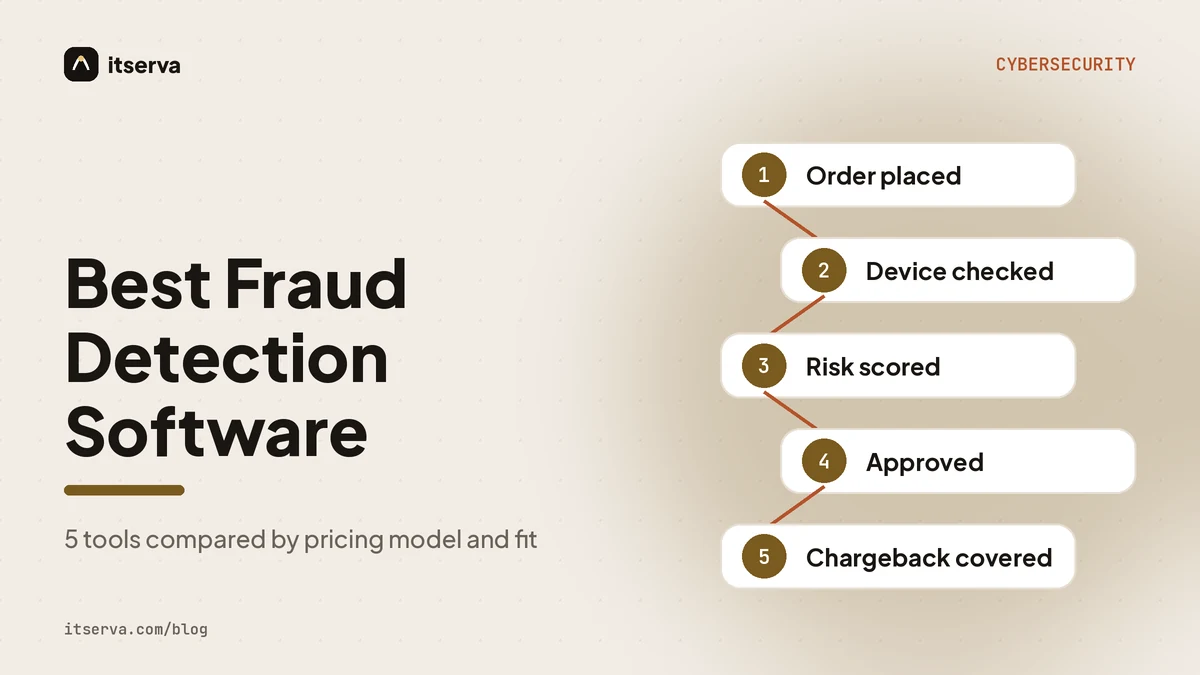
What does fraud detection software look at?
Fraud tools score each signup, login or payment using signals such as device fingerprint, IP and proxy use, email and phone history, and behavior on the page. A rules engine or model then approves, declines or sends the event for review.
Ecommerce tools add a financial guarantee: if an approved order turns into a fraud chargeback, the vendor pays. That changes the economics, since you pay a share of revenue instead of a flat fee.
Quick comparison
| Tool | Best for | Starting price | Free plan |
|---|---|---|---|
| SEON | Best fraud detection overall | $699/month (Starter, 2,500 checks) | Free trial on request |
| Signifyd | Large ecommerce with chargeback cover | Percentage of approved orders (custom) | No trial listed |
| Riskified | Raising approval rates at scale | Custom (demo) | No |
| NoFraud | Small and mid-size online stores | 1% of revenue ($250/month minimum) | Yes (up to 100 orders/month) |
| Fingerprint | Developer device intelligence | $99/month (Pro Plus, 20K calls) | Yes (1,000 API calls/month) |
The 5 best fraud detection software tools
#1
SEON
- Best for
- Best fraud detection overall
- Starting price
- $699/month (Starter, 2,500 checks)
- Free plan
- Free trial on request
SEON is a fraud prevention platform that scores users and transactions from more than 1,000 device and online signals. Starter costs $699 a month with 2,500 fraud checks, 10 users and 50 custom rules, and Premium adds unlimited API calls, case management and AML compliance on custom pricing.
The trade-off is that per-check overage prices are not listed, and there is no chargeback guarantee. SEON fits fintechs, marketplaces and gaming platforms that want their own rules plus AI scoring.
What we like
- 1,000+ data signals
- Custom rules and AI scoring
- AML on Premium
- Clear Starter price
Watch out for
- No chargeback guarantee
- Starter capped at 2,500 checks
#2
Signifyd
- Best for
- Large ecommerce with chargeback cover
- Starting price
- Percentage of approved orders (custom)
- Free plan
- No trial listed
Signifyd is a commerce fraud platform that charges a percentage of the order total when an order is approved, with no fee for orders declined as fraud. It offers a configurable financial guarantee from fraud-only cover up to a full chargeback liability shift, backed by a large merchant network.
The trade-off is that the percentage varies by vertical, volume and ticket size, so you need a quote. Signifyd fits mid-size and enterprise retailers that want to hand fraud risk to a vendor.
What we like
- Pay only on approved orders
- Configurable chargeback guarantee
- Expert re-review of declines
Watch out for
- Custom pricing only
- No trial listed
#3
Riskified
- Best for
- Raising approval rates at scale
- Starting price
- Custom (demo)
- Free plan
- No
Riskified combines machine learning with ecommerce fraud expertise and identity linkage to analyze orders in under a second. On its homepage Riskified claims approval rates up to 20% higher and fraud costs cut by as much as 50%, figures that come from the vendor itself.
The trade-off is that pricing is not published and starts with a sales conversation. Riskified fits large online retailers where small gains in approval rate are worth a lot of revenue.
What we like
- Sub-second order decisions
- Identity and linkage intelligence
- Focus on approval rates
Watch out for
- No public pricing
- Claims are vendor-reported
#4
NoFraud
- Best for
- Small and mid-size online stores
- Starting price
- 1% of revenue ($250/month minimum)
- Free plan
- Yes (up to 100 orders/month)
NoFraud screens ecommerce orders with AI and expert analysts. Pricing is a share of revenue: 1% with a $250 monthly minimum and cover up to $500 per transaction, rising to 1.5% with a $450 minimum and $2,000 cover, and approved orders with a NoFraud Pass carry a 100% fraud chargeback guarantee.
The trade-off is the monthly minimum for growing stores, and merchants above $50,000 a month move to custom pricing. NoFraud fits Shopify-style stores that want fast installs and predictable fraud costs.
What we like
- Free plan for 100 orders a month
- Fraud chargeback guarantee
- Installs in minutes
Watch out for
- Monthly minimums from $250
- Full chargeback cover is an add-on
#5
Fingerprint
- Best for
- Developer device intelligence
- Starting price
- $99/month (Pro Plus, 20K calls)
- Free plan
- Yes (1,000 API calls/month)
Fingerprint is a device intelligence API that identifies visitors, including anonymous ones, so you can spot account sharing, fake signups and bots. Free covers 1,000 API calls a month, Pro Plus costs $99 a month for 20,000 calls plus $4 per extra 1,000, and every plan includes VPN, proxy and browser bot detection.
The trade-off is that it supplies signals, not decisions: you build the rules or feed it into another fraud tool. Fingerprint fits product and engineering teams that want strong device data inside their own app.
What we like
- Free plan with 1,000 calls
- VPN, proxy and bot detection on all plans
- 14-day Pro Plus trial
- Low entry price
Watch out for
- No rules engine or case management
- Overage at $4 per 1,000 calls
How we chose
We compared tools that detect fraud in signups, logins and online payments. We weighted detection signals and decision features first, then pricing model and transparency, then guarantees and free tiers. Details come from vendor pricing and product pages checked in November 2026. No vendor paid for placement, and we did not run hands-on tests; we compare published information.
Flat fee vs revenue share vs guarantee
SEON and Fingerprint charge flat or usage fees, so you keep the chargeback risk but pay the same whatever your order value. NoFraud and Signifyd charge a share of revenue or approved orders and cover fraud chargebacks in return.
A store with $40,000 a month in sales would pay NoFraud at least $400 at 1%. Compare that with your current chargeback losses and manual review time before choosing a model.
How to choose
Start with where fraud hits you. Payment chargebacks point to Signifyd, Riskified or NoFraud, while fake accounts, bonus abuse or account takeover point to SEON or Fingerprint.
Next, model costs on last quarter's data. Use your order count, average order value and chargeback rate to compare flat fees with revenue-share pricing.
Finally, run a shadow test. Send live traffic to the tool without acting on its decisions for a few weeks and compare its flags with known fraud.