
What is configuration management software?
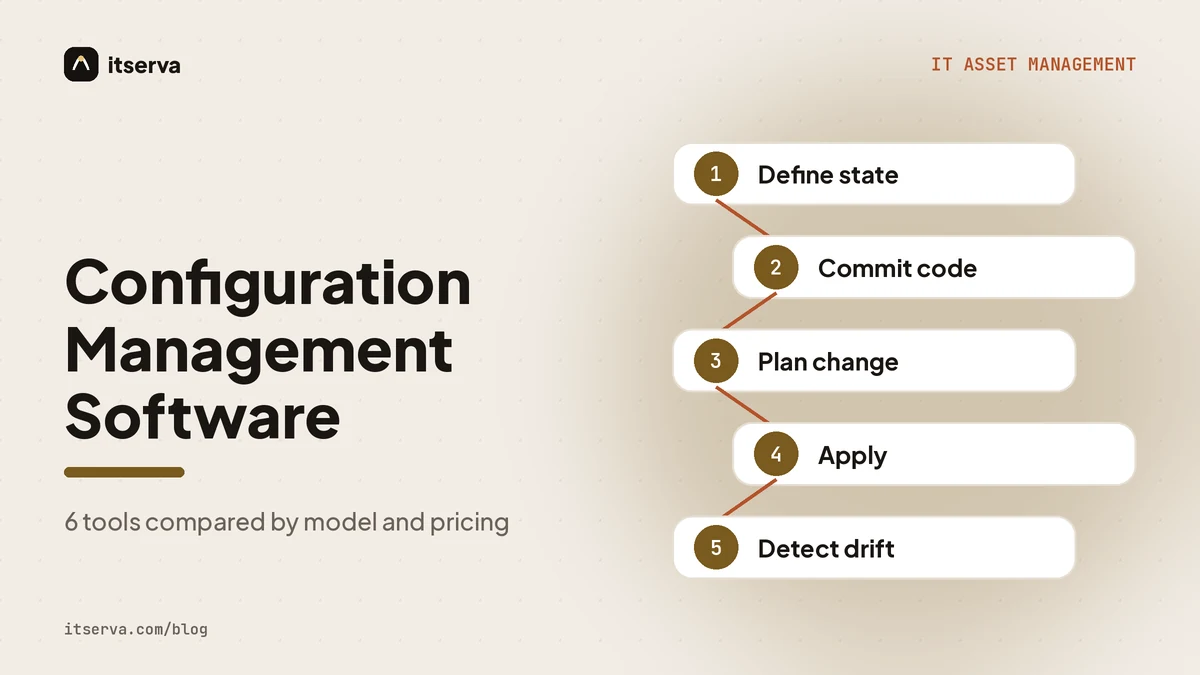
Configuration management software defines how servers, network devices and cloud resources should be set up, then applies and enforces that state automatically. It replaces manual setup with code that can be reviewed, versioned and repeated.
There are two broad styles. Tools like Ansible, Puppet, Chef and Rudder configure operating systems and applications, while Terraform and Pulumi provision cloud infrastructure. Many teams use one of each.
Quick comparison
| Tool | Best for | Starting price | Free plan |
|---|---|---|---|
| Red Hat Ansible Automation Platform | Best configuration management overall | Custom quote | Free trial |
| Puppet | Large server fleets with strict policy | Custom pricing (25+ nodes) | Yes (Developer, under 25 nodes) |
| Chef | Published per-node SaaS pricing | $59/node/year (Business SaaS) | Free trial on request |
| Terraform | Cloud infrastructure as code | Pay-as-you-go (usage-based) | $500 starter credit |
| Pulumi | Infrastructure as code in real languages | $40/month (Essentials) | Yes (individual Free tier) |
| Rudder | Security-focused config management | Annual per-node license (quote) | Yes (Rudder Core open source) |
The 6 best configuration management tools
#1
Red Hat Ansible Automation Platform
- Best for
- Best configuration management overall
- Starting price
- Custom quote
- Free plan
- Free trial
Red Hat Ansible Automation Platform is the supported, enterprise version of Ansible, which uses agentless YAML playbooks over SSH and WinRM. Subscriptions come in Standard with 9-to-5 support and Premium with 24x7 support, both including maintenance and upgrades.
The trade-off is that pricing depends on sizing and requires a quote from Red Hat or a partner. Ansible fits IT teams that want to automate servers, network gear and cloud tasks without installing agents.
What we like
- Agentless design
- Readable YAML playbooks
- Strong network automation
- 24x7 support on Premium
Watch out for
- No public price list
- Large playbooks need structure to stay maintainable
#2
Puppet
- Best for
- Large server fleets with strict policy
- Starting price
- Custom pricing (25+ nodes)
- Free plan
- Yes (Developer, under 25 nodes)
Puppet uses a declarative, agent-based model that keeps servers continuously in their desired state. Puppet Core is free for developer environments under 25 nodes, and the commercial Core edition, Puppet Enterprise and Puppet Enterprise Advanced use custom pricing.
The trade-off is a steeper learning curve for its own language and the need to run agents. Puppet fits enterprises with thousands of long-lived servers and strict compliance needs.
What we like
- Free for under 25 nodes
- Continuous drift correction
- Mature enterprise features
Watch out for
- Custom pricing only
- Agent and language to learn
#3
Chef
- Best for
- Published per-node SaaS pricing
- Starting price
- $59/node/year (Business SaaS)
- Free plan
- Free trial on request
Chef automates infrastructure configuration and compliance with code. The SaaS Business plan costs $59 per node per year, Enterprise costs $189 per node per year, and Enterprise Plus and self-managed editions are quote-based.
The trade-off is complexity. Chef's Ruby-based approach suits developers more than generalist admins. Chef fits DevOps teams that want config and compliance as code with transparent SaaS pricing.
What we like
- Clear per-node SaaS prices
- Compliance automation
- SaaS or self-managed
Watch out for
- Self-managed is quote-only
- Ruby-based learning curve
#4
Terraform
- Best for
- Cloud infrastructure as code
- Starting price
- Pay-as-you-go (usage-based)
- Free plan
- $500 starter credit
Terraform from HashiCorp, an IBM company, provisions cloud and on-premise infrastructure from declarative code. HashiCorp offers a usage-based pay-as-you-go plan with a $500 starter credit, Flex plans for single or multi-year terms and an Enterprise self-managed option.
The trade-off is scope. Terraform provisions infrastructure but is not built to configure software inside servers, and detailed rates live on a separate IBM pricing table. Terraform fits cloud and platform teams standardizing infrastructure across providers.
What we like
- Huge provider ecosystem
- Works across clouds
- $500 starter credit
- Flexible plan types
Watch out for
- Not for in-server configuration
- Usage pricing needs forecasting
#5
Pulumi
- Best for
- Infrastructure as code in real languages
- Starting price
- $40/month (Essentials)
- Free plan
- Yes (individual Free tier)
Pulumi lets teams define infrastructure in general-purpose languages instead of a custom syntax. The Free tier covers one user, Essentials costs $40 per month with unlimited users and up to 500 managed resources, and Pro costs $400 per month for up to 2,000 resources.
The trade-off is per-resource billing beyond included credits, and support plans start at $625 per month. Pulumi fits developer-led teams that want infrastructure code with normal testing and IDE tools.
What we like
- Free individual tier
- Unlimited users on paid plans
- Startup credit program
- Secrets management included
Watch out for
- Resource-based billing
- Support sold separately
#6
Rudder
- Best for
- Security-focused config management
- Starting price
- Annual per-node license (quote)
- Free plan
- Yes (Rudder Core open source)
Rudder focuses on security configuration management, patching and compliance. Rudder Core is open source and free to use, and the Enterprise plan adds security configuration management with either patch and vulnerability management or policy and benchmark compliance.
The trade-off is that paid plans are quoted per node and include a one-time onboarding fee in year one. Rudder fits European and regulated organizations that want hardening and compliance dashboards built in.
What we like
- Free open-source core
- Compliance dashboards
- Patch management option
Watch out for
- Per-node price needs a quote
- Onboarding fee in year one
How we chose
We compared tools that define and enforce the configuration of servers and infrastructure, ranked by overall fit for IT operations and DevOps teams. We weighted automation model and scale first, then support and compliance features, then pricing clarity. Facts come from each vendor's pricing page, checked in November 2026. No vendor paid for placement, and we did not run hands-on tests: we compare published information.
Agentless vs agent-based tools
Agentless tools such as Ansible connect over SSH or WinRM when a job runs, so there is nothing to install on targets. Agent-based tools such as Puppet and Chef check in on a schedule and correct drift on their own.
Agentless is quicker to start and suits network gear. Agents give stronger continuous enforcement on large, long-lived server fleets.
How to choose
Start by separating provisioning from configuration. Use Terraform or Pulumi to create infrastructure, and Ansible, Puppet, Chef or Rudder to configure what runs on it.
Next, match the tool to your team's skills. YAML playbooks suit generalist admins, while Pulumi and Chef suit developers who prefer real programming languages.
Finally, plan for compliance reporting. If auditors need proof of hardened settings, favor Puppet Enterprise, Chef or Rudder. Pair it with good records using our IT management software guide.